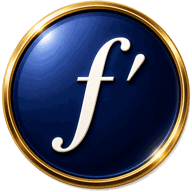
Write out the chain rule for each of the following functions.
for
for
for

Partial Derivatives
27 problems · hints, answers and solutions shown beside each one
Do you understand the idea? Usually little or no calculation.
Write out the chain rule for each of the following functions.
for
for
for
Review §2.4.1 in the CLP-3 text.
(a)
(b)
(c)
(c) We'll start with part (c) and follow the procedure given in §2.4.1 in the CLP-3 text. We are to compute the derivative of with respect to . For this function, the template of Step 2 in §2.4.1 is
Note that
The function appears once in the numerator on the left. The function , from which is constructed by a change of variables, appears once in the numerator on the right.
The variable, , in the denominator on the left appears once in the denominator on the right.
Now we fill in the blanks with every variable that makes sense. In particular, since is a function of , and , it may only be differentiated with respect to , and . So we add together three copies of our template — one for each of , and :
Since is a function of only one variable, we use the ordinary derivative symbol , rather than the partial derivative symbol in the third copy. Finally we put in the only functional dependence that makes sense. The left hand side is a function of , and , because is a function of , and . Hence the right hand side must also be a function of , and . As is a function of , and , this is achieved by evaluating at , and .
(a) We again follow the procedure given in §2.4.1 in the CLP-3 text. We are to compute the derivative of with respect to . For this function, the template of Step 2 in §2.4.1 is
Now we fill in the blanks with every variable that makes sense. In particular, since is a function of and , it may only be differentiated with respect to , and . So we add together two copies of our template — one for and one for :
In we are to differentiate the (explicit) function (i.e. the function ) with respect to . The answer is of course . So
Finally we put in the only functional depedence that makes sense. The left hand side is a function of , and , because is a function of and . Hence the right hand side must also be a function of and . As is a function of , , this is achieved by evaluating at .
(b) Yet again we follow the procedure given in §2.4.1 in the CLP-3 text. We are to compute the derivative of with respect to . For this function, the template of Step 2 in §2.4.1 is
(As is function of only one variable, we use the ordinary derivative symbol on the left hand side.) Now we fill in the blanks with every variable that makes sense. In particular, since is a function of , and , it may only be differentiated with respect to , and . So we add together three copies of our template — one for each of , and :
Finally we put in the only functional depedence that makes sense.
A piece of the surface is shown below for some continuously differentiable function . The level curve is marked with a blue line. The three points , , and lie on the surface.
On the level curve , we can think of as a function of . Let . We approximate, at , and . Identify the quantities , , and from the diagram.
This is a visualization, in a simplified setting, of Example 2.4.10 in CLP3.
To visualize, in a simplified setting, the situation from Example 2.4.10 in CLP3, note that is the rate of change of as we slide along the blue line, while is the change of as we slide along the orange line.
In the approximation , starting at the point , and .
In the approximation , starting at the point , again, and .
To visualize, in a simplified setting, the situation from Example 2.4.10 in CLP3, note that is the rate of change of as we slide along the blue line, while is the change of as we slide along the orange line.
In the partial derivative , we let change, while stays the same. Necessarily, that forces to change as well. Starting at point , if we move but keep fixed, we end up at . According to the labels on the diagram, is , and is .
The function is a constant function, so we expect . In the approximation , we let change, but stays the same. Necessarily, to stay on the surface, this forces to change. Starting at point , if we move but keep fixed, we end up at . According to the labels on the diagram, is again, and .
To compare the two situations, note the first case has while the second case has .
Let with and depending on . Suppose that at some point and at some time , the partial derivatives , and are equal to , and respectively, while and . Find and explain the difference between and .
Pay attention to which variables change, and which are held fixed, in each context.
and . gives the rate of change of as varies while and are held fixed. gives the rate of change of . For the latter all of , and are changing at once.
We are told in the statement of the question that . Applying the chain rule to by following the procedure given in §2.4.1 in the CLP-3 tex, gives
Substituting in the values given in the question
On the other hand, we are told explicitly in the question that is . The reason that and are different is that
gives the rate of change of as varies while and are held fixed, but
gives the rate of change of . For the latter all of , and are changing at once.
Thermodynamics texts use the relationship
Explain the meaning of this equation and prove that it is true.
The basic assumption is that the three quantites , and are not independent. Given any two of them, the third is uniquely determined. They are assumed to satisfy a relationship , which can be solved to
determine as a function of and (say ) and can alternatively be solved to
determine as a function of and (say ) and can alternatively be solved to
determine as a function of and (say ).
For example, saying that determines means that
for all and . The equation
really means
So use to compute . Use other equations similar to to compute and .
See the solution.
The basic assumption is that the three quantites , and are not independent. Given any two of them, the third is uniquely determined. They are assumed to satisfy a relationship , which can be solved to
determine as a function of and (say ) and can alternatively be solved to
determine as a function of and (say ) and can alternatively be solved to
determine as a function of and (say ).
As an example, if , then
implies that and
implies that and
implies that
In general, saying that determines means that
for all and . Set . Applying the chain rule to (with and independent variables) gives
The equation says that for all and . So differentiating the equation with respect to gives
for all and . Similarly, differentiating with respect to and with respect to gives
If is any point satisfying (so that and and ), then
and
What is wrong with the following argument? Suppose that and . By the chain rule,
Hence and so or .
Is the on the left hand side really the same as the on the right hand side?
The problem is that is used to represent two completely different functions in the same equation. See the solution for more details.
The problem is that is used to represent two completely different functions in the same equation. The careful way to write the equation is the following. Let and be continuously differentiable functions and define . By the chain rule,
While , it is not true that . For example, take and . Then for all , so that while for all .
Practising the skill itself, until applying it is automatic.
Use two methods (one using the chain rule) to evaluate and given that the function , with and .
To avoid the chain rule, write explicitly as a function of and .
Method 1: Since with , and we can write out explicitly:
Evaluate in terms of partial derivatives of . You may assume that is a smooth function so that the Chain Rule and Clairaut's Theorem on the equality of the mixed partial derivatives apply.
Start by setting . It might also help to define and .
We have
All functions on the right hand side have arguments . The notation , for example, means first differentiate with respect to the second argument and then differentiate with respect to the first argument.
By definition,
We'll compute the derivatives from the inside out. Let's call so that the innermost derivative is . By the chain rule
Here the subscript means take the partial derivative of with respect to the first argument while holding the second argument fixed, and the subscript means take the partial derivative of with respect to the second argument while holding the first argument fixed. Next call the middle derivative so that
By the chain rule (twice),
so that
In the last equality we used that . The notation means first differentiate with respect to the second argument and then differentiate with respect to the first argument. For example, if , then
Finally, we get to
By three applications of the chain rule
All functions on the right hand side have arguments .
Find all second order derivatives of . You may assume that is a smooth function so that the Chain Rule and Clairaut's Theorem on the equality of the mixed partial derivatives apply.
Here denotes the partial derivative of with respect to its first argument, is the result of first taking one partial derivative of with respect to its first argument and then taking a partial derivative with respect to its second argument, and so on.
The given function is
The first order derivatives are
The second order derivatives are
Here denotes the partial derivative of with respect to its first argument, is the result of first taking one partial derivative of with respect to its first argument and then taking a partial derivative with respect to its second argument, and so on.
Assume that satisfies Laplace's equation . Show that this is also the case for the composite function . That is, show that . You may assume that is a smooth function so that the Chain Rule and Clairaut's Theorem on the equality of the mixed partial derivatives apply.
Start by showing that, because , the second derivative .
See the solutions.
By the chain rule,
and
Suppressing the arguments
as desired.
Let where and . Find the values of the constants , and such that
You may assume that is a smooth function so that the Chain Rule and Clairaut's Theorem on the equality of the mixed partial derivatives apply.
The notation in the statement of this question is horrendous —
the symbol is used with two different meanings in one equation.
On the left hand side, it is a function of and ,
and on the right hand side, it is a function of and .
Unfortunately that abuse of notation is also very common.
Until you get used to it, undo this notation conflict by renaming the
function of and to . That is,
.
Then, evaluate each term on the right-hand side of the equation.
and .
The notation in the statement of this question is horrendous —
the symbol is used with two different meanings in one equation.
On the left hand side, it is a function of and ,
and on the right hand side, it is a function of and .
Unfortunately that abuse of notation is also very common.
Let us undo the notation conflict by renaming the function of and
to . That is,
In this new notation, we are being asked to find , and so that
with the arguments on the right hand side being and the arguments on the left hand side being .
By the chain rule,
and
Suppressing the arguments
Finally, translating back into the (horrendous) notation of the question
so that and .
Let be a function on . Denote points in by and the corresponding partial derivatives of by , , , , etc.. Assume those derivatives are all continuous. Express
in terms of partial derivatives of the function .
Let , and . Then .
Let , and . Then . By the chain rule
is defined as
for an arbitrary function .
If , find and .
For an arbitrary show that satisfies
(b) Since is a function of only one variable, the chain rule for (say) has only one term.
(a) ,
(b) See the solution.
For any (differentiable) function , we have, by the chain and product rules,
(a) In particular, when , and
(b) In general
Let and be two functions of satisfying and . If is a function of and , find the value of when and .
At some point, you'll be using the chain rule you learned in first-semester calculus.
By the chain rule,
In particular
Suppose that , where is a differentiable function. Show that
Just compute the first order partial derivatives of .
See the solution.
We'll first compute the first order partial derivatives of . Write and so that . By the chain rule,
So
as desired.
Suppose has continuous second order partial derivatives, and , . Express the following partial derivatives in terms , , and partial derivatives of .
The function depends on both and , so don't forget to account for both of these when you take its partial derivative.
(a)
(b)
with all of the partial derivatives of evaluated at .
By definition .
(a) By the chain rule
(b) By linearity, the product rule and the chain rule
with all of the partial derivatives of evaluated at .
Let , where has continuous second-order partial derivatives, and
Find when , and .
Write with , . We are to compute . By the chain rule
By linearity, the product rule, and the chain rule,
In particular, when , and since ,
Assume that the function satisfies the equation and the mixed partial derivatives and are equal. Let be some constant and let . Find the value of such that .
Just compute , and .
.
By the chain rule
and
and
We can evaluate the second derivatives by applying the chain rule to the four terms on the right hand sides of
Alternatively, we can observe that replacing by in (E1) and (E2) gives
replacing by in (E1) and (E2) gives
Consequently
and
So, suppressing the arguments,
if .
Let be a differentiable function, and suppose it is given that . Let , where and are constants. Evaluate at the point , that is, find .
By the chain rule
In particular
Let be a differentiable function of two variables, and let be a differentiable function of and defined implicitly by . Show that
Use implicit differentiation to find and .
See the solution.
We are told that the function obeys
for all and . By the chain rule,
so differentiating with respect to and with respect to gives
or, leaving out the arguments,
Solving the first equation for and the second for gives
so that
as desired.
Remark:
This is of course under the assumption that
is nonzero. That is equivalent, by the chain rule,
to the assumption that is non zero.
That, in turn, is almost, but not quite, equivalent to the statement
that is can be solved for as a function of and .
Let for some twice differentiable function .
Find in terms of , , and (you can assume that ).
Suppose . For what constant will ?
(a)
(b)
(a) By the chain rule
and
(b) Again by the chain rule
and
Consquently, for any constant ,
Given that , this will be zero, as desired, if . (Then .)
Suppose that is twice differentiable (with ), and and .
Evaluate , and in terms of , and partial derivatives of with respect to and .
Let be another function satisfying and . Express and in terms of , and , .
This question uses bad (but standard) notation, in that the one symbol is used for two different functions, namely and . Until you get used to it, undo this notation conflict by renaming the function of and to . That is, . Similarly, rename , viewed as a function of and , to . That is, .
(a)
with the arguments of , , , and all being .
(b)
This question uses bad (but standard) notation, in that the one symbol is used for two different functions, namely and . Let us undo this notation conflict by renaming the function of and to . That is,
Similarly, rename , viewed as a function of and , to . That is,
In this new notation, we are being asked
in part (a) to find , and in terms of , , and , and
in part (b) to express and in terms of , and , .
(a) By the chain rule
with the arguments of , , , and all being .
(b) Replacing by in (E1) gives
Replacing by in (E2) gives
or
By definition, the gradient of the differentiable function at the point is
Suppose that we know
Suppose also that
and
Assuming , , and , find
By the chain rule
In particular
Hence .
Let be an arbitrary differentiable function defined on the entire real line. Show that the function defined on the entire plane as
satisfies the partial differential equation:
The equations , and define as a function of and . Determine at the point which corresponds to the point .
(b) Think of , as two equations in the two unknowns , with , just being given parameters. The question implicitly tells us that those two equations can be solved for , in terms of , , at least near , . That is, the question implicitly tells us that the functions and are determined by , . Then is determined by .
(a) See the solution. (b)
(a) By the product and chain rules
Hence
as desired.
(b) Think of , as two equations in the two unknowns , with , just being given parameters. The question implicitly tells us that those two equations can be solved for , in terms of , , at least near , . That is, the question implicitly tells us that the functions and are determined by
Applying to both sides of the equation gives
Then applying to both sides of gives
Substituting in , , , gives
From the second equation . Substituting into the first equation gives
so that and . The question also tells us that . Hence
The equations
define and implicitly as functions of and (i.e. , and ) near the point at which .
Find
at .
If , determine at the point .
The question tells us that and ar eimplicitly determined by
at least near , . Then, in part (b), really means .
(a) , (b)
(a) We are told that
Applying to both equations gives
Setting , , , gives
Substituting , from the first equation, into the second equation gives so that and .
(b) We are told that . So
Substituting in , , , and using the results of part (a),
Let be a differentiable function, and let and . Find a constant, , such that
This question uses bad (but standard) notation, in that the one symbol is used for two different functions, namely and . A better wording is
Let and be differentiable functions such that . Find a constant, , such that
This question uses bad (but standard) notation, in that the one symbol is used for two different functions, namely and . A better wording is
Let and be differentiable functions such that . Find a constant, , such that
By the chain rule
Hence
So does the job.
Further than practice: several ideas at once, or an unfamiliar situation.
The wave equation
arises in many models involving wave-like phenomena. Let and be related by the change of variables
Show that if and only if .
Show that if and only if for some functions and .
Interpret in terms of travelling waves. Think of as the height, at position and time , of a wave that is travelling along the -axis.
Remark: Don't be thrown by the strange symbols and . They are just two harmless letters from the Greek alphabet, called “xi” and “eta” respectively.
Use the chain rule to show that .
See the solutions.
Recall that . By the chain rule
Again by the chain rule
and
so that
Hence
(b) Now . Temporarily rename . The equation says that, for each fixed , is a constant. The value of the constant may depend on . That is, , for some function . (As a check, observe that .) So the derivative of with respect to , (viewing as a constant) is .
Let be any function whose derivative is (i.e. an indefinite integral of ). Then . This is the case if and only if, for each fixed , is a constant, independent of . That is, if and only if
for some function . Hence
(c) We'll give the interpretation of . The case is similar. Suppose that . Think of as the height of water at position and time . Pick any number . All points in space time for which have the same value of , namely . So if you move so that your position is (i.e. you move the right with speed ) you always see the same wave height. Thus represents a wave moving to the right with speed .
Similarly, represents a wave moving to the left with speed .
Evaluate
if
if
if
and
For each part, first determine which variables is a function of.
(a)
(b)
(c)
(a) We are told to evaluate . So has to be a function of and possibly some other variables. We are also told that , , and are related by the single equation . So we are to think of and as being independent variables and think of as being determined by solving for as a function of and . That is, the function obeys
for all and . Applying to both sides of this equation gives
(b) We are told to evaluate . So has to be a function of the single variable . We are also told that and are related by . So the function has to obey
for all . Applying to both sides of that equation and using the chain rule gives
(c) The hard part of this question is figuring out what it is that we are to compute. We are asked to find some derivative of some function y. But what function? Four variables appear in this question. Namely , , and . But we are not free to assign arbitrary values to all four of them. They have to be related by the two equations and . If we assign values to any two of , , and , the values of the other two are to be determined by solving , . That is, we may choose any two of , , and to be independent variables (i.e. variables that may be assigned any value). Then the other two variables are functions of those independent variables that are determined by solving the given equations.
We are told to evaluate . According to Notation 2.2.2 in the CLP-3 text, is the partial derivative of with respect to with being held fixed. So and have to be independent variables and has to be a function of and . The fourth variable also has to be a function of and . The functions and must obey
for all and . Applying to both sides of both of these equations gives
Substituting, , from the second equation, into the first equation gives
Now cannot be because . So
From the UBC Math 200 open textbook project, © Joel Feldman, Andrew Rechnitzer, Elyse Yeager and others. Licensed CC BY-NC-SA 4.0; this HTML adaptation is released under the same licence. Full attribution.