
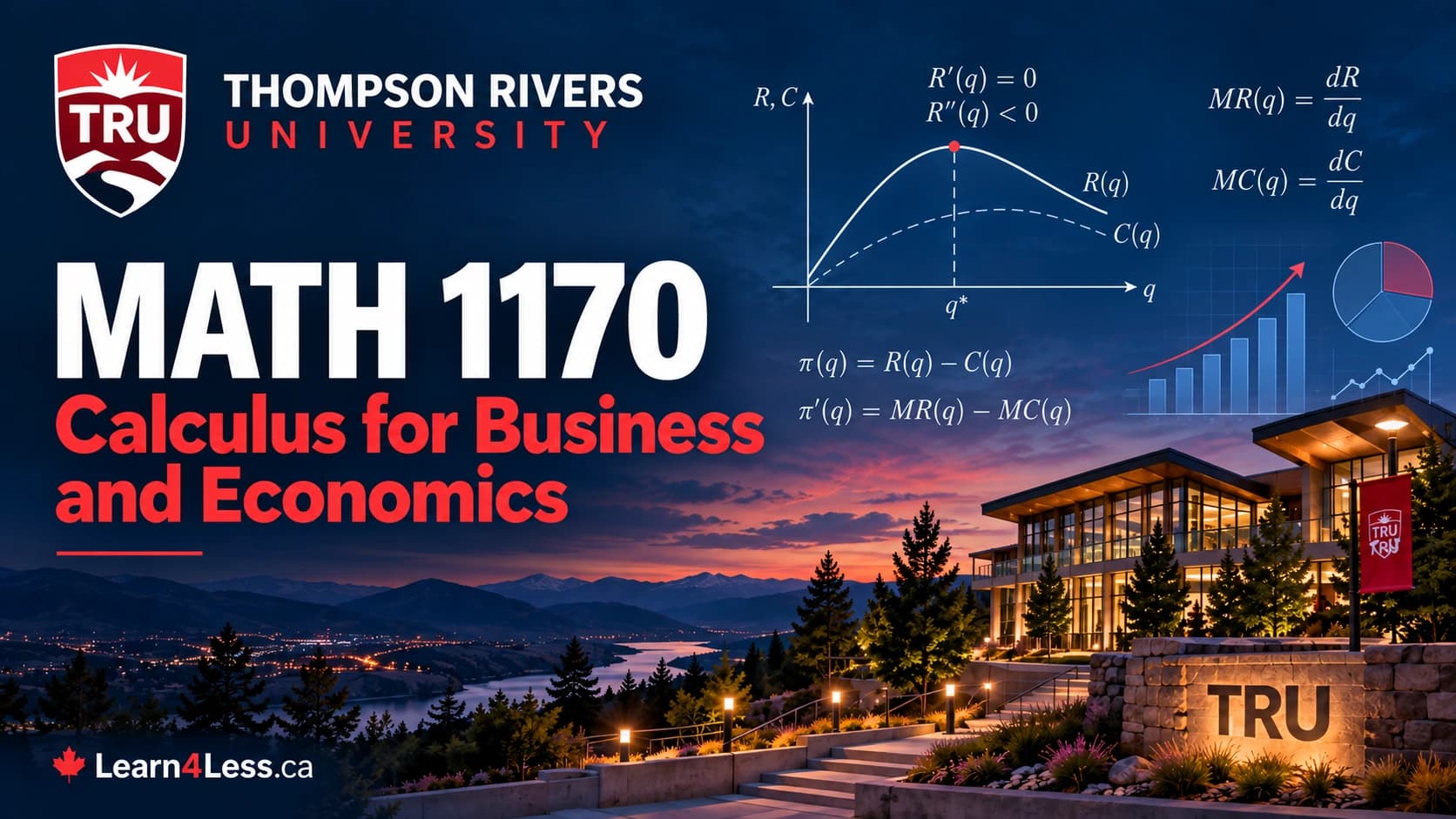
MATH 1170 is Thompson Rivers University's calculus course for Business and Economics students. The material is unusually concrete for a first calculus course — marginal cost really is a derivative, and the profit-maximising quantity really is where one equals zero — and it goes somewhere most first-year calculus courses do not: multivariable functions, partial derivatives and Lagrange multipliers, all inside a three-credit first-year course. There is also a registration decision attached to it that matters more than most, and it is the first thing on this page for a reason.
The credit exclusion to understand before you register
TRU grants credit for only one of MATH 1130, MATH 1140, MATH 1141, MATH 1150, MATH 1157, MATH 1170 and MATH 1171.
MATH 1170 is in the Calculus 1 group. That means taking it closes MATH 1140, the general Calculus 1, and MATH 1130, the engineering one.
The consequence worth spelling out: MATH 1170 does not lead to Calculus 2. MATH 1240 accepts MATH 1130, 1140, 1141, 1150 or 1157 — not MATH 1170. So a student who takes MATH 1170 and later moves toward a quantitative field cannot simply add MATH 1140, because the two are credit excluded.
None of that is a reason to avoid MATH 1170 if your program requires it. It is a reason to check your program requirements, and to talk to an academic advisor if there is a realistic chance you will switch programs later.
What is covered in TRU MATH 1170?
TRU's calendar describes it as intended for Business and Economics students, covering calculation and interpretation of derivatives, curve sketching, optimization applied to business and economics, and multivariable functions including partial derivatives, optimization and Lagrange multipliers. In practice:
- Functions in economic terms: cost, revenue, profit, demand and supply, and what each shape implies
- Limits and the derivative: enough theory to define the derivative properly, then straight to what it means
- Differentiation rules: power, product, quotient and chain rules, plus implicit differentiation
- Exponential and logarithmic derivatives: continuous compounding and growth models
- Interpreting a derivative: marginal cost, revenue and profit, and average against marginal quantities
- Curve sketching: increasing and decreasing intervals, concavity and inflection points, read as economic behaviour
- Optimization: profit maximisation, cost minimisation and pricing problems, justified with the second derivative test
- Multivariable functions: functions of two or more variables, and what a surface represents
- Partial derivatives: differentiate with respect to one variable, hold the others constant
- Constrained optimization: Lagrange multipliers, for maximising subject to a budget or resource constraint
Three credits, in a 3-1.5-0 format — three lecture hours plus a tutorial.
Lagrange multipliers in a first-year course is genuinely unusual. It is there because a firm maximising output subject to a budget is the standard problem of the subject, and it cannot be done any other way.
Who MATH 1170 is for
The prerequisite is Pre-Calculus 12 with a minimum of 67% (C+), or MATH 0610, 0630 or 0633 with a C−, or MATH 1000 or MATH 1001 with a C−, or MATH 1070 with a C−.
That last route is worth knowing: MATH 1070, the business mathematics course, is itself a way in. A student who took Foundations of Math 12 rather than Pre-Calculus 12 can reach MATH 1170 through MATH 1070.
Common challenges students face in MATH 1170
Half the difficulty is economics vocabulary
"Marginal" means derivative. "Elastic" is a statement about a derivative's size. Students who never get the vocabulary straight spend the term solving the wrong problem correctly, and that is a language gap rather than a mathematics gap.
Partial derivatives arrive without much runway
They come late in a first calculus course, they look like a new subject, and the notation changes. They are not conceptually hard — differentiate with respect to one variable, treat the others as constants — but that instruction is genuinely strange the first four times you follow it.
Lagrange multipliers get memorised as a ritual
Set up the Lagrangian, take three partial derivatives, set them to zero, solve. Students learn the choreography and never learn what λ is or why the method works, and then cannot handle a question that departs from the template.
Optimization answers need justification, not just a number
Setting the derivative to zero finds a candidate. Showing it is a maximum — second derivative or sign chart — is what earns the marks, and in an economics context the distinction is real, because a minimum-profit quantity is a genuine and wrong answer.
The algebra is assumed
MATH 1170 does not re-teach exponent laws, logarithms or factoring. Students who scraped a 67% in Pre-Calculus 12 often find the calculus reasonable and the algebra underneath it the actual bottleneck.
Word problems are most of the course
Business calculus is applied by design. Almost every question is a paragraph, and the skill being tested is turning it into a function before any calculus starts.
How Learn4Less helps you succeed in MATH 1170
We make the economics vocabulary explicit
Marginal, average, elastic, inelastic, constrained optimum — each tied to the mathematical object it names, so that reading a question stops being the hard part.
We teach partial derivatives as one small rule
Differentiate with respect to one variable, hold the others still. Practised until the notation stops being intimidating, including second-order and mixed partials.
We make Lagrange multipliers mean something
What λ actually is — the rate at which the optimum improves as the constraint relaxes — turns a ritual into a method you can adapt. It is usually worth a dedicated session.
We repair the algebra inside the course
If logarithms or exponent laws are the real problem, we fix them within the calculus question you are stuck on, so you are not simultaneously behind and reviewing.
MATH 1170 exam and midterm preparation
Practice on unseen business contexts
Your section's course outline is the authority on how you are assessed. What is reliable is that exam questions reframe familiar calculus in an unfamiliar business setting, and that is what we practise against the clock.
Tutorial sheets first
MATH 1170 is 3-1.5-0, and the tutorial hour is where problems closest to exam style get worked. We treat those sheets as primary material.
Justifying the answer
The sentence after the computation — why this critical point is a maximum, and what the number means in dollars or units. Quick to write once you know the pattern, and worth real marks.
Checking your own work
Our free derivative calculator works each differentiation step, so a chain-rule computation that came out wrong becomes a specific line rather than a mystery.
Why choose Learn4Less for MATH 1170 tutoring?
We tutor the business calculus stream across several universities
TRU MATH 1170, KPU MATH 1140, SFU MATH 157 and 158, UBC's commerce sections. The same sticking points recur, and we know which explanations work for students who did not come to university to do mathematics.
Nobody is treated as a reluctant mathematician
Most students in this course are here for a program requirement. That is fine, and it changes how a session is best run — practical, concrete, and aimed at the marks.
Online across Canada and the US
TRU is in Kamloops, so sessions run online, with screen sharing and live work on a shared page that you keep afterwards. In-person tutoring is available in the Vancouver area only.
Free resources between sessions
The derivative calculator and our concept reviews are open to anyone.
Frequently Asked Questions
Can I take MATH 1240 after MATH 1170?
No. MATH 1240's prerequisites are MATH 1130, 1140, 1141, 1150 or 1157 with a C− — MATH 1170 is not among them. And because MATH 1170 is credit excluded with MATH 1140, you cannot take MATH 1140 afterwards for credit either. If more calculus is a real possibility, discuss it with an academic advisor before you register for MATH 1170.
What is the difference between MATH 1070 and MATH 1170?
MATH 1070 is not a calculus course — it covers business models, systems of equations, matrices, linear programming, difference equations and financial mathematics. MATH 1170 is the calculus course: derivatives, optimization, partial derivatives and Lagrange multipliers. MATH 1070 with a C− is one of the ways into MATH 1170, and many business programs ask for both.
Why does MATH 1170 cover partial derivatives when other first calculus courses do not?
Because economics is full of functions of several variables — output as a function of labour and capital, cost as a function of two inputs. Holding one variable constant and differentiating with respect to the other is the standard tool for describing those, so the business stream introduces it immediately rather than waiting for a third calculus course.
Is MATH 1170 easier than MATH 1140?
It has less theory, but it is not a light course: the multivariable material is genuinely extra, and the word problems demand economic interpretation as well as calculation. Students who expect a soft option are usually the ones who struggle.
When should I get a tutor for MATH 1170?
If your Pre-Calculus 12 was a 67% and a while ago, before the term starts or in the first two weeks — the algebra gap shows up early and compounds. Otherwise, at the point where marginal analysis begins, which is where the vocabulary and the calculus first have to work together, and again when partial derivatives arrive.