
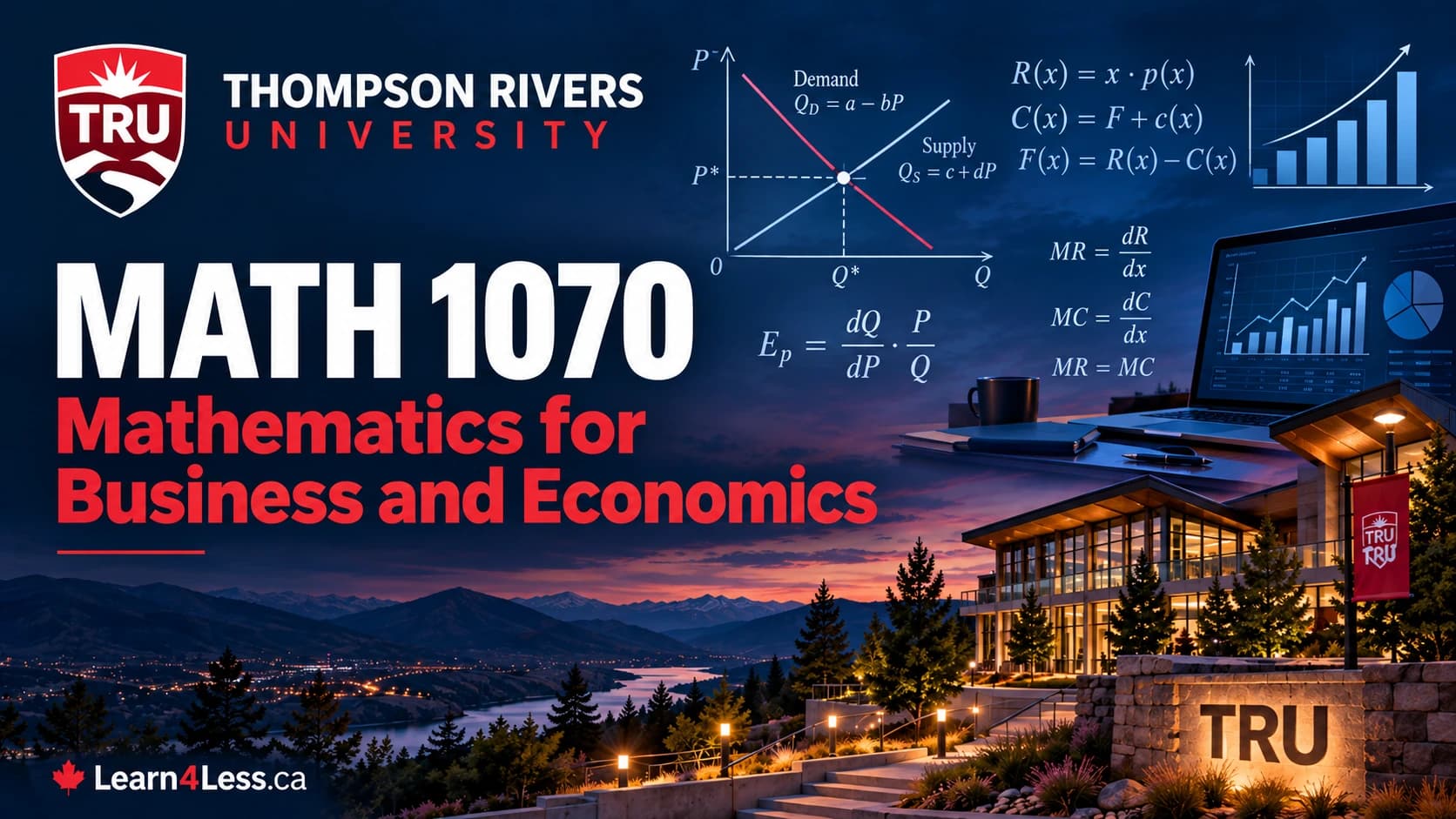
MATH 1070 is Thompson Rivers University's quantitative course for Business and Economics students, and the thing to know first is that it is not a calculus course. There are no derivatives in it. It is about the models business actually runs on — cost, revenue, profit, demand and supply — plus matrices, linear programming, difference equations, and the mathematics of money: interest, annuities, mortgages and loans. Students who arrive expecting calculus are surprised; students who arrive expecting arithmetic are surprised in the other direction.
What is covered in TRU MATH 1070?
TRU's calendar lists linear and non-linear functions and models applied to cost, revenue, profit, demand and supply; systems of equations, linear and nonlinear; matrices; linear programming; difference equations; and mathematics of finance, including simple and compound interest, annuities, mortgages and loans. In practice:
- Functions as business models: linear, quadratic and exponential cost, revenue and profit functions, and what each shape implies
- Demand and supply: equilibrium price and quantity, and what moves them
- Break-even analysis: where revenue meets cost, and what the answer means for a decision
- Systems of equations: linear and nonlinear, solved algebraically and graphically
- Matrices: matrix algebra, inverses, and solving systems with them
- Linear programming: objective functions and constraints, feasible regions, and optimising over a polygon's corners
- Difference equations: quantities that change in steps rather than continuously
- Mathematics of finance: simple and compound interest, annuities, amortisation, mortgages and loan schedules
Three credits, in a 3-1.5-0 format — three lecture hours plus a tutorial.
The finance section is the part students remember afterwards, because it is the one piece of first-year mathematics that turns up in ordinary life. Working out what a mortgage actually costs is a MATH 1070 problem.
Who MATH 1070 is for, and where it leads
The prerequisite is Foundations of Math 12 or Pre-Calculus 12 with a minimum of 67% (C+), or equivalent. Foundations of Math 12 being accepted matters: it is the one first-year mathematics course at TRU on this list that does not require the pre-calculus pathway.
Credit is granted for only one of MATH 1070, MATH 1071, MATH 1091, MATH 1100 and MATH 1101.
Where it leads: MATH 1070 with a C− is one of the routes into MATH 1170 Calculus for Business and Economics — so for a student who did Foundations of Math 12 rather than Pre-Calculus 12, this course is the bridge into business calculus.
Worth being clear about what it does not do. MATH 1070 is not in the Calculus 1 credit-exclusion group and is not a calculus course, so it neither opens nor closes MATH 1140. It also does not lead to MATH 1240 Calculus 2.
Common challenges students face in MATH 1070
Breadth, not depth, is what makes it hard
Most courses go deep on one idea. MATH 1070 covers seven or eight only loosely related topics — matrices have nothing to do with annuities — so there is no single thread to hold onto, and falling behind on one unit does not get rescued by understanding the next.
The finance formulas are memorised and misapplied
Annuity, present value, future value, amortisation. The formulas look similar, the variables mean different things in each, and the exam gives a described situation rather than naming the formula. Choosing the right one is the skill; substituting into it is not.
Linear programming is a translation exercise
Turning "each unit of A needs three hours of machine time and we have 120" into a constraint inequality is the whole difficulty. Once the system is written, finding the optimum at a corner is mechanical.
Matrices feel abstract in a business course
Row reduction arrives with no obvious business meaning attached, and students treat it as arbitrary symbol-pushing. It becomes much easier once it is tied back to solving a system of production or pricing equations.
The interpretation carries marks
An answer of 4,300 earns little without the sentence that says what it is — the break-even quantity is 4,300 units, below which the firm loses money. Students practise computing and lose marks on the explaining.
How Learn4Less helps you succeed in MATH 1070
We sort the finance formulas by the question they answer
Not by how they look. Given a described situation, what is being asked, and which formula answers that — practised until recognition is quick, because that is what the exam tests.
We teach linear programming as a translation procedure
Read a clause, write a constraint. Name the objective. Then the graphing and corner-checking, which is the easy part.
We tie matrices back to the systems they solve
Row reduction stops being arbitrary once you can see the production problem it is solving. That connection is usually a single session and it changes the whole unit.
We work on the interpretation sentence
The one or two lines after a computation are worth real marks and take thirty seconds once the pattern is familiar.
MATH 1070 exam and midterm preparation
Timed practice across the whole breadth
Because the topics are only loosely connected, revision has to be deliberate rather than cumulative. We work back across the units you have not touched since their midterm, which is usually where the final's marks are hiding.
Unseen business contexts
Your course outline is the authority on how your section is assessed. What is predictable is that exam questions put a familiar method into an unfamiliar business setting, and that is what we practise.
Showing method in finance questions
Writing which formula you are using and what each variable stands for is quick, and it is what lets a marker award most of the marks when the arithmetic slips at the end.
Free resources between sessions
Our concept reviews are open to anyone.
Why choose Learn4Less for MATH 1070 tutoring?
We tutor the business and economics mathematics stream across several universities
TRU MATH 1070 and 1170, KPU MATH 1140, SFU MATH 157 and 158, UBC's commerce sections. The same sticking points recur, and we know which explanations work for students who did not come to university to do mathematics.
Nobody is treated as a reluctant mathematician
Most students in this course are here for a program requirement. That is fine, and it shapes how a session is best run — practical, concrete, and aimed at the marks.
Online across Canada and the US
TRU is in Kamloops, so sessions run online, with screen sharing and live work on a shared page that you keep. In-person tutoring is available in the Vancouver area only.
Sessions built around your own problems
Bring the assignment that is due, or the midterm question you want to understand rather than shelve.
Frequently Asked Questions
Is MATH 1070 a calculus course?
No. It covers functions and models, systems of equations, matrices, linear programming, difference equations and financial mathematics. There are no derivatives. MATH 1170 is the calculus course for Business and Economics students.
Does MATH 1070 lead to MATH 1170?
Yes — MATH 1070 with a C− is one of the routes into MATH 1170, alongside Pre-Calculus 12 at 67% and TRU's preparatory MATH courses. That makes it the practical bridge for students who took Foundations of Math 12 rather than Pre-Calculus 12.
I took Foundations of Math 12, not Pre-Calculus 12. Can I take this?
Yes. MATH 1070 accepts Foundations of Math 12 with a minimum of 67%, which is unusual among TRU's first-year mathematics courses and is one of the reasons it exists.
Does taking MATH 1070 stop me taking MATH 1140 later?
No. The Calculus 1 credit-exclusion group covers MATH 1130, 1140, 1141, 1150, 1157, 1170 and 1171 — MATH 1070 is not in it. It is excluded only against MATH 1071, 1091, 1100 and 1101. Note that MATH 1170 is in the calculus group, so that is the choice to think carefully about.
When should I get a tutor for MATH 1070?
The course's failure mode is falling behind on one self-contained unit and never catching up, so the useful moment is as soon as a unit stops making sense — typically matrices or the finance formulas. Because the topics do not build on each other, a single focused session on one unit often fixes it completely.