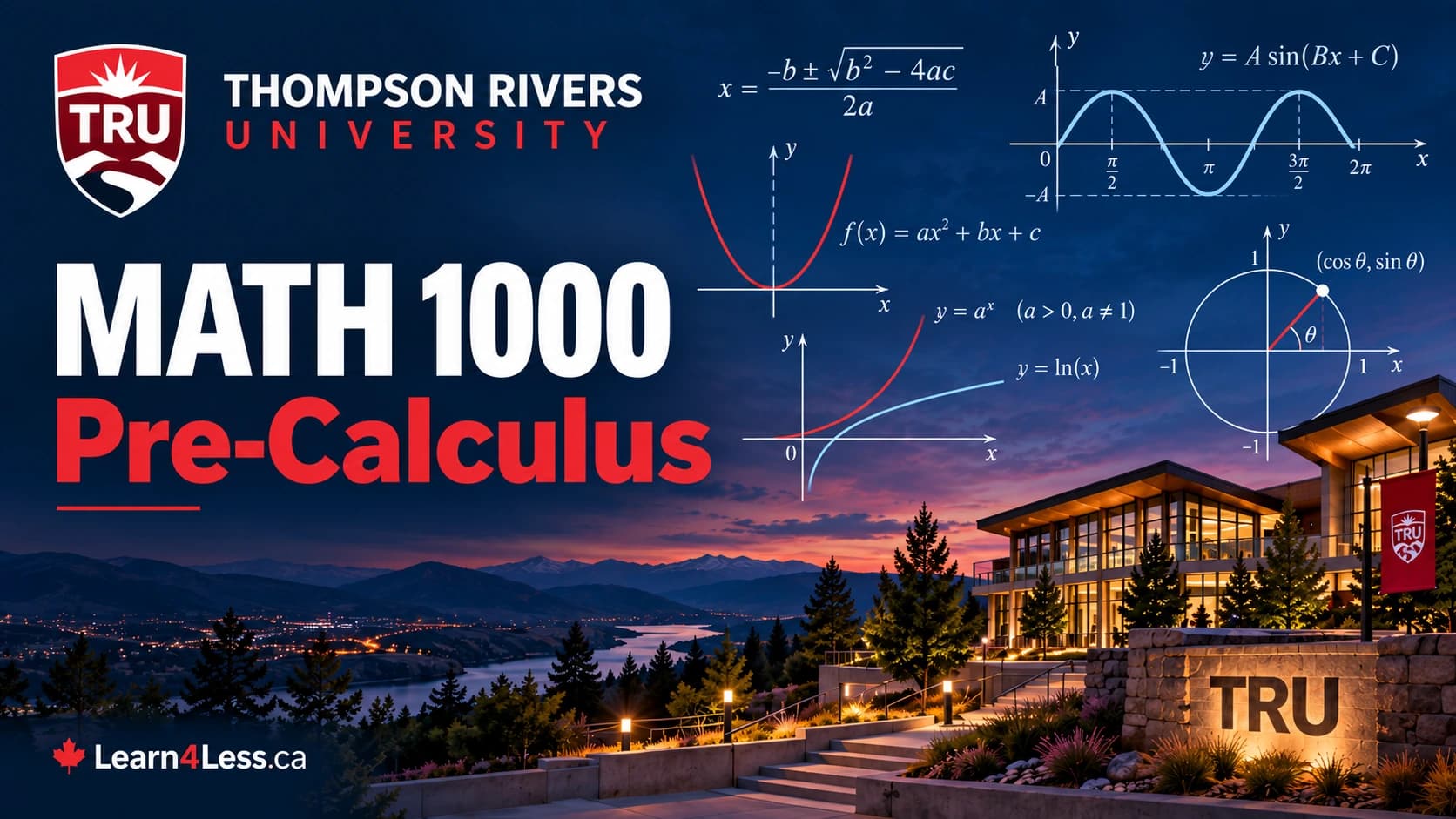
MATH 1000 is Thompson Rivers University's pre-calculus course, and its job is stated in TRU's own calendar in one line: it provides the mathematical foundation for an introductory calculus course. That is the whole point of it. Pass it with a C− and you meet the prerequisite for MATH 1140 and MATH 1170 — which makes it the route into calculus for anyone whose Pre-Calculus 12 grade, or whose memory of Pre-Calculus 12, is not going to carry them.
What is covered in TRU MATH 1000?
TRU's description lists equations and inequalities; functions, models and graphs; polynomial and rational functions; exponential and logarithmic functions; and trigonometric functions, identities and equations. In practice:
- Equations and inequalities: linear, quadratic, rational and radical equations; inequalities including absolute value, with solutions written in interval notation
- Functions as objects: domain, range, composition, inverses, and what makes an inverse exist
- Models and graphs: reading a graph off an equation rather than plotting it point by point, and transformations — shifts, stretches, reflections
- Polynomial functions: end behaviour, zeros and multiplicity, and the shape those imply
- Rational functions: vertical, horizontal and slant asymptotes, and holes
- Exponential and logarithmic functions: the laws of logarithms, change of base, and solving equations where the unknown sits in an exponent
- Trigonometric functions: radian measure, the unit circle, amplitude, period and phase shift, and graphing transformed sine and cosine
- Trigonometric identities and equations: Pythagorean, sum and difference, and double-angle identities, and solving over a given interval
Three credits, in a 5-0-0 format — five lecture hours a week and no scheduled tutorial. That is a lot of contact time, and no timetabled slot in which someone works problems with you.
Who MATH 1000 is for, and where it leads
The prerequisite is Pre-Calculus 12 with a minimum of 60% (C), or MATH 0630 or MATH 0633 with a C, or MATH 0600 with a B, or equivalent. Credit is granted for only one of MATH 1000 or MATH 1001.
Where it leads is the important part. MATH 1000 with a C− satisfies the prerequisite for:
So the pathway is MATH 1000 → MATH 1140 → MATH 1240 for science and mathematics, or MATH 1000 → MATH 1170 for business and economics.
Note what it does not do: it does not admit you to MATH 1130 Calculus 1 for Engineering, whose prerequisite is admission to the Engineering program rather than any grade.
There is also a decision hiding here. MATH 1140's own prerequisite is Pre-Calculus 12 at 67%, and MATH 1000's is Pre-Calculus 12 at 60%. If you are sitting between the two, MATH 1000 is not optional — it is your route. If you are above 67% but only just, it is a choice, and it is often the faster one overall, because MATH 1140 assumes this material is automatic rather than merely passed.
Common challenges students face in MATH 1000
It gets treated as review, and it is not
Much of the vocabulary is familiar from Grade 11 and 12, which makes the first three weeks feel like revision. Then trigonometric identities arrive, the pace does not slow, and students who coasted through the recognisable part have no momentum for the rest.
Trigonometry decides the grade
The unit circle, radian measure, identities and trigonometric equations are where most MATH 1000 marks are won or lost. Students who learned trigonometry as triangle ratios in high school have to rebuild it as functions on the real line, and that is a genuine conceptual shift rather than more practice.
Logarithms are memorised, not understood
The log laws get learned as three rules to apply forwards. When an equation needs them applied in reverse, or when the unknown appears both inside and outside a logarithm, the rules stop being enough.
Graphing is done by plotting points
It works, slowly, and it fails under exam time. The course wants you to read a graph off the equation — this is a parabola, shifted right two and down five, opening downward — because calculus will assume you can do that instantly.
Five lecture hours, no tutorial
A 5-0-0 schedule means nothing in your week is set aside for working problems with someone. That is fine if you build the habit deliberately, and a slow disaster if you assume it will happen by itself.
How Learn4Less helps you succeed in MATH 1000
We find the gap that is actually the problem
Difficulty in MATH 1000 is almost always two or three specific things — the unit circle, or log laws, or function composition — rather than general weakness. The first session is diagnostic, because fixing the right gap is much faster than reviewing everything.
We rebuild trigonometry as functions
The unit circle, radians and the graphs taught as one connected idea rather than three chapters, because that is the form calculus needs and the form that stops the identities feeling arbitrary.
We teach graphing by transformation
Reading a graph from its equation is a learnable skill with a short list of moves. We drill it until it is automatic, and it pays for itself in every course after this one.
We can be the tutorial the timetable does not include
For a 5-0-0 course, a standing weekly session working problems with someone is often the whole of what is missing.
MATH 1000 exam and midterm preparation
Timed practice with unseen questions
Section outlines differ on how many midterms there are and what they are worth, so your own outline is the authority. What we can do is make sure you have solved unfamiliar problems under time pressure before the exam does it to you.
Killing the recurring errors
Most students lose marks to the same three or four mistakes all term: a dropped negative, an un-flipped inequality, an extraneous root left in the answer, an angle in degrees when the question wanted radians. Naming yours is usually worth more than another chapter of practice.
Aiming above the prerequisite grade
MATH 1140 and MATH 1170 both need a C−. Aim comfortably above it — the calculus course moves faster and assumes everything here is automatic.
Free tools between sessions
Our concept reviews cover the functions and graphing work this course builds on, and they are open to anyone.
Why choose Learn4Less for MATH 1000 tutoring?
Foundations are not a lesser subject to us
We tutor Pre-Calculus 11 and Pre-Calculus 12 every term alongside university calculus, and we know exactly which weaknesses at this level cause trouble two courses later.
We teach for the course after this one
Everything in MATH 1000 gets used in MATH 1140 or MATH 1170. We teach it in the form it will be needed, which is not always the form it is first presented in.
Online across Canada and the US
TRU is in Kamloops, so sessions run online — screen sharing and live work on a shared page, saved for you afterwards. In-person tutoring is available in the Vancouver area only.
No embarrassment, ever
Plenty of capable people arrive at university with gaps in their algebra, usually because of a disrupted year, a language change or a long gap since school. Sessions start from where you are.
Frequently Asked Questions
Does MATH 1000 get me into MATH 1140?
I have Pre-Calculus 12 at 67%. Should I take MATH 1000 anyway?
You qualify for MATH 1140 directly, so it is a genuine choice. A 67% is a thin margin for a course that spends pre-calculus rather than teaching it, and a term of preparation is often the faster path overall — but if the material was solid and the grade was a bad exam day, going straight in is reasonable. Either way, be honest with yourself about the trigonometry.
What is the difference between MATH 1000 and MATH 1001?
Credit is granted for only one of the two. MATH 1000 is the campus-delivery pre-calculus course; the courses TRU lists as alternatives to it generally differ in delivery mode rather than in what they cover. Check the current calendar entry for MATH 1001 and speak to an advisor if the choice matters for your schedule.
Does MATH 1000 lead to MATH 1130?
No. MATH 1130 Calculus 1 for Engineering has admission to the Engineering program as its prerequisite, not a mathematics grade. MATH 1000 is good preparation for it, but it is not the key that opens it.
I have not done math in several years. Is this the right starting point?
Usually yes, provided you meet the prerequisite — Pre-Calculus 12 at 60% or one of TRU's MATH 0600-level courses. It is designed to rebuild exactly the skills that fade. If you are below that, TRU's preparatory MATH courses come first, and an academic advisor can confirm your placement.