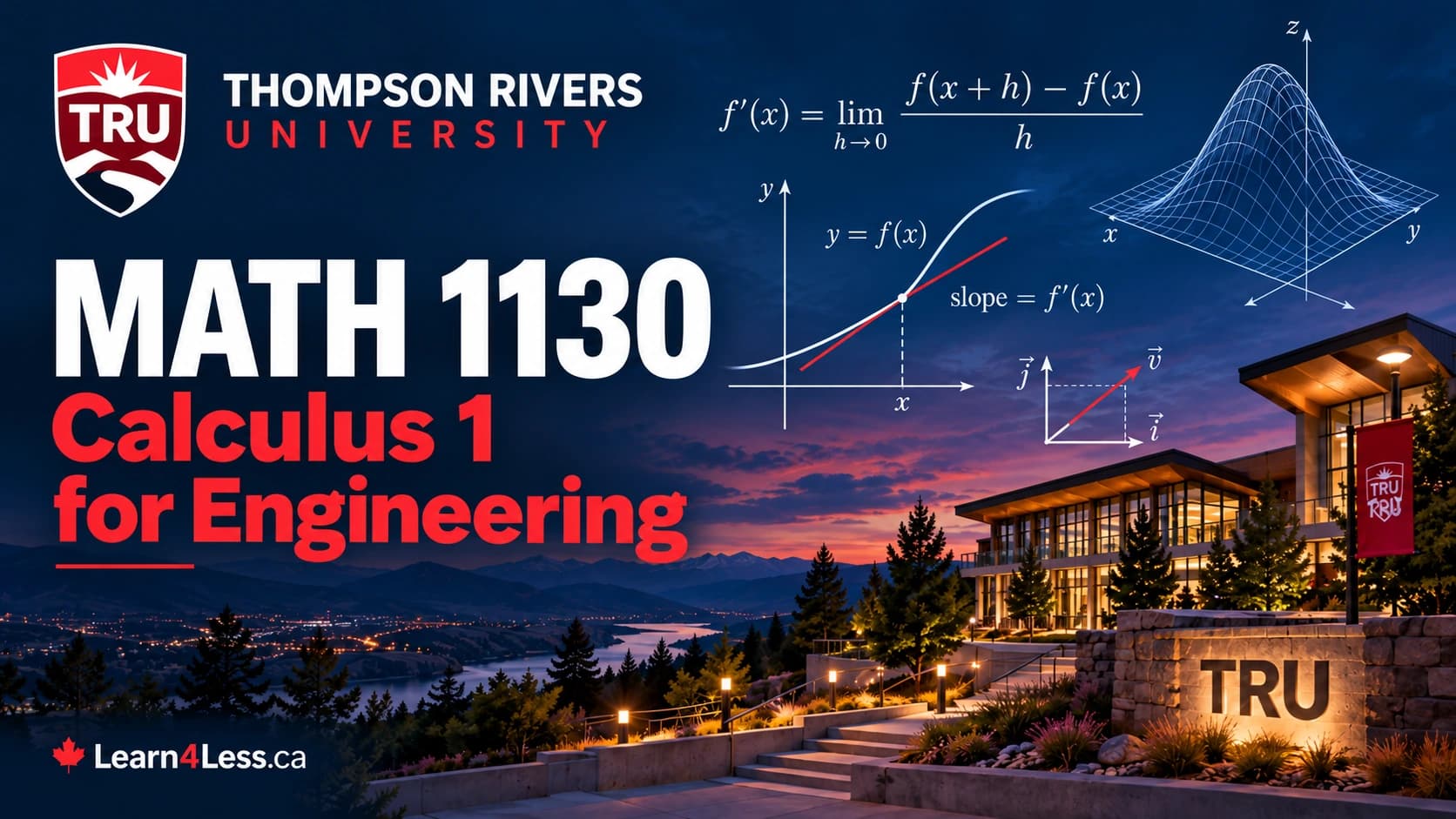
MATH 1130 is Thompson Rivers University's Calculus 1 for Engineering, and the first thing to know about it is its prerequisite: admission to the Engineering program. Not a grade, not a placement score — a seat in the program. That makes it the one first-year calculus course at TRU you cannot choose your way into, and it also means everyone in the room is on the same path, working toward the same second year.
What is covered in TRU MATH 1130?
TRU's calendar says students build a strong mathematical foundation for engineering by learning the ideas, methods and applications of single-variable differential calculus: limits and derivatives are defined and calculated, derivatives are interpreted as slopes and rates of change, and derivatives are then applied to many sorts of problems, such as finding maximum and minimum values of functions. In practice:
- Limits and continuity: one-sided limits, limits at infinity, and when a limit fails to exist
- The derivative, defined: the limit definition, built rather than asserted, and differentiability against continuity
- Differentiation rules: power, product, quotient and chain rules, implicit and logarithmic differentiation
- Transcendental derivatives: exponential, logarithmic, trigonometric and inverse trigonometric functions
- The derivative as a slope: tangent lines, linear approximation, and the geometry behind the algebra
- The derivative as a rate of change: velocity and acceleration, and rates in physical systems
- Applications: curve sketching, optimization, maxima and minima, related rates
Three credits, in a 3-1.5-0 format — three lecture hours with a tutorial hour, which is where the problems closest to exam style get worked.
The emphasis in TRU's own wording is worth noticing. It says derivatives are interpreted as slopes and rates of change, not merely computed. Engineering calculus is taught toward meaning, because the derivative has to survive being attached to a physical quantity later.
Who MATH 1130 is for
The prerequisite is admission to the Engineering program, which is what separates it from MATH 1140 — the general Calculus 1, open on Pre-Calculus 12 at 67% or an equivalent.
Credit is granted for only one of MATH 1130, MATH 1140, MATH 1141, MATH 1150, MATH 1157, MATH 1170 and MATH 1171. All are Calculus 1 in some form and they are alternatives rather than a sequence. If you have already taken one of the others and are entering Engineering, raise it with an advisor before registration rather than after.
Where it leads:
- MATH 1230 Calculus 2 for Engineering requires MATH 1130 with a C. Note the grade: a C−, which is a pass, is not enough. That is the grade to plan for from week one.
- MATH 1240 Calculus 2 accepts MATH 1130 with a C−, so the general Calculus 2 has the gentler bar.
- MATH 2110 Calculus 3 then needs MATH 1230 or MATH 1240 with a C.
Common challenges students face in MATH 1130
The C requirement for MATH 1230 is discovered too late
A pass in MATH 1130 is a C−. Continuing into Calculus 2 for Engineering needs a C. Every year students finish the term with a grade that clears the course and not the next one, and it is entirely avoidable if you know in September.
The limit definition is treated as a formality
Everyone moves to the rules within a fortnight. Then an exam asks for a derivative from first principles or why a function is not differentiable at a corner, and the rules do not help. In an engineering course this matters twice over, because the definition is what makes a derivative mean something physical rather than being a symbol you manipulate.
Interpreting a derivative is marked, and rarely practised
TRU's description makes interpretation explicit. An answer of −4.2 earns few marks without the sentence saying what it is — the temperature is falling at 4.2 degrees per minute at that instant. Students practise computing and lose marks on the explaining.
Optimization and related rates are reading problems
Turning a described situation into a relationship between variables is the hard part; the differentiation is the last two lines. That translation is what the course is training and what most practice sets skip.
The pace assumes fluent algebra and trigonometry
MATH 1130 spends Pre-Calculus 12 rather than teaching it. Identities, log laws and rational expressions have to be automatic, not merely available, or the arithmetic eats the exam clock.
How Learn4Less helps you succeed in MATH 1130
We teach the derivative as a quantity, not a symbol
Slope, rate of change, units. Engineering calculus punishes students who can differentiate but cannot say what the result is, and that habit is easier to build in first year than to retrofit in third.
We rebuild the algebra inside the calculus
If trigonometric identities or logarithm laws are the real bottleneck, we fix them within the problem you are already stuck on so you keep moving with the course.
We plan the term around the grade you need
If MATH 1230 is next, the target is a C, not a pass. We say so in the first session and work backwards from it.
We work from your section's material
Your assignments, your tutorial sheets and your instructor's notes — what you are marked on, not a generic syllabus.
MATH 1130 exam and midterm preparation
Timed practice on unseen problems
Your course outline is the authority on how your section is weighted. What is constant is that exam questions are unfamiliar by design, and that is exactly what we practise.
Tutorials are the closest thing to the exam
MATH 1130 is 3-1.5-0, and the tutorial hour is where exam-style problems get worked. We treat those sheets as primary material.
Justifying an optimization answer
Setting the derivative to zero finds a candidate. Showing it is a maximum — second derivative or sign chart — is what earns the marks, and it takes fifteen seconds once it is a habit.
Checking work between sessions
Our free derivative calculator works each step, so a long chain-rule computation that came out wrong becomes a specific line to look at.
Why choose Learn4Less for MATH 1130 tutoring?
We tutor engineering calculus streams across several universities
TRU MATH 1130 and 1230, UBC's engineering-stream MATH 100 and 101 sections, SFU MATH 151 and 152, KPU MATH 1120 and 1220. The applications differ; the sticking points are remarkably consistent.
Sessions built around your own problems
Bring the assignment that is due, the tutorial question you could not finish, or the midterm you want to understand rather than file away.
Online across Canada and the US
TRU is in Kamloops, so sessions run online — screen sharing and live work on a shared page, with everything written down for you afterwards. In-person tutoring is available in the Vancouver area only.
Free resources between sessions
The derivative calculator, the integral calculator and our concept reviews are open to anyone.
Frequently Asked Questions
Can I take MATH 1130 if I am not in the Engineering program?
No. The prerequisite is admission to the Engineering program, which is unusual — every other Calculus 1 at TRU is gated on a grade. If you are not in Engineering, MATH 1140 is the general Calculus 1 and covers substantially the same differential calculus.
What grade do I need to continue to MATH 1230?
A C in MATH 1130. That is above a bare pass, and it is the requirement students most often discover too late. If Calculus 2 for Engineering is on your map, treat a C as the floor from the first week of term.
Can I take MATH 1240 instead of MATH 1230?
MATH 1240 accepts MATH 1130 with a C−, so it is formally open to you. But MATH 1230 is the course built for the engineering sequence, and credit is granted for only one of MATH 1230, 1240, 1241 and 1250 — so this is a program-requirements question for an advisor rather than a preference.
How different is MATH 1130 from MATH 1140?
The differential calculus is largely the same. The framing differs — MATH 1130 is taught toward engineering interpretation and application — and so does the audience, since everyone in MATH 1130 is in the Engineering program. They are credit excluded with each other.
When should I get a tutor for MATH 1130?
Early, and especially if your Pre-Calculus 12 was a while ago. The algebra gap shows up in the first month and compounds, and the grade you finish with decides whether MATH 1230 is available — which makes an early fix worth more here than in most courses.