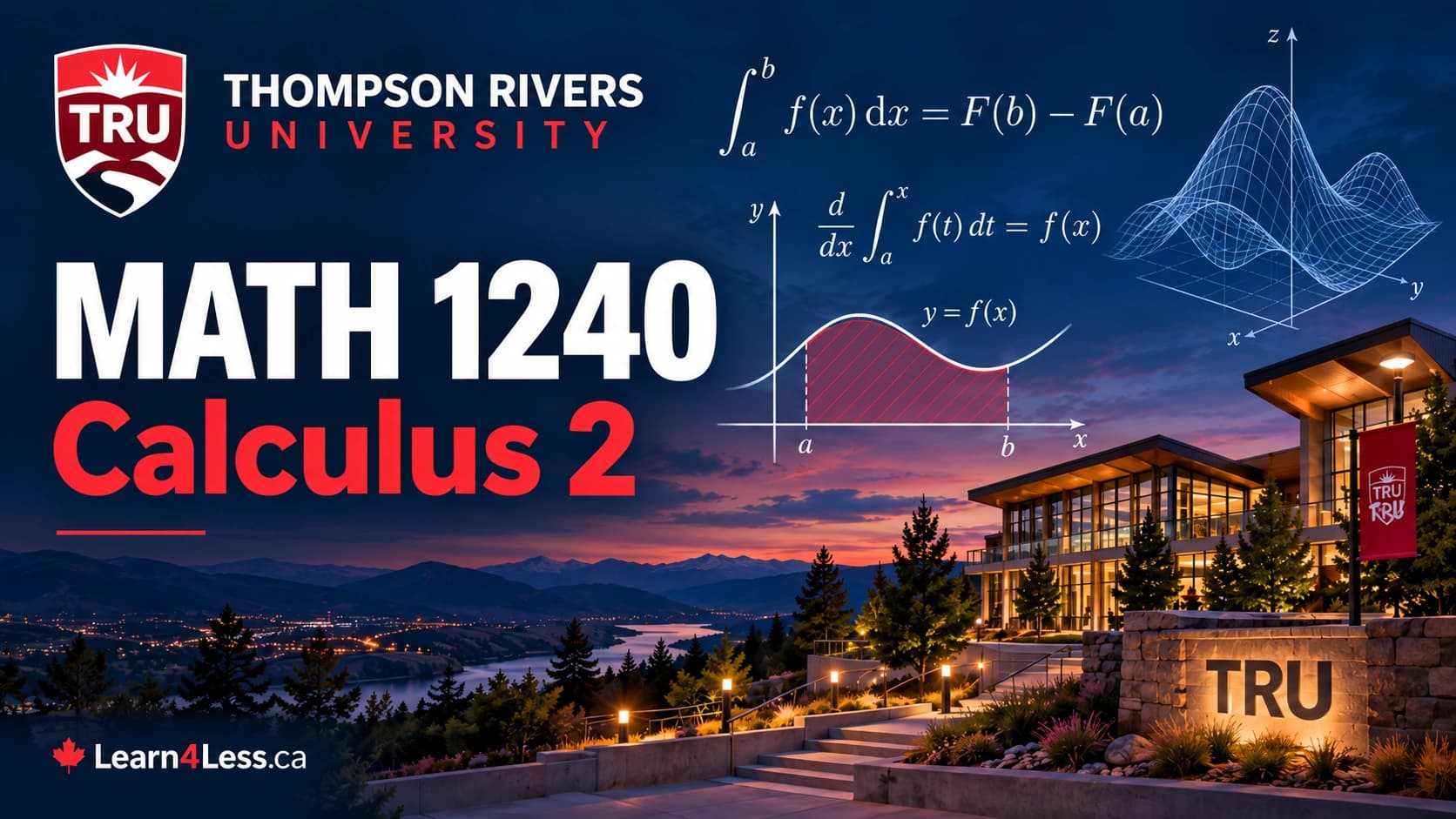
MATH 1240 is Thompson Rivers University's Calculus 2, and it is a different kind of difficulty from Calculus 1. Differentiation is an algorithm: some rule always applies. Integration is a search — you look at an integral and decide which of six or seven techniques might work, and sometimes none of them do. Then series arrive, and the question stops being "what is the answer" and becomes "does an answer exist at all". Students who were comfortable last term are often surprised by that shift, and the surprise is the normal starting point rather than a warning sign.
What is covered in TRU MATH 1240?
TRU's calendar describes MATH 1240 as integral calculus for functions of one variable, with applications emphasizing the physical sciences: Riemann sums, definite and indefinite integrals, techniques of integration, improper integrals, applications of integration including area, volume, arc length, probability and work, separable differential equations, and series. Unpacked:
- Riemann sums: area as a limit of sums, before any shortcut is allowed
- The definite and indefinite integral: and the Fundamental Theorem that connects them, in both directions
- Techniques of integration: substitution, integration by parts, trigonometric integrals and substitution, partial fractions
- Improper integrals: infinite limits and infinite discontinuities, and deciding whether a value exists at all
- Applications: areas between curves, volumes of revolution, arc length, work — and probability, which is less common in a Calculus 2 syllabus than the rest of this list
- Separable differential equations: and the initial-value problems that go with them
- Series: convergence and divergence, the battery of tests, power series and Taylor series
Three credits. TRU runs it in a 3-1.5-0 format with a tutorial or a 5-0-0 format without one — worth checking which your section is, because it changes how much supported practice your week contains.
Who MATH 1240 is for, and where it leads
The prerequisite is one of MATH 1130, MATH 1140, MATH 1141, MATH 1150 or MATH 1157, each with a minimum of C−.
Two things that list tells you:
- MATH 1170 is not on it. TRU's business calculus course does not lead to MATH 1240. If you took MATH 1170 and now need Calculus 2, talk to an advisor first — the Calculus 1 courses are credit excluded with each other, so the path back is not simply "take MATH 1140 as well".
- MATH 1130 is on it. Engineering students can continue into MATH 1240, though MATH 1230 is the course built for them. Credit is granted for only one of MATH 1230, 1240, 1241 and 1250.
Where it leads: MATH 2110 Calculus 3 requires MATH 1230, 1240 or 1241 with a C — note the C, not a bare pass — and MATH 2120 Linear Algebra 1 accepts MATH 1240 as well. This is the hinge the second year of a mathematics or physical science degree turns on.
Common challenges students face in MATH 1240
There is no algorithm for choosing a technique
This is the central difficulty and it is genuinely new. A product in Calculus 1 told you to use the product rule. A product inside an integral might mean parts, might mean substitution, might mean a trigonometric identity first. Recognition is built by volume and reflection, not by reading worked examples.
Volumes fail on the picture, not the integral
Discs, washers and shells are three formulas, and none of them is the hard part. Drawing the region, choosing the variable to integrate in, and getting the limits right is. Students who set up the picture correctly nearly always finish; students who guess nearly never do.
Integration by parts gets applied blindly
Choosing u and dv badly turns one hard integral into a harder one. Students often push through the resulting mess rather than backing up and choosing again, and lose ten minutes on an exam that has none to spare.
Convergence tests become a memory game
Eight or nine tests, each with conditions. Memorising the list without learning which shapes of series suggest which test leaves you trying all of them under exam pressure, when the paper rewards the one that finishes in two lines.
Probability applications arrive without warning
TRU lists probability among the applications of integration, and it is not in every Calculus 2 course. Continuous distributions, density functions and expected values as integrals are a small topic with its own vocabulary, and students routinely under-prepare it.
Last term's derivatives have gone rusty
MATH 1240 uses MATH 1140's differentiation constantly, and a break is enough for it to fade. Re-deriving a trigonometric derivative mid-problem is time not spent on the integral around it.
How Learn4Less helps you succeed in MATH 1240
We build a decision procedure for integrals
Rather than drilling each technique separately, we work on the first fifteen seconds: what to look at in an integrand, what each feature suggests, and how to tell quickly that a route is not working. That is the skill the exam tests.
We start volume problems with the drawing
Region, axis, slice, limits — then the integral. In that order the hardest questions on the paper become routine ones.
We turn convergence tests into a map
Each test tied to the shape of series it handles well. A factorial suggests one thing, an alternating sign another, a rational expression a third. Recognition replaces recall.
We repair the differential calculus in place
If the real sticking point is a derivative you have forgotten, we fix it inside the integration problem rather than sending you back a term.
MATH 1240 exam and midterm preparation
Unseen integrals, on the clock
Your course outline is the authority on weighting. What is constant is that you will meet integrals you have not seen, with the technique choice left entirely to you. That is what we practise.
Writing a long solution so it can be marked
Integration answers run to half a page. A marker who cannot follow your substitution cannot award the marks for it. We work on stating the substitution, changing the limits, and keeping the write-up legible under pressure.
Aiming above a pass if Calculus 3 is coming
MATH 2110 needs a C in MATH 1240, not a bare pass. If it is on your program map, that is a target to set in week one rather than discover in December.
Checking your own work
Our free integral calculator works definite and indefinite integrals step by step, including improper integrals and divergence, so a long computation that came out wrong becomes a specific line rather than a mystery.
Why choose Learn4Less for MATH 1240 tutoring?
Integral calculus is a core subject for us
We tutor the Calculus 2 course at UBC, SFU, KPU, UVic and TRU. Seeing the same technique go wrong across five curricula is how you learn which explanations actually land.
Sessions built around your own problems
Bring the assignment that is due, the tutorial question you could not finish, or the midterm you want to understand rather than shelve.
Online across Canada and the US
TRU sessions run online, with screen sharing and live work on a shared page — for long integration write-ups often better than paper, because the whole session is saved for you. In-person tutoring is available in the Vancouver area only.
Free tools, no session required
The integral calculator, the derivative calculator and our concept reviews are open to anyone.
Frequently Asked Questions
Can I take MATH 1240 after MATH 1170?
No. MATH 1170 is not on the prerequisite list for MATH 1240 — TRU accepts MATH 1130, 1140, 1141, 1150 or 1157, each with a C−. Because the Calculus 1 courses are credit excluded with one another, a student who has taken MATH 1170 cannot simply add MATH 1140. An academic advisor is the right person to ask before you register.
What is the difference between MATH 1240 and MATH 1230?
MATH 1230 is Calculus 2 for Engineering and requires MATH 1130 with a C. MATH 1240 is the general course and accepts several Calculus 1 courses with a C−. The syllabuses overlap heavily; MATH 1230 leans on force, work and centres of mass, MATH 1240 on the broader physical-science applications plus probability. Credit is granted for only one of MATH 1230, 1240, 1241 and 1250.
Is MATH 1240 harder than MATH 1140?
Different, and harder in a specific way. The computations are longer and there is no rule telling you what to do first. Students who got through Calculus 1 by pattern matching usually find Calculus 2 harder; students who understood why the rules worked usually find it manageable.
What comes after MATH 1240?
MATH 2110 Calculus 3, which extends single-variable calculus to vectors, several variables, Lagrange multipliers and double integrals, and requires a C. MATH 2120 Linear Algebra 1 also accepts it.
When should I get a tutor for MATH 1240?
The techniques stack, so early — usually around integration by parts, where most students first notice that the method is no longer obvious. Waiting until series means tackling two problems at once with less term left to do it in.