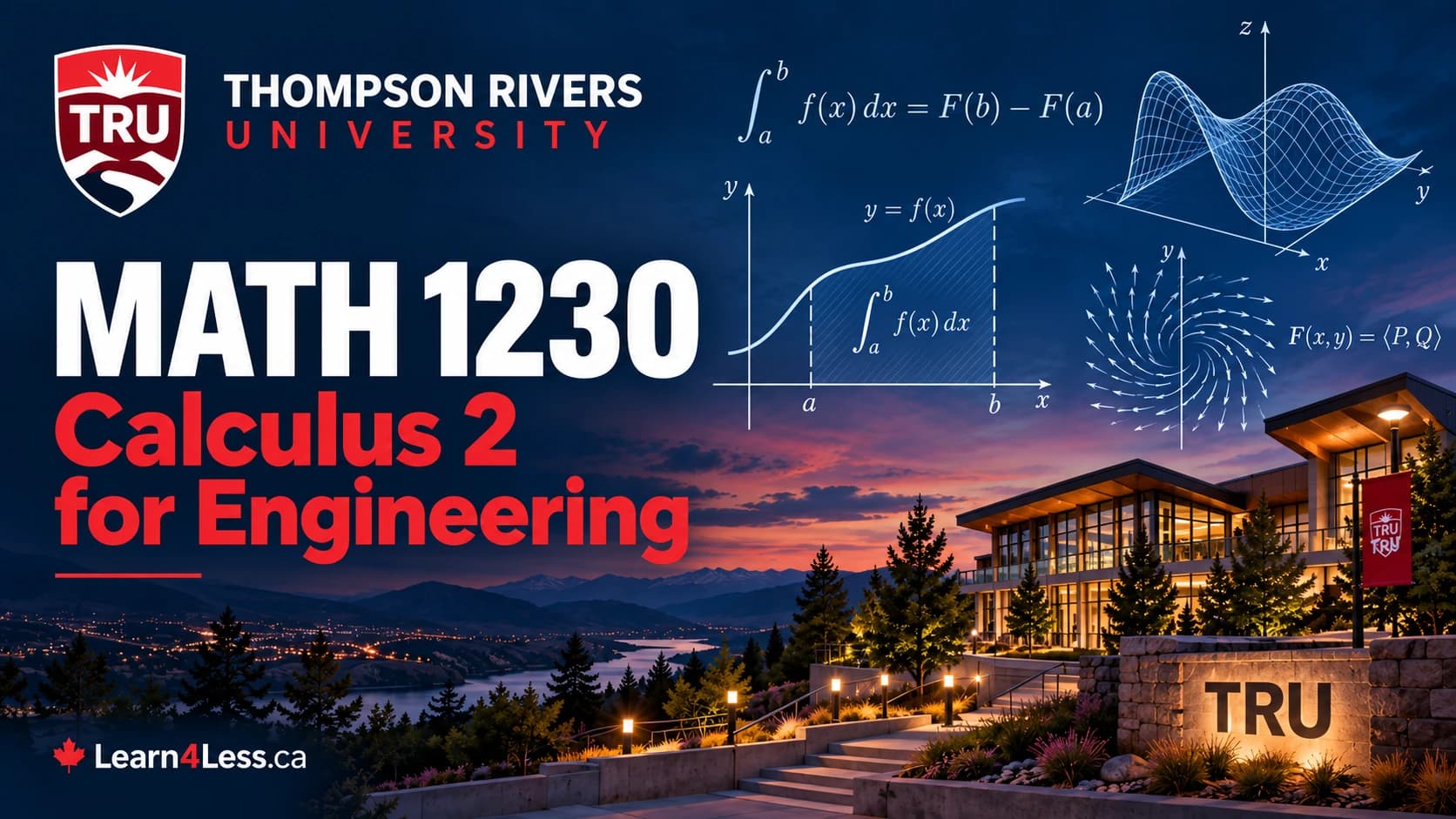
MATH 1230 is Thompson Rivers University's Calculus 2 for Engineering, the continuation of MATH 1130 and the course where integration stops being a technique and starts being a way of computing physical quantities. Force, work, centres of mass, differential equations that model real systems, Taylor series that make an intractable function computable — this is the term where the mathematics starts doing the job engineering hired it for. It is also where a lot of students meet their first genuinely open-ended problems.
What is covered in TRU MATH 1230?
TRU's calendar describes it as the ideas and techniques of single-variable integral calculus from an engineering perspective: integrals are defined, evaluated and used to calculate areas, volumes, arc lengths and physical quantities such as force, work and centres of mass; differential equations are introduced and used to model various physical phenomena; and ideas about infinite series are pursued, including some convergence tests, with particular emphasis on Taylor series. In practice:
- The definite integral defined: Riemann sums, and the Fundamental Theorem in both directions
- Techniques of integration: substitution, integration by parts, trigonometric integrals and substitution, partial fractions
- Geometric applications: areas between curves, volumes of revolution, arc length
- Physical applications: work, hydrostatic force, and centres of mass — the part that distinguishes this course from the general one
- Differential equations: separable equations, and modelling physical phenomena with them
- Series: convergence and divergence with a selection of tests
- Taylor series: given particular emphasis, because approximating a function by a polynomial with a known error bound is the everyday engineering use of the whole subject
Three credits, in a 3-1.5-0 format — three lecture hours plus a tutorial.
Who MATH 1230 is for, and where it leads
The prerequisite is MATH 1130 with a minimum grade of C. Not a C−, which is a pass. That single letter is the most commonly missed fact in TRU's first-year mathematics sequence: finishing Calculus 1 for Engineering does not by itself qualify you for Calculus 2 for Engineering.
Credit is granted for only one of MATH 1230, MATH 1240, MATH 1241 and MATH 1250. They are alternative Calculus 2 courses, not a sequence.
Where it leads: MATH 2110 Calculus 3 accepts MATH 1230 with a C, extending the subject to vectors, functions of several variables, the gradient, Lagrange multipliers and double integrals. MATH 2120 Linear Algebra 1 also accepts it. Both are standard second-year engineering requirements.
Common challenges students face in MATH 1230
There is no algorithm for choosing a technique
This is the central difficulty of any Calculus 2 and it is genuinely new. A product in Calculus 1 told you to use the product rule. A product inside an integral might mean parts, might mean substitution, might mean a trigonometric identity first. Recognition is built by volume and reflection rather than by reading worked examples.
Work and centre-of-mass problems are physics before they are calculus
A cable being wound, a tank being pumped out, a plate of varying density. The integral is the easy half; deciding what a thin slice contributes, and what its limits are, is the half that loses marks. These are also the problems most likely to appear in an unfamiliar dress on an exam.
Volumes fail on the picture, not the integral
Discs, washers and shells are three formulas and none of them is the hard part. Drawing the region, choosing the variable, and getting the limits right is. Students who set up the picture correctly nearly always finish.
Differential equations look like a new subject
Separating variables is mechanical; recognising that a described physical situation is a differential equation, and building it, is the skill being taught. That is a modelling step, and modelling is rarely what the homework drills.
Taylor series carries the emphasis and gets the least revision time
TRU singles it out, and it arrives at the end of term when everyone is tired. Writing a Taylor series is mechanical once you have the derivatives; understanding that you are trading an intractable function for a polynomial within a controllable error is what makes the remainder term worth caring about — and what makes the topic stick.
The differentiation from last term has decayed
MATH 1230 uses MATH 1130's derivatives constantly, and a term break is enough for them to fade. Re-deriving a trigonometric derivative mid-problem is time not spent on the integral around it.
How Learn4Less helps you succeed in MATH 1230
We build a decision procedure for integrals
The first fifteen seconds: what to look at in an integrand, what each feature suggests, and how to recognise quickly that a chosen route is not working. That is the skill the exam tests.
We work physical applications as modelling problems
For work, force and centre-of-mass questions we start where they actually start — what does a thin slice contribute, and between what limits — because once that line is written the integral is routine.
We make Taylor series mean something
Error bounds, radius of convergence, and why an engineer truncates a series at all. Given the emphasis TRU places on it, this is usually worth a dedicated session rather than a passing mention.
We repair the differential calculus in place
If the real sticking point is a derivative you have forgotten, we fix it inside the integration problem rather than sending you back a term.
MATH 1230 exam and midterm preparation
Unseen integrals, on the clock
Your course outline is the authority on weighting. What is constant is that you will meet integrals and applied setups you have not seen, with the method left entirely to you. That is what we practise.
Tutorial sheets first
MATH 1230 is 3-1.5-0, and the tutorial hour is where problems closest to exam style get worked. We treat those sheets as primary material.
Writing a long solution so it can be marked
Integration answers run to half a page, and an applied problem adds a diagram and a setup. A marker who cannot follow your slice or your substitution cannot award the marks. We work on making the reasoning visible under pressure.
Aiming above a pass if Calculus 3 is coming
MATH 2110 needs a C in MATH 1230. Worth planning for in September rather than discovering in April.
Checking your own work
Our free integral calculator works definite and indefinite integrals step by step, including improper integrals and divergence, so a long computation that came out wrong becomes a specific line rather than a mystery.
Why choose Learn4Less for MATH 1230 tutoring?
We tutor engineering calculus across several universities
TRU MATH 1130 and 1230, UBC's engineering-stream MATH 100 and 101 sections, SFU MATH 151 and 152, KPU MATH 1120 and 1220. The physical applications differ; the sticking points are remarkably consistent.
Sessions built around your own problems
Bring the assignment that is due, the tutorial question you could not finish, or the midterm you want to understand rather than shelve.
Online across Canada and the US
TRU sessions run online, with screen sharing and live work on a shared page — for long applied setups often better than paper, because the diagram and the working are saved for you. In-person tutoring is available in the Vancouver area only.
Free tools, no session required
The integral calculator, the derivative calculator and our concept reviews are open to anyone.
Frequently Asked Questions
What grade do I need in MATH 1130 to take MATH 1230?
A C. A C− passes MATH 1130 but does not admit you to MATH 1230 — this is the requirement students most often miss. If Calculus 2 for Engineering is on your map, treat a C in MATH 1130 as the floor from the first week of that course.
What is the difference between MATH 1230 and MATH 1240?
Both are Calculus 2 and the core techniques are the same. MATH 1230 is taught from an engineering perspective and leans on force, work, centres of mass and physical modelling; MATH 1240 is the general course and includes probability among its applications. MATH 1230 requires MATH 1130 with a C; MATH 1240 accepts several Calculus 1 courses with a C−. Credit is granted for only one of MATH 1230, 1240, 1241 and 1250.
Is MATH 1230 harder than MATH 1130?
Different, and harder in a specific way. The computations are longer, there is no rule telling you what to do first, and the applied problems ask you to model before you calculate. Students who got through Calculus 1 by pattern matching usually find this term harder.
What comes after MATH 1230?
MATH 2110 Calculus 3, which requires a C and extends the subject to vectors, several variables, Lagrange multipliers and double integrals. MATH 2120 Linear Algebra 1 also accepts MATH 1230.
When should I get a tutor for MATH 1230?
The techniques stack, so early — usually around integration by parts, where most students first notice that the method is no longer obvious. The second useful moment is when work and centre-of-mass problems start, because those need a modelling habit rather than more integration practice.