
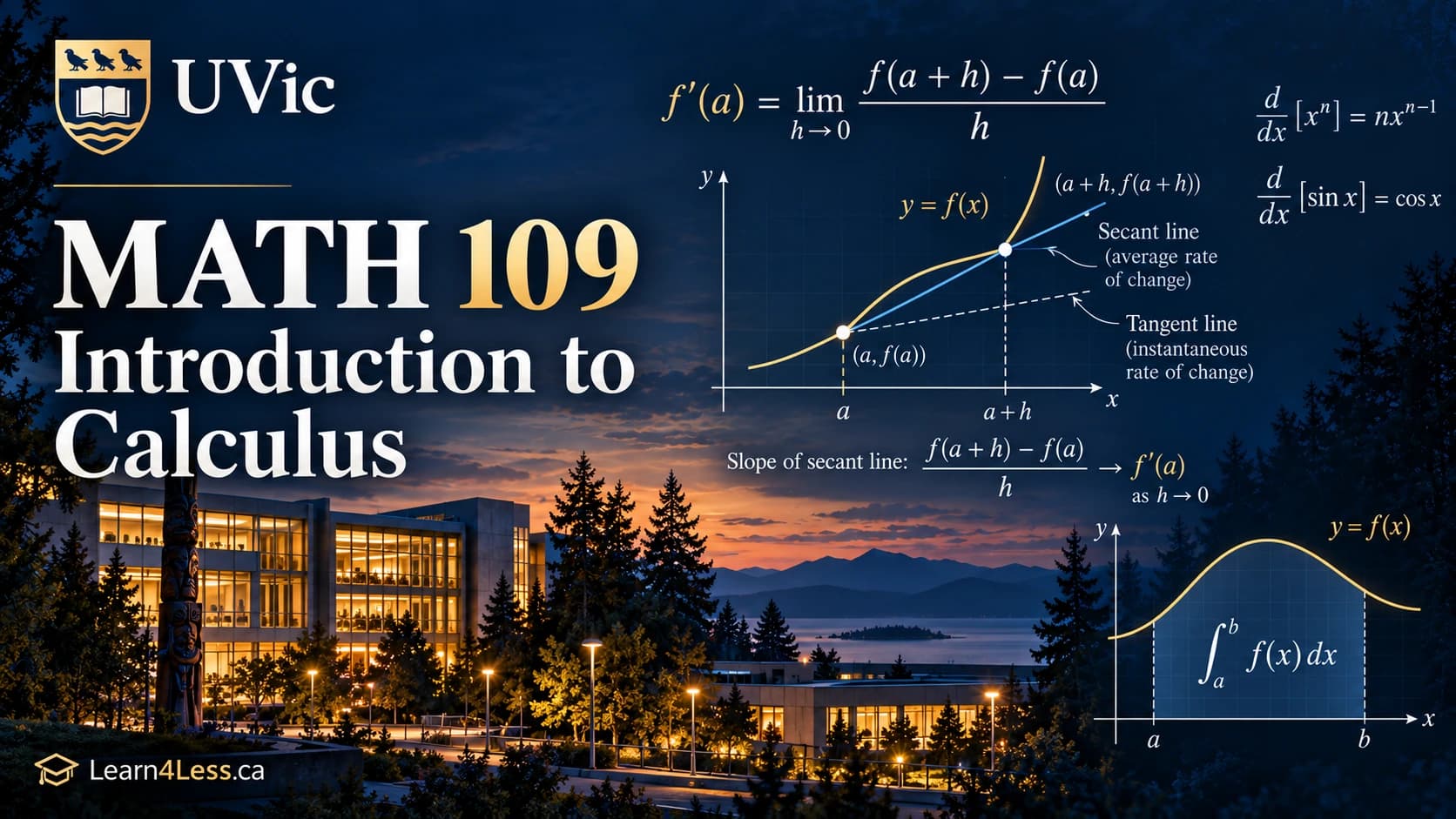
MATH 109 is the University of Victoria's Calculus I course for students who have never done calculus. That is the whole of the difference between it and MATH 100 — same prerequisites, same textbook, same learning objectives, same difficulty, same eligibility for MATH 101 afterwards. UVic says so plainly. If you arrived from Pre-Calculus 12 or MATH 120 without Calculus 12, this is not a remedial course you have been shunted into; it is the same Calculus I, taught in a room where nobody has seen a derivative before either.
What is covered in UVic MATH 109?
UVic's calendar describes MATH 109 as a first course intended for students with no previous exposure to calculus, covering: review of analytic geometry; functions and graphs; limits; derivatives; techniques and applications of differentiation; antiderivatives; the definite integral and area; logarithmic and exponential functions; trigonometric functions; Newton's, Simpson's and trapezoidal methods; and l'Hôpital's rule.
That list is word for word the MATH 100 list. In practice:
- Analytic geometry and functions: reviewed rather than assumed, which is the part that differs in the room
- Limits and continuity: one-sided limits, limits at infinity, and when a limit does not exist
- The derivative: built up from average rate of change to instantaneous, with the limit definition developed rather than quoted
- Differentiation techniques: power, product, quotient and chain rules, implicit and logarithmic differentiation
- Applications: curve sketching, related rates, optimization, linear approximation
- Transcendental functions: exponential, logarithmic, trigonometric and inverse trigonometric derivatives
- l'Hôpital's rule: indeterminate forms and how to spot them
- Antiderivatives and the definite integral: area under a curve, and the first sight of integration
- Numerical methods: Newton's method, the trapezoidal rule and Simpson's rule
1.5 units, listed as 3-0-1 — three lecture hours a week with a tutorial. Credit is granted for only one of MATH 109, MATH 100 and MATH 102.
Who MATH 109 is for
The prerequisite is identical to MATH 100's: one of MATH 120 with a minimum of C+, Pre-Calculus 12 with a minimum of B (73%), or Principles of Mathematics 12 with a minimum of B — or permission of the department, which is also how IB results and the department's pretests are handled.
UVic's own guidance is that most students in MATH 109 come straight from Pre-Calculus 12 or MATH 120, that Calculus 12 is not required, and that students benefit from being among others with a similar background. That last point is the real argument for the course. In MATH 100 the instructor can say "you saw this last year" and most of the room nods; in MATH 109 nobody saw it last year, so nothing gets skipped on that assumption.
Completing MATH 109 puts you exactly where MATH 100 would have: eligible for MATH 101, and for MATH 211 Matrix Algebra I.
Common challenges students face in MATH 109
Assuming the course is a step down
It is not, and students who treat it as one are the ones who struggle. Same textbook, same objectives, same exams' worth of material in the same number of weeks. What you are spared is an instructor assuming prior calculus — not the content, and not the pace.
Limits are genuinely strange the first time
"What the function approaches without necessarily reaching" is a real conceptual step, and it is the foundation for everything after it. Students meeting it for the first time often push past it to get to the rules, which are easier, and pay for that in week nine when an exam asks about differentiability.
The rules arrive quickly once the definition is done
After two or three weeks on limits and the definition, the differentiation rules come fast — power, product, quotient, chain — and each is easy alone. Applying three in one expression, under time pressure, is where the bookkeeping fails.
Nothing in the algebra gets re-taught
Pre-Calculus 12 is the prerequisite and MATH 109 spends it: exponent laws, log laws, trigonometric identities, rational expressions. Being able to do these slowly is not the same as being able to do them without thinking, and only the second is fast enough.
Numerical methods look unrelated
Newton's method and the trapezoidal and Simpson's rules arrive with their own notation and no obvious connection to the term's other work. They are also reliable marks, which makes skipping them a poor trade.
How Learn4Less helps you succeed in MATH 109
We teach calculus as if it is new, because for you it is
No "you'll remember this from Calculus 12". We build the derivative from average rate of change to instantaneous, with the limit in between, so the rules arrive as consequences rather than as things to memorise.
We make limits concrete before we make them formal
Graphs and numerical tables first, notation second. Students who see what a limit is have no trouble with the notation; students given the notation first often never see what it is.
We fix the pre-calculus inside the calculus
If log laws or trigonometric identities are the real problem, we repair them within the problem you are working on rather than sending you back to review. You stay with the course.
We work from your section's material
Your assignments, your tutorial sheets, your instructor's notes. That is what you are marked on.
MATH 109 exam and midterm preparation
Unseen problems, timed
Your course outline is the authority on how your section is assessed. What is constant is that exam questions are unfamiliar by design, so we practise exactly that rather than re-working problems you have already seen.
The tutorial hour matters
MATH 109 is 3-0-1: three lecture hours and a tutorial. Tutorial problems are usually the closest thing to exam questions available to you, so we treat those sheets as primary material.
Showing method, not just answers
Partial credit is earned by visible reasoning. Stating what you are differentiating, defining your variables, keeping track of signs — quick habits that are worth real marks, and easier to build early than to retrofit.
Checking work between sessions
Our free derivative calculator works each step, so a long computation that came out wrong becomes a specific line you can look at rather than a mystery.
Why choose Learn4Less for MATH 109 tutoring?
We teach a lot of first-time calculus students
Between UVic MATH 109, UBC MATH 180 and SFU MATH 150, courses built for students without prior calculus are a substantial part of what we do. The explanations that work for a first encounter are different from the ones that work as a refresher, and we know which are which.
Nobody is treated as behind
Arriving at university without Calculus 12 is a scheduling fact, not a verdict on ability. Plenty of strong mathematicians started here.
Online across Canada and the US
UVic sessions run online — screen sharing and live work on a shared page, with the whole session written down for you to keep. In-person tutoring is available in the Vancouver area only.
Free resources between sessions
The derivative calculator and our concept reviews are open to anyone.
Frequently Asked Questions
Is MATH 109 worth less than MATH 100?
No. UVic states the two are equivalent Calculus I courses that bring students to the same level, with the same learning objectives and textbook, and that either one lets you enrol in MATH 101. Credit is granted for only one of MATH 100, 102 and 109, so they are alternatives, not a ladder.
Can I take MATH 101 after MATH 109?
Yes. MATH 101's prerequisite is MATH 100 or MATH 109 — either one, with no extra grade condition beyond the pass.
I have Calculus 12. Should I still take MATH 109?
Usually MATH 100 is the better fit, because its instructor will build on what you already have and your classmates will be doing the same. But MATH 109 is a legitimate choice if your Calculus 12 was a long time ago, went badly, or covered much less than the course title suggests. Neither choice closes anything off.
Can I switch to MATH 100 after starting MATH 109?
They share a textbook, so switching costs nothing in materials — but you must change your lecture and tutorial registration before the add date, subject to availability, and you accept responsibility for anything missed. Decide in the first two weeks if you are going to decide at all.
When should I get a tutor for MATH 109?
Around limits, which is where the first genuinely unfamiliar idea appears and where a gap does the most damage downstream. That is usually weeks two to four — earlier than most students think to ask.