
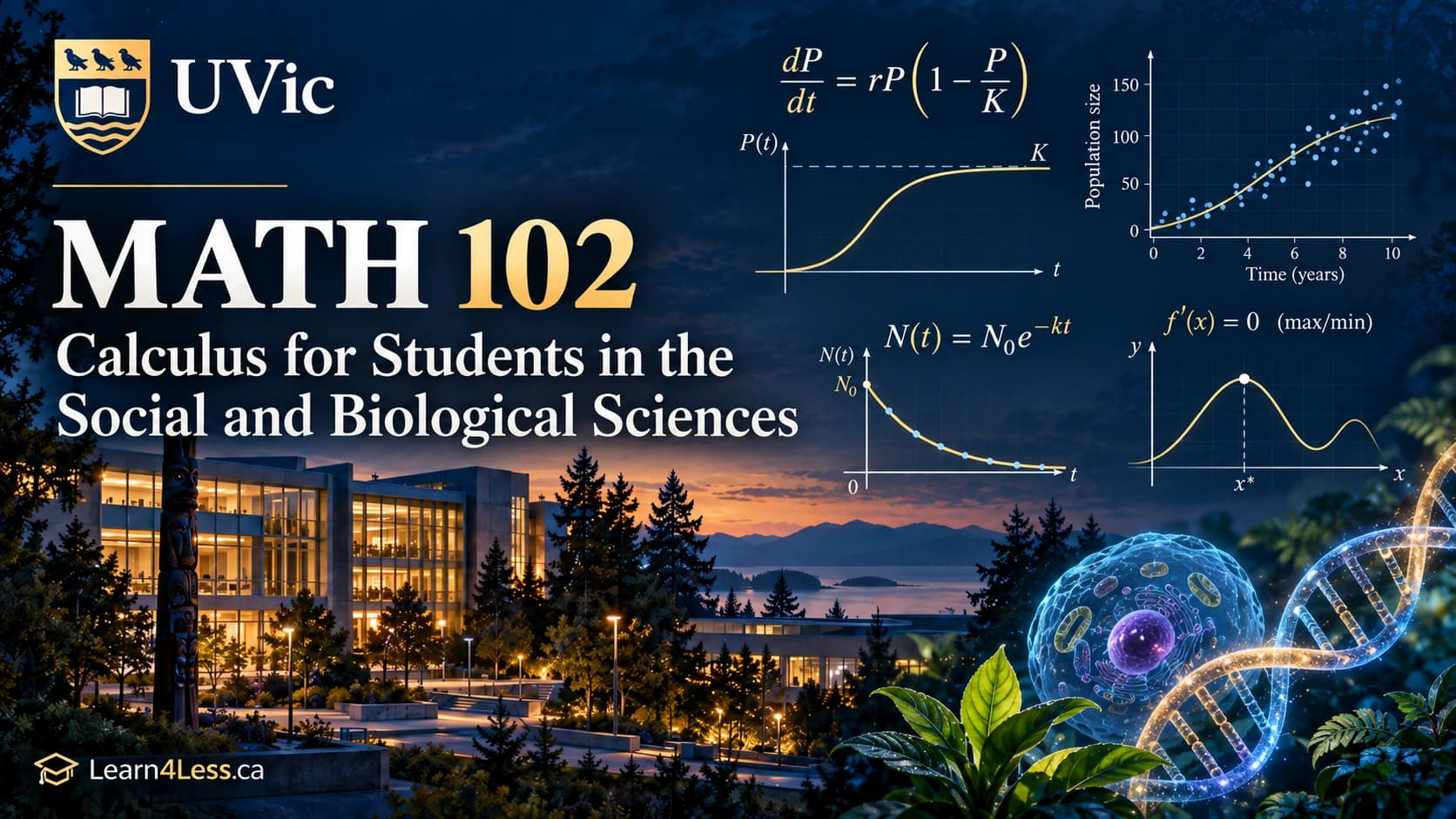
MATH 102 is the University of Victoria's calculus course for students in the social and biological sciences, and it is the one course in UVic's first-year lineup where the choice itself deserves as much thought as the material. It is a real calculus course — limits, derivatives, optimization, exponential and logarithmic models — taught with the applications a psychology, biology or economics student will actually meet. It is also, by UVic's own description, terminal: it does not lead to MATH 101, and it rules out a range of courses that require MATH 100 or MATH 109. Take it on purpose, not by default.
What is covered in UVic MATH 102?
UVic's calendar describes MATH 102 as the calculus of one variable with applications to the social and biological sciences, covering: review of functions and graphs; limits; derivatives; techniques and applications of differentiation; antiderivatives; the definite integral and area; and logarithmic and exponential functions. In practice:
- Functions as models: linear, power, polynomial, exponential and logarithmic, and what each implies about a process
- Limits: enough to define the derivative honestly, including limits at infinity and long-run behaviour
- The derivative: as a rate of change in units that mean something — organisms per year, dollars per unit, concentration per hour
- Differentiation techniques: power, product, quotient and chain rules, and implicit differentiation
- Applications of differentiation: curve sketching, maxima and minima, and optimization read in context
- Exponential and logarithmic functions: growth and decay, half-life, doubling time, and the interpretation of a fitted rate constant
- Antiderivatives and the definite integral: area under a curve, and accumulation as the reverse of a rate
1.5 units, listed as 3-0-0 — three lecture hours a week and no tutorial. That is a real difference from MATH 100, 101 and 109, which are all 3-0-1. The scheduled hour where someone works problems with you does not exist in this course, which puts more weight on office hours and on your own practice.
The choice to make before you register
UVic is unusually direct about this, and it is worth quoting the shape of it.
MATH 102 is not equivalent to MATH 100 or MATH 109. Credit is granted for only one of the three. MATH 102 uses a different textbook, has different learning objectives, and does not serve as a prerequisite for MATH 101. The department's own wording is that it "does not prepare students for further study of calculus and will restrict future options by ruling out a range of courses which require MATH 100 or MATH 109", and that it should only be taken by students whose program of study does not include courses with MATH 100 as a prerequisite.
So:
- Take MATH 102 if your program requires one calculus course and your path does not run through MATH 101. Calculus 12 is not required, and the prerequisite is the gentlest of the three: MATH 120 with a minimum of C, or Pre-Calculus 12, or Principles of Mathematics 12.
- Take MATH 100 or MATH 109 instead if there is any real chance you will want quantitative work later — mathematical modelling, data science, a switch into a science major, a graduate program with a calculus requirement. UVic's own advice is that these leave more options open. MATH 109 exists precisely so that not having Calculus 12 is not a reason to settle for MATH 102.
One door MATH 102 does open: MATH 211 Matrix Algebra I accepts MATH 100, MATH 102 or MATH 109. So linear algebra remains available.
If you are unsure, the department's advising address is the right place to ask before the add date, not after.
Common challenges students face in MATH 102
"Applied" is mistaken for "easier"
The biological and social context does not remove any calculus; it adds a translation step at each end. You read a paragraph, build a function, differentiate, and then say what the number means about the population or the price. That is more work than a bare derivative, not less.
Interpretation carries marks, and is rarely practised
An answer of 0.043 earns little without the sentence that says what it is — the population is growing at 4.3 percent per year at that moment. Students practise computing and lose marks on the explaining, because the explaining was never the homework.
Exponentials and logarithms run the whole course
Every growth and decay model depends on them. Shaky log laws are not a small gap here; they are a gap in the main topic, and it shows up in every applied section.
No tutorial hour
With a 3-0-0 schedule there is no timetabled session where someone works problems with you. Students used to high school, where practice was supervised, often do not notice what is missing until the first midterm.
Parameters are letters, not numbers
Differentiating with respect to t while r, K and N₀ sit in the expression as constants is a small conceptual step that causes real trouble. Students comfortable with numbers often freeze when the expression is mostly symbols.
How Learn4Less helps you succeed in MATH 102
We teach the translation in both directions
From a described situation to a function, and from a derivative back to a sentence about the organism or the population. That round trip is what MATH 102 assesses, and what generic calculus practice never touches.
We fix the exponential and logarithm work first
If growth models are going badly, the cause is usually log laws rather than calculus. We repair that inside the problems you are already working on.
We can be the tutorial the course does not have
A weekly session working problems with someone is exactly what a 3-0-0 course leaves out. For a lot of MATH 102 students that, rather than rescue after a bad midterm, is the useful shape.
We work with parameters deliberately
Practice differentiating expressions full of symbols until it feels like differentiating numbers, because every model in this course and in your later biology or economics courses looks like that.
MATH 102 exam and midterm preparation
Practice on unfamiliar contexts
Your course outline is the authority on how your section is assessed. What is predictable is that exam questions put familiar calculus into an unfamiliar setting — a different species, a different quantity — and that is what we practise.
Writing the interpretation
The one or two sentences after a computation are worth marks and take thirty seconds once you know the pattern. We drill that pattern.
The errors that repeat
Dropped negatives in decay models, rate constants left uninterpreted, units omitted, a maximum asserted without the second derivative or a sign chart. Naming your own recurring three is usually worth more than another chapter of practice.
Checking work between sessions
Our free derivative calculator works each differentiation step, so a chain-rule computation that came out wrong becomes a specific line rather than a mystery.
Why choose Learn4Less for MATH 102 tutoring?
We tutor the life and social sciences calculus stream across four universities
UVic MATH 102, KPU MATH 1130 and 1140, SFU MATH 154, 155, 157 and 158, and UBC's life-sciences sections. The same misconceptions recur, so we usually recognise yours quickly.
Nobody is treated as a reluctant mathematician
Most students in this course are here for a program requirement. That is fine, and it changes how a session is best run: practical, concrete, and aimed at the marks.
Online across Canada and the US
UVic sessions run online, with screen sharing and live work on a shared page that you keep afterwards. In-person tutoring is available in the Vancouver area only.
Free resources between sessions
The derivative calculator and our concept reviews are open to anyone.
Frequently Asked Questions
Can I take MATH 101 after MATH 102?
No. MATH 101 requires MATH 100 or MATH 109, and UVic states explicitly that MATH 102 does not serve as a prerequisite for it. If your plans change, talk to an academic advisor — you would normally need MATH 100 or MATH 109, and credit is granted for only one of the three courses.
I am in biology. Should I take MATH 102 or MATH 100?
Check your program's requirements first. Beyond that, UVic's own guidance is that while MATH 102 is sufficient for a degree in the biological or social sciences, stronger mathematics sets you up better if you might pursue quantitative aspects of those fields — mathematical modelling or data science, for instance — and that MATH 100 or MATH 109 leaves more options open. Not having Calculus 12 is not a reason to choose MATH 102, because MATH 109 exists for exactly that situation.
Is MATH 102 easier than MATH 100?
It covers less ground and has a gentler prerequisite, so in that sense yes. But it has no tutorial hour, and the applied questions demand interpretation as well as computation, which many students find harder than a bare derivative. "Narrower" is more accurate than "easier".
Does MATH 102 count for anything beyond itself?
It satisfies calculus requirements in programs that ask for one calculus course, and MATH 211 Matrix Algebra I accepts it alongside MATH 100 and MATH 109. What it does not do is open the MATH 101 sequence.
When should I get a tutor for MATH 102?
Two good moments. Before the term starts, if your Pre-Calculus 12 was a while ago — the exponential and logarithm work begins early and compounds. Or from week one as the standing practice session the 3-0-0 schedule does not provide, which is how a lot of MATH 102 students use us.