
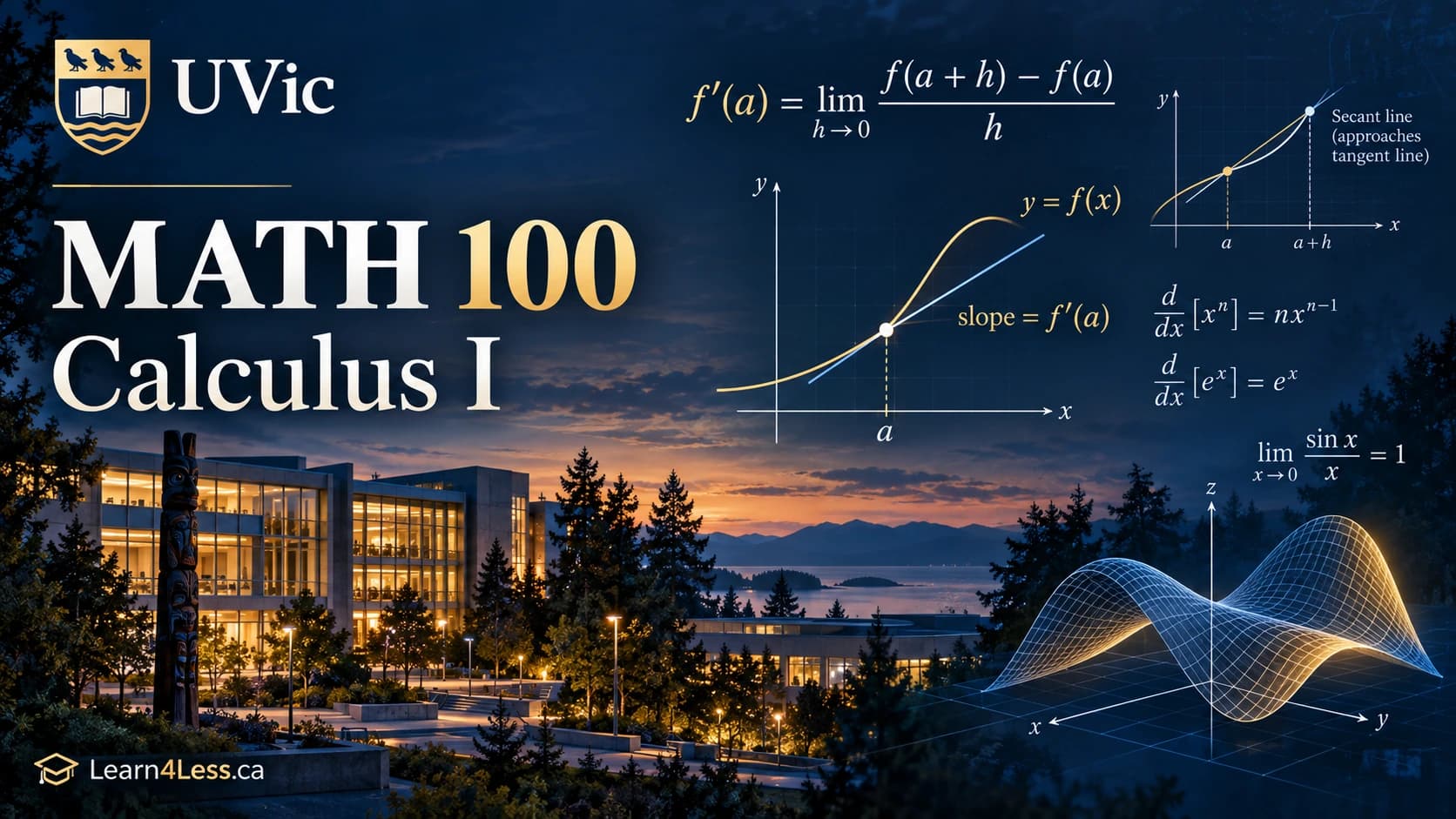
MATH 100 is the University of Victoria's main first-year calculus course, and the one that sits at the front of most science, mathematics and engineering pathways. It is a 1.5-unit course, three lecture hours a week with a tutorial, and it moves at a pace that catches out students who found Calculus 12 straightforward. The important thing to know before you register is that UVic runs a second course covering the same material — MATH 109 — and which of the two you should be in has nothing to do with ability.
What is covered in UVic MATH 100?
UVic's calendar description lists the course as: review of analytic geometry; functions and graphs; limits; derivatives; techniques and applications of differentiation; antiderivatives; the definite integral and area; logarithmic and exponential functions; trigonometric functions; Newton's, Simpson's and trapezoidal methods; and l'Hôpital's rule. In practice:
- Analytic geometry and functions: the review the rest of the course spends rather than teaches
- Limits and continuity: one-sided limits, limits at infinity, and the cases where a limit fails to exist
- The derivative: the limit definition, and differentiability versus continuity
- Differentiation techniques: power, product, quotient and chain rules, implicit and logarithmic differentiation
- Applications of differentiation: curve sketching, related rates, optimization and linear approximation
- Transcendental functions: derivatives of exponential, logarithmic, trigonometric and inverse trigonometric functions
- l'Hôpital's rule: indeterminate forms, and recognising which ones it applies to
- Antiderivatives and the definite integral: area under a curve, and the first sight of integration
- Numerical methods: Newton's method for roots, and the trapezoidal and Simpson's rules for integrals
That last group is worth noticing. Numerical methods are often left out of a first calculus course; here they are in the calendar description, and they carry exam marks.
Credit is granted for only one of MATH 100, MATH 102 and MATH 109.
MATH 100 or MATH 109? The decision that matters most
This is the question UVic students most often get wrong, so it is worth being precise.
MATH 100 and MATH 109 have the same prerequisites, the same textbook, the same learning objectives and the same difficulty level. Both are Calculus I, and both lead to MATH 101. The department says so explicitly.
The single difference is what the instructor assumes in the room:
- MATH 100 builds on previous experience with calculus. UVic highly recommends Calculus 12 for it.
- MATH 109 assumes no previous exposure to calculus and teaches from there. Calculus 12 is not required.
So the choice is not "harder or easier" — it is "which room do you want to be in". If you took Calculus 12 and it went reasonably, MATH 100 is where your classmates are. If you came straight from Pre-Calculus 12 or MATH 120 and have never differentiated anything, MATH 109 gives you a cohort in the same position and lessons that start where you actually are.
The prerequisite for both is one of: MATH 120 with a minimum of C+, Pre-Calculus 12 with a minimum of B (73%), or Principles of Mathematics 12 with a minimum of B — or permission of the department, which is also the route for IB results and for the department's pretests.
Common challenges students face in MATH 100
Calculus 12 gave a false sense of pace
Most of the first few weeks will look familiar to anyone who took Calculus 12, and that familiarity is the trap: MATH 100 covers in a fortnight what a high school year spread over a term, and then keeps going past where Calculus 12 stopped. Students who coast through the recognisable part have no habits in place when the new material starts.
The limit definition is learned once and then tested
f′(a) = lim (f(a+h) − f(a))/h gets used twice and abandoned in favour of the rules. Then an exam asks for a derivative from first principles, or why a function is not differentiable at a corner, and the rules are no help at all.
Related rates and optimization are reading problems
Both ask you to turn a paragraph of English into a relationship between variables and then differentiate. The calculus is the last two lines; the first eight are the part that loses marks, and the part nobody practises.
Numerical methods feel like a different subject
Newton's method, the trapezoidal rule and Simpson's rule arrive with their own notation and no obvious link to the derivative work around them. They are also straightforward marks once the setup is clear, which makes skipping them expensive.
The algebra and trigonometry are spent, not taught
MATH 100 does not revisit trigonometric identities, log laws or rational expressions. It uses them constantly. A student whose algebra is correct but slow runs out of time on every assessment, which reads like a calculus problem and is not one.
How Learn4Less helps you succeed in MATH 100
We work from your section's material
We use your own assignments, your tutorial problems and your instructor's notes, because that is what you are marked on — not a generic calculus syllabus.
We rebuild the algebra inside the calculus
If trigonometric identities or logarithm laws are the real bottleneck, we fix them within the problem you are already stuck on. You keep moving with the course instead of falling further behind while you review.
We teach the setup for applied problems
Naming the variables, finding the constraint, deciding what to differentiate with respect to. Once that is on paper, related rates and optimization stop being the hardest questions on the exam.
We make the reasoning sayable
Being able to explain in one sentence why the chain rule works is what lets you apply it to a form you have not seen. That is the gap between doing the homework and doing the exam.
MATH 100 exam and midterm preparation
Practice under exam conditions
Assessment weighting varies by section, so your course outline is the authority on how many midterms you have and what each is worth. What does not vary is that exam questions are unfamiliar on purpose. We build sessions around unseen problems with the clock running.
Tutorials are part of the assessment, not an optional extra
MATH 100 is listed as 3-0-1 — three lecture hours and a tutorial hour. The tutorial is where the problems closest to the exam get worked. We treat your tutorial sheets as primary material.
Writing for partial credit
A correct derivative with no visible method can score less than an incomplete solution with clear reasoning. We work on defining variables, stating what is being differentiated, and keeping signs and units straight under time pressure.
Checking your own work between sessions
Our free derivative calculator shows each step rather than only the answer, so you can find where a long chain-rule computation went wrong instead of only learning that it did.
Why choose Learn4Less for MATH 100 tutoring?
First-year calculus is our core subject
We tutor the first calculus course at UBC, SFU, KPU and UVic. The same handful of misconceptions recur across all four, which usually means we recognise yours in the first session rather than the fourth.
Sessions built around your own problems
Bring the assignment that is due, the tutorial question you could not finish, or the midterm you want to understand rather than file away.
Online across Canada and the US
UVic is across the strait from us, so sessions with UVic students run online — screen sharing and live work on the same page, which for calculus is no worse than sitting beside someone and often better, because the whole session is written down. In-person tutoring is available in the Vancouver area only.
Free resources, no session required
The derivative calculator, the integral calculator and our concept reviews are open to anyone.
Frequently Asked Questions
Is MATH 109 easier than MATH 100?
No. UVic states that the two are at the same difficulty level, with the same learning objectives and the same textbook, and that either one lets you enrol in MATH 101. MATH 109 assumes no previous calculus and teaches accordingly; MATH 100 assumes some and builds on it. Pick the room that matches your background, not the one you think is softer.
Can I switch between MATH 100 and MATH 109?
The department notes that switching between them does not mean buying new materials, since they use the same textbook — but you have to change your lecture and tutorial registration before the add date, subject to availability, and you take on responsibility for anything you missed. If you are considering it, do it in the first two weeks.
What is the difference between MATH 100 and MATH 102?
They are not equivalent. MATH 102 is calculus for the social and biological sciences, covers less, and does not lead to MATH 101 — UVic warns that it rules out a range of courses that require MATH 100 or MATH 109. If there is any chance you will need more calculus, MATH 100 or MATH 109 is the safer choice.
Do I need Calculus 12 for MATH 100?
It is not a prerequisite, but UVic highly recommends it and says MATH 100 expects some previous exposure to calculus. The formal requirement is MATH 120 with a C+, or Pre-Calculus 12 or Principles of Mathematics 12 with a B (73%). Without Calculus 12, MATH 109 is designed for exactly your situation.
When should I get a tutor for MATH 100?
Before the first midterm rather than after. Calculus compounds — a shaky grasp of limits becomes a shaky grasp of derivatives, which becomes lost marks on optimization. Students who ask in week three are fixing one topic; students who ask in week eight are fixing four.