
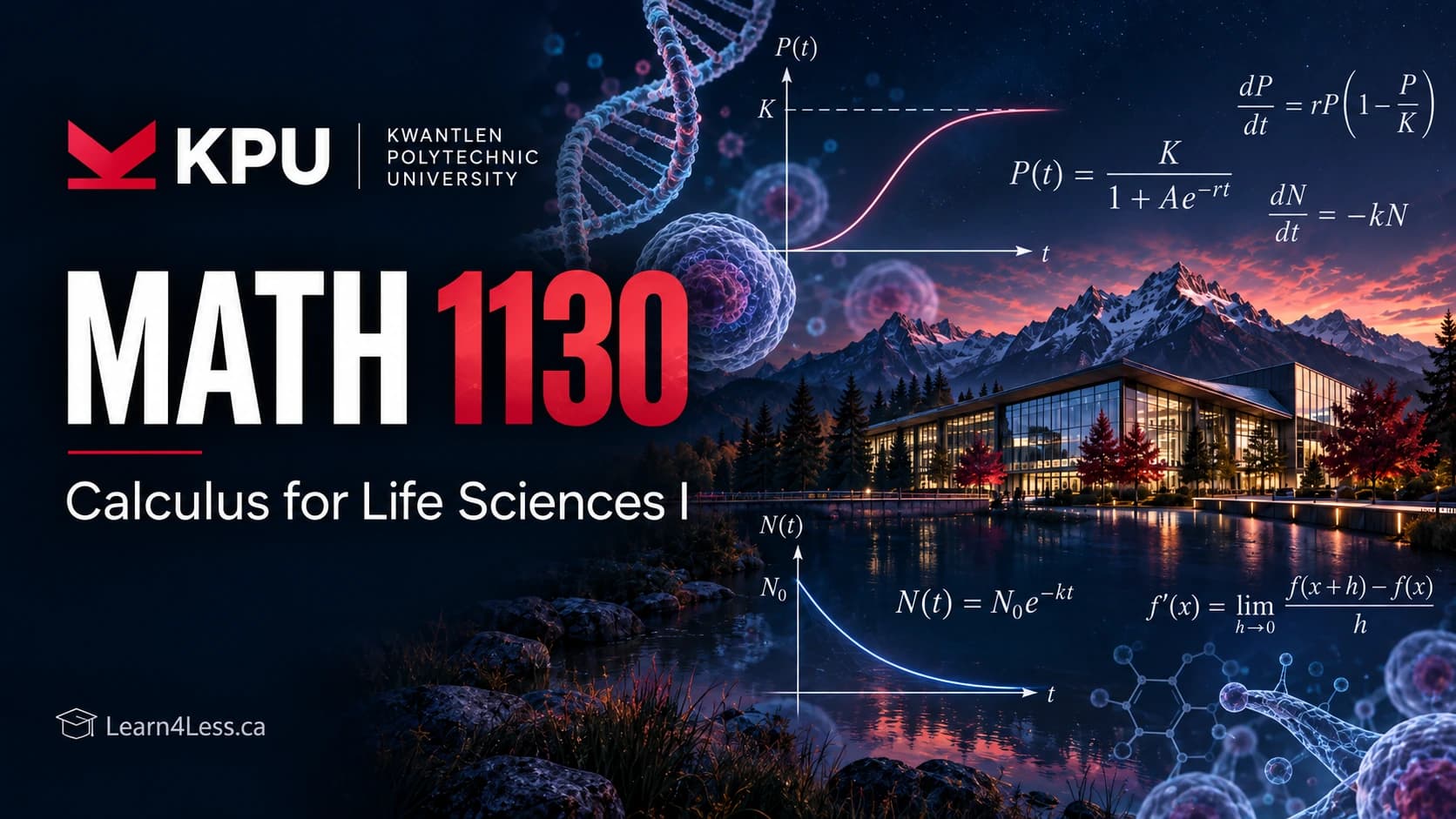
MATH 1130 is calculus taught for people who are going to use it on living systems. It covers the same core machinery as Kwantlen's science calculus course — limits, derivatives, optimization — but it spends its examples on population growth, drug clearance, enzyme kinetics and dose response rather than on beams and projectiles. If you are in a biology, health science or environmental program, this is almost certainly the calculus course on your map, and the most common mistake students make with it is assuming the biology framing makes it an easier course. It does not; it makes it a different one.
What is covered in KPU MATH 1130?
KPU's calendar description is direct: you study differential calculus and its applications to the biological sciences, and in particular limits and the differentiation of algebraic and elementary transcendental functions, with applications to graphing and optimization. In practice:
- Functions as models: linear, power, exponential, logarithmic and logistic functions, and what each one implies about a biological process
- Limits and continuity: including limits at infinity, which is how you read a long-run population size or a saturation level off a model
- The derivative: the limit definition, and the derivative read as a rate of change in units that mean something — cells per hour, milligrams per litre per minute
- Differentiation rules: power, product, quotient and chain rules, plus implicit and logarithmic differentiation
- Exponential and logarithmic derivatives: the core of every growth and decay model in the course
- Curve sketching: increasing and decreasing behaviour, concavity, inflection points and asymptotes, interpreted biologically
- Optimization: maxima and minima applied to problems from the life sciences
- Applied modelling: exponential growth and decay, logistic growth toward a carrying capacity, and the interpretation of parameters in a fitted model
Three credits, with the ASTR and QUAN attributes.
What it does not include, compared with MATH 1120: rectilinear motion and parametric curves. That difference matters if you might later take MATH 1220, which returns to parametric curves.
Who MATH 1130 is for, and what you need to get in
The prerequisite is Level B1 in KPU's Math Alternatives Table: Pre-Calculus 12 with a C+, or a Math Placement Test score of 70 or higher — or anything at Level A1, which includes Calculus 12, AP Calculus and MATH 1112 with a C.
The entry bar is lower than MATH 1120's, which asks for a B in Pre-Calculus 12. That is the practical reason many students end up here, and it is a legitimate one.
Two things to settle before you register:
- MATH 1130 is credit excluded with MATH 1120. You may enroll in and earn credit for only one of them. If your program, or a program you might transfer into, requires MATH 1120 specifically, taking MATH 1130 first closes that door.
- The grades needed after it are higher than a pass. MATH 1230, the integral calculus course for life sciences, accepts MATH 1130, and MATH 1220 accepts it with a C+. MATH 1152 and MATH 2232 also want a C+. Plan for the C+ from week one, not from week ten.
Common challenges students face in MATH 1130
"Applied" is mistaken for "easier"
The biological context does not remove any calculus; it adds a translation step at both ends. You read a paragraph about a bacterial culture, turn it into a function, differentiate, and then say what the number means in the original setting. That is more work than a bare derivative, not less.
Interpretation is marked, and rarely practised
An answer of 0.043 earns few marks without the sentence that says what it is: the population is growing at 4.3 percent per hour at that instant. Students practise computing and then lose marks on the explaining, because the explaining was never the homework.
Exponentials and logarithms carry the whole course
Every growth and decay model runs on them. A student whose log laws are shaky does not have a small gap in MATH 1130 — they have a gap in the main topic, and it shows up in every application section.
Chain rule inside a model
Real models are compositions: an exponential inside a rational function, a logarithm of a sum. The chain rule is fine on a textbook exercise and fails on a model that has three layers and named parameters instead of numbers.
Parameters are not numbers, and that is unsettling
Differentiating with respect to t while r, K and N₀ sit in the expression as constants is a small conceptual step that causes real trouble. Students who are comfortable with numbers often freeze when the expression is mostly letters.
How Learn4Less helps you succeed in MATH 1130
We teach the translation both ways
From a biological description to a function, and from a derivative back to a sentence about the organism. That round trip is what MATH 1130 assesses and what generic calculus practice never touches.
We fix the exponential and logarithm work first
If growth models are going badly, the cause is usually log laws rather than calculus. We repair that inside the problems you are already working on rather than sending you back a course.
We work with parameters, deliberately
Practice differentiating expressions full of symbols until it feels the same as differentiating numbers, because every model in the course and in your later biology courses looks like that.
We work from your section's material
KPU runs MATH 1130 across campuses and sections differ in pace and emphasis. We use your assignments, your WeBWorK sets and your instructor's notes, not a generic syllabus.
MATH 1130 exam and midterm preparation
Practice on unfamiliar contexts
Your course outline is the authority on how your section is assessed. What is predictable is that exam questions will put familiar calculus in an unfamiliar biological setting — a different organism, a different quantity — and that is exactly what we practise.
KPU's sample finals
The KPU library keeps sample finals on course reserve, searchable by instructor. KPU notes the actual exam may differ markedly, which is fair, but the format and balance are informative and they cost nothing.
Writing the interpretation
We work on the one or two sentences that follow a computation, because those sentences are worth marks and take thirty seconds once you know the pattern.
Checking work between sessions
Our free derivative calculator works the differentiation step by step, so you can locate where a long chain-rule computation went wrong instead of only discovering that it did.
Why choose Learn4Less for MATH 1130 tutoring?
We tutor the life-sciences calculus stream at three universities
KPU MATH 1130, SFU's MATH 154 and 155, and UBC's life-sciences sections. The same misconceptions recur across all three, which means we usually recognise yours quickly.
Sessions built on your own problems
Bring the assignment, the WeBWorK question that keeps being marked wrong, or the midterm you want to understand properly.
Online anywhere, in person in Vancouver
Most sessions run online, across Canada and the United States, with screen sharing and live work on the same page. In-person sessions are available in the Vancouver area subject to tutor availability; we do not currently run sessions on KPU's campuses.
Free resources, no session required
The derivative calculator and our concept reviews are open to anyone.
Frequently Asked Questions
Should I take MATH 1130 or MATH 1120?
Follow your program requirements first — that is the deciding factor, and an academic advisor can confirm it. Broadly, MATH 1130 is the life sciences stream and MATH 1120 is the science, mathematics and engineering stream. MATH 1120 has the higher entry requirement, covers rectilinear motion and parametric curves, and is the cleaner prerequisite for the second-year sequence. They are credit excluded with each other, so you get one.
Is MATH 1130 easier than MATH 1120?
The entry requirement is lower and the topic list is shorter, so in that sense yes. But the applied questions demand interpretation as well as computation, and students frequently find that harder than a bare derivative. "Different" is more accurate than "easier".
Can I take MATH 1220 after MATH 1130?
Yes, with a C+ in MATH 1130. Note that MATH 1130 does not cover parametric curves, which MATH 1220 uses — a small gap, but one worth closing before the term starts rather than during it. MATH 1230, Calculus for Life Sciences II, is the other continuation and is the usual choice within the life sciences stream.
What if I already took MATH 1120?
Then you cannot also take MATH 1130 for credit — they are credit excluded. MATH 1120 satisfies anything MATH 1130 would have satisfied.
When should I get a tutor for MATH 1130?
Early, and especially if exponentials and logarithms were shaky in pre-calculus. They are the backbone of this course rather than one chapter of it, and a gap there quietly affects every applied section that follows.