
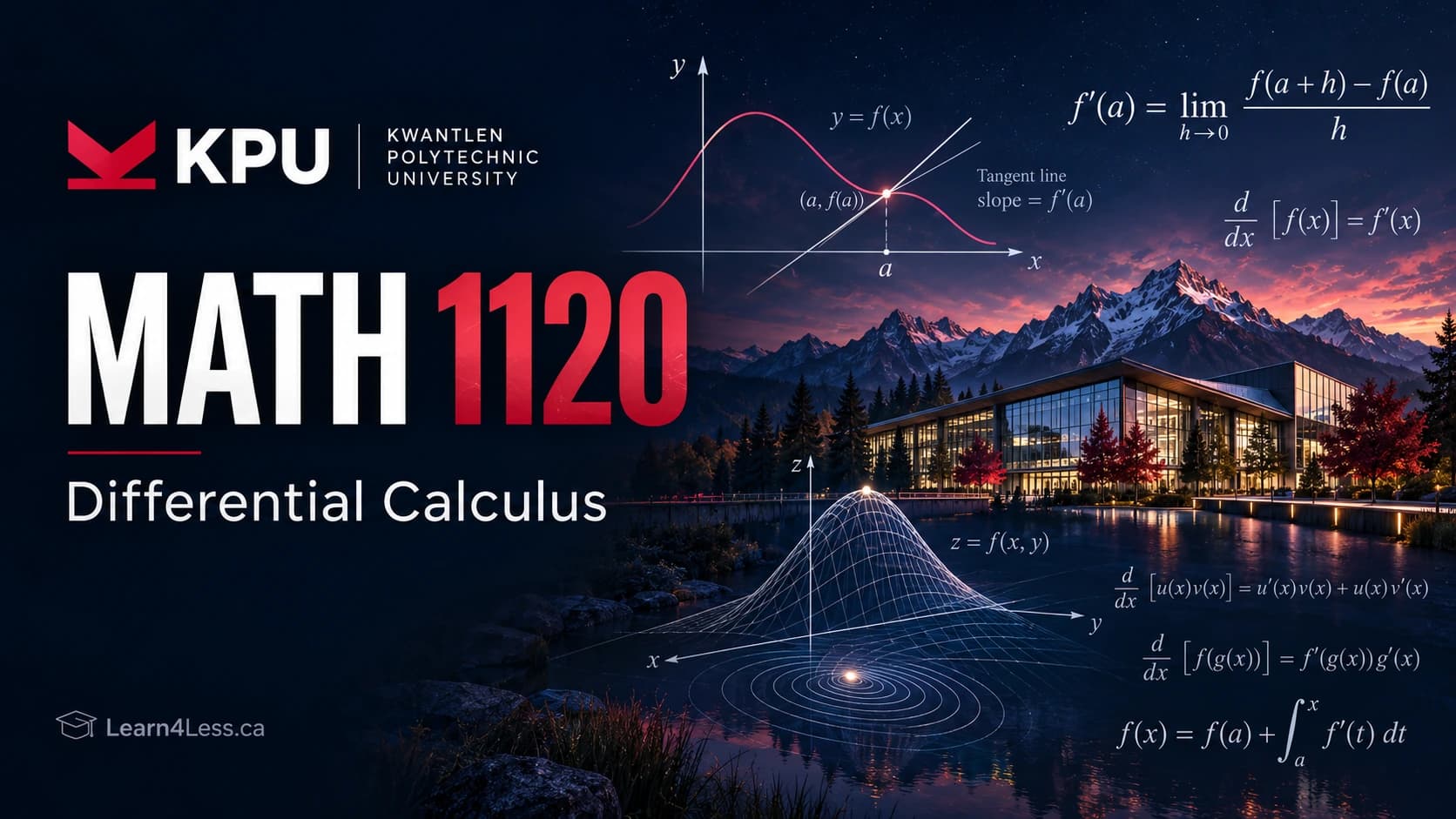
MATH 1120 is Kwantlen's main first-year calculus course, and it is the one that sits at the front of the science, mathematics and engineering pathways. It is also the course where the rules change: the algebra you have been doing for years stops being the answer and becomes the thing you use to get the answer. If limits feel like a trick, if the chain rule works until the moment a question is worded differently, or if you are already a week behind, that is the ordinary experience of week four — not a sign you are in the wrong course.
What is covered in KPU MATH 1120?
KPU's calendar description for MATH 1120 is short and precise: you learn to differentiate algebraic and elementary transcendental functions and to apply those skills to graphing, maxima and minima, related rates, and rectilinear motion, and you are introduced to parametric curves and their differential calculus. In practice that means:
- Limits and continuity: one-sided limits, limits at infinity, and what it means for a limit to fail to exist
- The derivative: the limit definition, and why the definition matters even once you have the rules
- Differentiation rules: power, product, quotient and chain rules, applied to compositions several layers deep
- Transcendental functions: exponential, logarithmic, trigonometric and inverse trigonometric derivatives, plus logarithmic and implicit differentiation
- Curve sketching: increasing and decreasing intervals, concavity, inflection points, asymptotes, and the mean value theorem behind them
- Optimization and related rates: the two applied problem types that decide most MATH 1120 grades
- Rectilinear motion: position, velocity and acceleration as successive derivatives
- Parametric curves: dy/dx from parametric equations, tangent lines, and curves that fail the vertical line test
That last topic is worth noticing. Many first-year calculus courses leave parametric curves for second semester; MATH 1120 introduces them, and they show up again in MATH 1220 when you integrate along them.
Three credits, and KPU lists it with the ASTR and QUAN attributes, so it counts toward an associate degree and satisfies a quantitative program requirement.
Who MATH 1120 is for, and what you need to get in
MATH 1120 requires Level A1 in KPU's Math Alternatives Table. That is satisfied by any one of Pre-Calculus 12 with a B, Calculus 12 with a C, AP Calculus AB or BC with a 3, IB Mathematics: Analysis and Approaches HL with a 4, a Math Placement Test score of 76 or higher, or MATH 1112 with a C.
Two consequences students miss every term:
- A C+ in Pre-Calculus 12 gets you into MATH 1130 or MATH 1140, but not MATH 1120. The gap between C+ and B on one Grade 12 transcript line is the difference between three pathways.
- If you are short, MATH 1112 is the route in. Pass it with a C and you meet Level A1 outright.
MATH 1120 is credit excluded with MATH 1130 — you may enroll in and earn credit for only one of them. Choose deliberately, because switching later costs a semester.
Finishing MATH 1120 with a C also does something quietly useful: it satisfies the mathematics requirement for any KPU course that has a high school math prerequisite, whatever faculty that course lives in.
Common challenges students face in MATH 1120
The limit definition is treated as a formality, then tested
Most students learn f′(x) = lim (f(x+h) − f(x))/h, use it twice, and never think about it again. Then a midterm asks them to differentiate from first principles, or to explain why a function is not differentiable at a corner, and the rules are no help. The definition is not a ceremony before the real material — it is the reason the rules are true.
The chain rule is fine until it is nested
One layer is mechanical. Three layers — an inverse trig function of a quotient of exponentials — is where the bookkeeping fails. The error is almost never conceptual; it is losing track of which function is outer and which is inner, under time pressure.
Related rates and optimization are reading problems
Both are the same skill in different clothing: turn a paragraph of English into a relationship between variables, then differentiate. Students who can differentiate anything still lose these marks, because the calculus is the last two lines and the setup is the first eight.
Parametric curves arrive late and feel unrelated
They land near the end of a term when everyone is tired, they look like a different subject, and they carry their own notation. They are not optional — they reappear immediately in MATH 1220.
The pace assumes the algebra is automatic
MATH 1120 does not re-teach factoring, exponent laws, trigonometric identities or rational expressions. It spends them. A student whose algebra is solid but slow will run out of time on every assessment.
How Learn4Less helps you succeed in MATH 1120
We start from your section, not from a syllabus
KPU runs MATH 1120 across Surrey, Richmond and Langley, and sections differ in pace, assessment weighting and emphasis. We work from your own notes, your WeBWorK sets and your instructor's handouts, because those are what you will be marked on.
We rebuild the algebra underneath, without stopping the course
If trigonometric identities or log laws are the real bottleneck, we fix them inside the calculus problem you are already stuck on rather than sending you back to a review chapter. You keep moving forward while the foundation gets repaired.
We teach the setup, not just the solution
For related rates and optimization we work on the part that is actually hard: naming the variables, finding the constraint, and deciding what to differentiate with respect to. Once that is written down, the calculus is the easy half.
We make the reasoning visible
Understanding why the chain rule works — and being able to say it in a sentence — is what lets you use it in a form you have not seen before. That is the difference between a student who can do the homework and one who can do the exam.
MATH 1120 exam and midterm preparation
Practice under exam conditions, not open-book
Assessment formats vary by section, so your course outline is the authority on how many midterms you have and what each is worth. What does not vary is that exam questions are unfamiliar by design. We build sessions around unseen problems with the clock running.
KPU's own sample finals
The KPU library holds sample finals on course reserve — search the course reserves tab by instructor. They will not match your exam question for question, and KPU says as much, but they are the closest thing to the real style, and they are free. We work through them with you and diagnose what the misses have in common.
Partial credit is earned by writing, not by knowing
A correct derivative with no visible method can score less than an incomplete solution with clear reasoning. We work on the habits that make your thinking legible to a marker: defining variables, stating what you are differentiating, and keeping units and signs straight.
WeBWorK, used properly
KPU's Mathematics department runs WeBWorK, and its instant feedback can turn into guess-and-submit very quickly. We use the wrong answers as evidence — they usually point at one specific misconception, not at bad luck. You can also check your own work between sessions with our free derivative calculator, which shows the steps rather than just the answer.
Why choose Learn4Less for MATH 1120 tutoring?
First-year calculus is what we do
Differential calculus is our core subject across UBC, SFU and KPU. We have seen the same handful of misconceptions hundreds of times, which means we usually recognise yours in the first session rather than the fourth.
Sessions built around your assignments
No generic worksheets. Bring the problem set that is due, the midterm you just got back, or the WeBWorK question that keeps rejecting your answer.
Online anywhere, in person in Vancouver
Sessions run online across Canada and the United States, which is how most of them run, with screen sharing and real-time work on the same page. In-person tutoring is available in the Vancouver area subject to tutor availability; we do not currently run in-person sessions on KPU's campuses.
Free resources between sessions
The derivative calculator and the quick concept reviews are open to everyone, whether or not you ever book a session.
Frequently Asked Questions
What is the difference between MATH 1120, MATH 1130 and MATH 1140?
They are Kwantlen's three alternative first calculus courses, aimed at different programs. MATH 1120 is the science, mathematics and engineering stream and is the most demanding of the three — it is the only one that covers rectilinear motion and parametric curves. MATH 1130 is the life sciences stream. MATH 1140 is the business, economics and social sciences stream, and is the only one that covers partial derivatives. Check what your program requires before choosing, because MATH 1120 and MATH 1130 are credit excluded with each other.
I got a C+ in Pre-Calculus 12. Can I take MATH 1120?
Not directly — MATH 1120 needs Level A1, which is Pre-Calculus 12 with a B. Your options are the Math Placement Test, where 76 or higher also meets Level A1, or MATH 1112, which meets it with a C.
Do I need MATH 1120 before MATH 1220?
You need one of MATH 1120, MATH 1130 with a C+, or MATH 1140 with a B−. MATH 1120 is the straightforward route: a pass is enough.
Is MATH 1120 harder than Calculus 12?
Yes, and mostly in ways that are not about the topics. The pace is roughly three times faster, the exams ask you to apply ideas in settings you have not seen, and the algebra is assumed rather than taught. Students who found Calculus 12 comfortable usually still find the first month of MATH 1120 a shock.
When should I get a tutor?
Before the first midterm, not after. Calculus compounds — a gap in limits becomes a gap in derivatives, which becomes a gap in optimization. The students who recover most easily are the ones who ask in week three, when the problem is still one topic wide.