Pausing Learning Videos: Should Kids Answer Questions?
Yes—pause at a few useful moments and let the child answer before continuing. Keep the questions short and tied to the video. Direct child evidence here comes from preschool story videos, so this is a promising routine rather than a proven rule for fourth-grade homework.
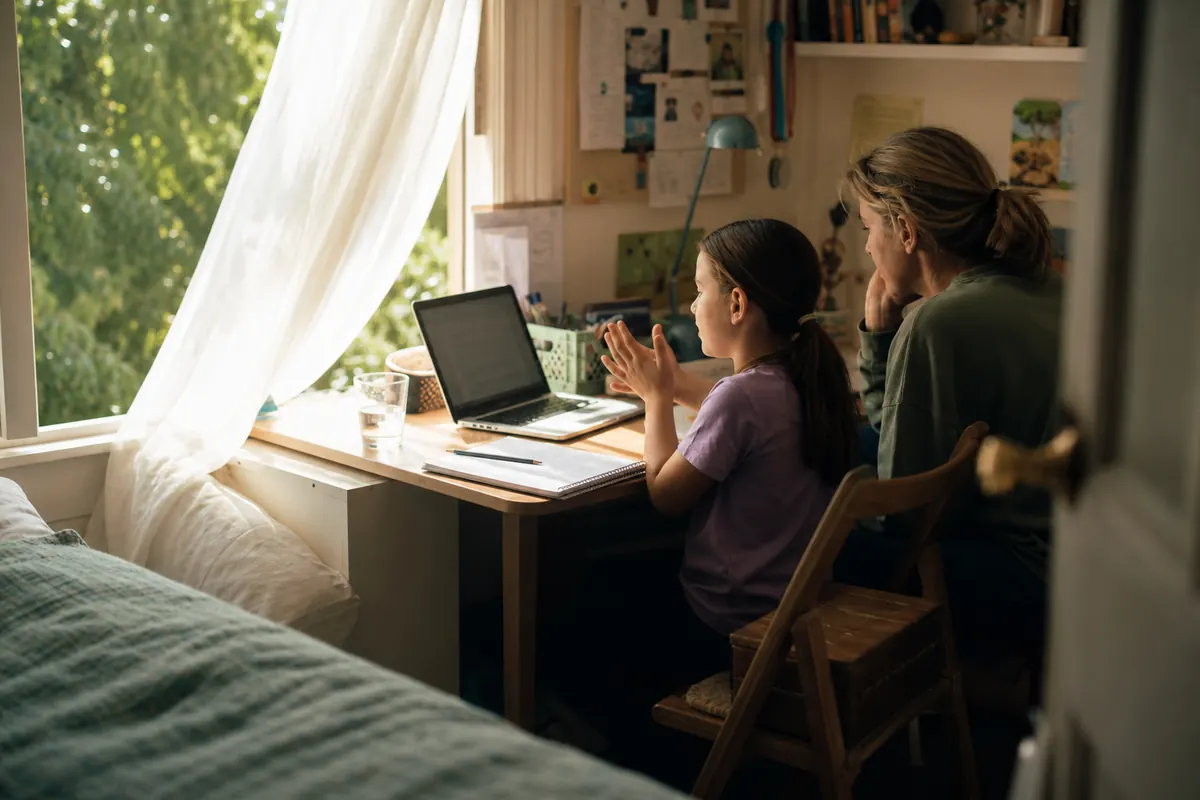
Suppose a parent is helping a fourth-grader watch a homework video. The child seems to follow along. The parent wonders whether to stop for quick questions or let the video play straight through.
The better routine is usually neither constant stopping nor completely passive watching. Pick a few moments when the child can recall, explain, or predict something important. Then restart the video and check.
Questions can turn watching into active thinking
A child can watch an explanation without doing much thinking. A short question asks the child to bring an idea to mind before more information arrives.
An article summarizing several video-lecture experiments found benefits from placing brief quizzes between sections. The quizzes reduced wandering attention and increased useful actions such as taking notes. Students also learned more and judged their understanding more accurately[1].
Several separate studies found better learning when questions appeared during educational videos rather than relying only on passive viewing[2][3][4]. These studies mainly involved university and community college students. They do not prove that the same routine works equally well for fourth-graders.
Still, there is some direct evidence involving young children. One study worked with 81 parents and their three-year-olds over four weeks. Some parents paused story videos, asked questions, and encouraged children to retell parts of the story[5].
Those children later did better on story understanding and story vocabulary than children whose parents only paused to comment or played the videos normally[5]. This is useful evidence for parent-led questioning. However, the children watched stories, not homework lessons.
The question should match what the child just watched
A pause alone does not ask the child to remember or explain anything. The useful part is what happens during the pause.
Two experiments compared activities placed between sections of a science and technology lecture. There were 249 people in the first experiment and 246 in the second[6]. Questions about the lecture improved learning of later material. Questions about unrelated personal memories or general knowledge did not[6].
That finding gives families a simple rule: ask about the lesson, not just anything that creates a break.
After a short section, a parent might ask:
- “What was the main idea?”
- “Why did the teacher do that?”
- “What do you think comes next?”
- “Can you explain that in your own words?”
- “Which part still feels confusing?”
These do not need to sound like test questions. They are quick checks that require the child to think about the video’s content.
A child should answer before the video reveals the answer. If the answer is wrong, avoid turning the pause into a long correction. Ask what the child noticed, replay the relevant part, and try again.
Pause before the answer, not after every sentence
For a worked example, pause just before the teacher shows the next step. Ask the child to predict what comes next and give a short reason. Then play the video and compare.
This exact prediction routine was not tested in the sources here. It is a practical way to apply the broader finding that questions should use the material being taught[6].
The child does not need to copy every step. A spoken answer may be enough. For a harder example, the child can write one possible next step before pressing play.
Do not pause after every sentence. Too many interruptions can make the lesson feel like an interview. Instead, choose moments where the child has enough information to make a meaningful attempt.
A useful starting point is one question after each short section or major example. Adjust from there. If the child is explaining clearly, fewer pauses may be enough. If the child keeps saying “I get it” but cannot answer, add a pause sooner.
Learn4Less sessions can use the same pause-predict-check routine with worked examples.
Feeling confident is not the same as understanding
Videos can feel easy because the teacher is doing the difficult thinking. The explanation moves smoothly, and every step looks sensible once it appears.
A study with high-school and college students found that repeated questions during recorded lectures raised actual performance toward students’ predictions of how well they had learned[7]. A single test after the lecture instead lowered unrealistic judgments about learning[7].
This matters at the kitchen table. “Did that make sense?” often invites a quick yes. “What should happen next?” gives the child something clear to do.
Questions during videos may also help attention. In a study of 298 university students watching a statistics lecture, questions presented throughout the lecture reduced wandering attention more than questions shown only before it[8]. Again, these were university students rather than children.
The question does not need to be difficult. Its job is to reveal whether the child can use the idea without immediately seeing the teacher’s answer.
Try this routine during tonight’s homework
Use one short video first. The aim is to improve the quality of watching, not make homework much longer.
- Preview the video. Find two or three natural stopping points, such as the end of an explanation or before a worked example’s next step.
- Play one section. Let the child watch without talking over the teacher.
- Pause and ask one focused question. Keep it tied to what the child just watched[6].
- Wait for an answer. Give the child time to think instead of answering immediately.
- Check with the video. Restart it, compare the explanation, and replay a short part if needed.
Keep the tone low-pressure. “Take a guess and we’ll check” is often more inviting than “Were you paying attention?” The purpose is to make thinking visible, not catch the child making mistakes.
If the video already stops for embedded questions, let the child answer them before continuing. One study involving students from different university courses found higher test scores after videos with questions placed throughout[2]. Students also strongly supported having those questions, although their general ratings did not detect a difference between video formats[2].
What these studies do not settle
Only one study here directly examined parent-led questions with young children. It involved three-year-olds watching story videos, not elementary students watching homework instruction[5].
The studies showing learning gains from embedded questions mainly involved older students[1][2][3][4][7]. Their findings may not carry over fully to children aged seven to twelve.
One study of adults aged 25 to 74 found no difference in correct answers between questions shown during videos and questions shown afterward. Questions during videos were answered more efficiently, and preferences differed with age[9]. This warns against treating question timing as a rule that fits everyone.
The sources here also do not identify the ideal number of pauses for a fourth-grader. They do not directly compare prediction questions with explanation or recall questions.
Make one pause do real work this week
For the next homework video, choose one important moment before the answer appears. Pause and ask, “What do you think comes next, and why?”
Let the child commit to an answer. Then restart the video and compare. If that pause reveals confusion, replay only the needed section.
One well-placed question is a manageable first step. It changes the child’s job from following an explanation to thinking ahead of it.
Summary
- Pause at useful moments. Ask a short question before the video gives the answer.
- Keep questions connected. Ask about the lesson rather than an unrelated topic.
- Try prediction first. Pause before the next step, predict it, and then check.
- Start with one pause. Add more only when they help the child think.
References
- Schacter, D. L., & Szpunar, K. K. (2015). Enhancing attention and memory during video-recorded lectures. Scholarship of Teaching and Learning in Psychology, 1(1), 60–71. https://doi.org/10.1037/stl0000011
- Rice, P., Beeson, P., & Blackmore-Wright, J. (2019). Evaluating the Impact of a Quiz Question within an Educational Video. TechTrends, 63(5), 522–532. https://doi.org/10.1007/s11528-019-00374-6 Free full text
- Kestin, G., & Miller, K. (2022). Harnessing active engagement in educational videos: Enhanced visuals and embedded questions. Physical Review Physics Education Research, 18(1). https://doi.org/10.1103/physrevphyseducres.18.010148 Free full text
- Chan, J. C. K., Ahn, D., Szpunar, K. K., Assadipour, Z., & Gill, H. (2025). In-lecture quizzes improve online learning for university and community college students. Communications Psychology, 3(1), 54. https://doi.org/10.1038/s44271-025-00234-5 Free full text
- Strouse, G. A., O'Doherty, K., & Troseth, G. L. (2013). Effective coviewing: Preschoolers’ learning from video after a dialogic questioning intervention. Developmental Psychology, 49(12), 2368–2382. https://doi.org/10.1037/a0032463
- Assadipour, Z., Ahn, D., & Chan, J. C. K. (2025). Interpolated Retrieval of Relevant Material, Not Irrelevant Material, Enhances New Learning of a Video Lecture In-Person and Online. Behavioral Sciences, 15(5), 668. https://doi.org/10.3390/bs15050668 Free full text
- Szpunar, K. K., Jing, H. G., & Schacter, D. L. (2014). Overcoming overconfidence in learning from video-recorded lectures: Implications of interpolated testing for online education. Journal of Applied Research in Memory and Cognition, 3(3), 161–164. https://doi.org/10.1016/j.jarmac.2014.02.001
- Zhou, S. S., Taylor, A. G., Tuer, A., Breithaupt, S., Pan, S., & Wammes, J. D. (2026). Concurrent testing improves attention generally and selectively during video lectures. Journal of Educational Psychology, 118(3), 325–344. https://doi.org/10.1037/edu0000998 Free full text
- Zolkwer, M. B., Hidalgo, R., & Singer, B. F. (2023). Making educational videos more engaging and enjoyable for all ages: an exploratory study on the influence of embedded questions. International Journal of Lifelong Education, 42(3), 283–297. https://doi.org/10.1080/02601370.2023.2196449 Free full text