
Should Kids Stop Counting on Their Fingers for Math?
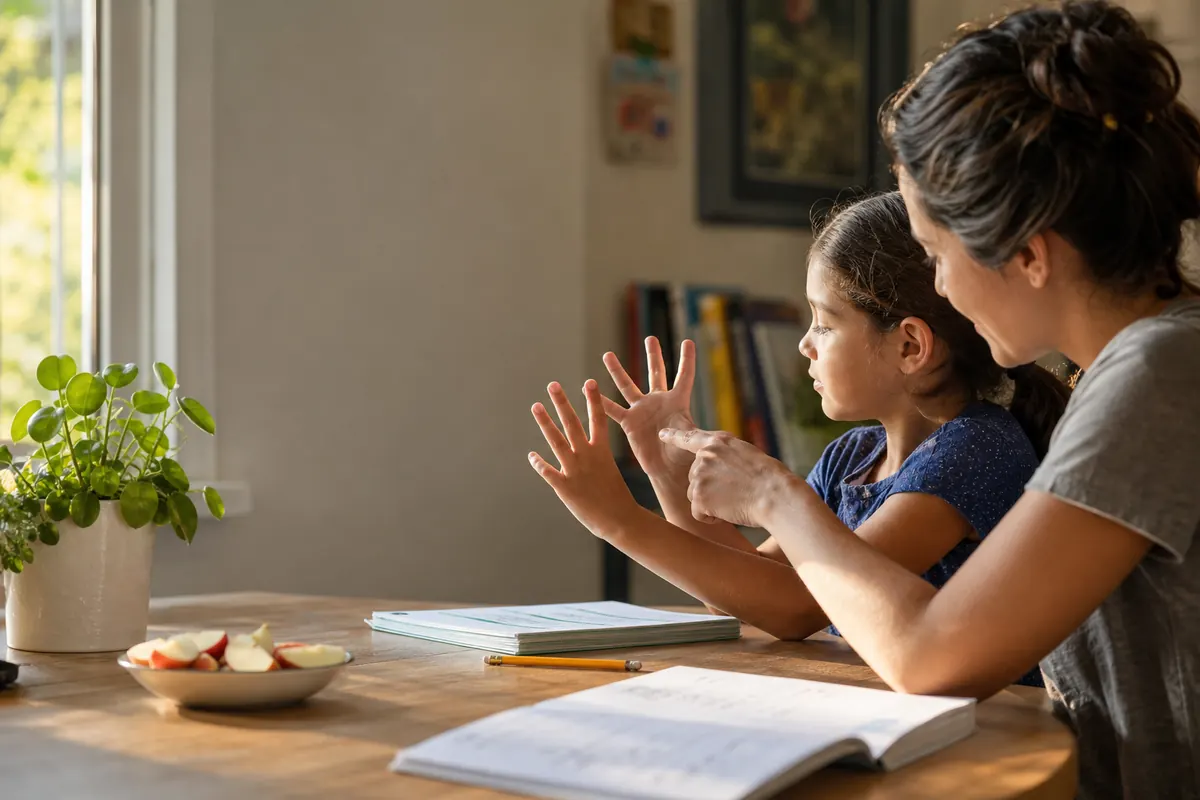
No. A second-grader does not need to hide their fingers while addition facts are still developing. Keep fingers available, then help the child move from counting every item toward counting on, making ten, and recalling facts when ready.
Suppose a second-grader faces 8 + 7 at the kitchen table. They begin raising and lowering fingers. Their parent wonders, “If I allow this, will they ever learn that 8 + 7 = 15?”
The useful question is not simply whether the child uses fingers. Ask how they use them and whether their strategy is becoming more efficient.
Finger counting is not a mathematical dead end
A study followed 165 children from age 4½ for three years. Children who used fingers early did not perform worse at age 7½ than children never seen using them. Children who began using fingers earlier also moved earlier to accurate mental methods[1].
A smaller study followed 24 finger-counting kindergarteners until Grade 2. The children who used their fingers most efficiently in kindergarten were more likely to use mental methods later[2].
These findings do not mean that every kind of finger counting is equally helpful. They do answer the main worry. Early finger use did not block the move toward mental addition in these children[1].
There is also evidence from teaching studies. In one study, first-graders received 18 finger-based lessons lasting about 30 minutes each. At the end of first grade, the 119 trained children did better in written addition and subtraction than 123 children receiving their usual lessons. The difference was still present nine months later[3].
Another study involved 190 children aged 4 to 5. Finger-counting training improved addition more than number-line counting or usual teaching[4]. This result came from preschoolers, so it does not tell us exactly what will happen with every second-grader.
Fingers can connect written numbers to real amounts
The written digit 7 is a symbol. Seven raised fingers make the amount visible. That connection matters because children who were better at getting an amount from a written digit also recalled more arithmetic facts. They completed both remembered and step-by-step solutions faster[5].
Reviews describe fingers as an early way to experience one-to-one counting and whole-part relationships[6]. One-to-one counting means matching one number word to one object. A child touches or raises one finger while saying each number.
A review of developmental studies found that finger awareness and fine hand control went together with counting, number knowledge, judging amounts, and calculation[7]. However, those links do not prove that finger skill alone caused stronger mathematics[7].
Fingers can therefore be a bridge between a symbol and an amount. They should not become a rule that every problem must be solved in exactly the same way.
The next step is better counting, not forced guessing
Consider 8 + 7. A child may first count everything from one. That is called counting all.
A more efficient method is counting on. The child keeps 8 in mind. They raise seven fingers one at a time while saying:
“9, 10, 11, 12, 13, 14, 15.”
The fingers now track only the added amount. The child does not rebuild the 8 from the beginning.
In one study of six-year-olds, finger counting went with more accurate addition. Children with stronger memory skills were more likely to count on from the larger number. Children with weaker memory skills more often counted everything[8]. Because the two things were measured together, this study cannot prove that finger counting produced the greater accuracy.
The next move is decomposition, which means breaking a number into useful parts. For 8 + 7, ask, “How many does 8 need to make 10?”
The answer is 2. Break 7 into 2 and 5:
8 + 7 = 8 + 2 + 5
8 + 2 = 10
10 + 5 = 15
Fingers can still support this. Show seven fingers. Identify two fingers that join the 8 to make 10. Five remain. The child is now using the arrangement of the fingers, not merely counting each one.
Research with young children shows that the way fingers are used matters. In 126 observations of four- and five-year-olds solving subtraction, some finger methods only tracked counted items. Other methods represented the number in a structured way, and the methods had different success rates[9]. That study examined subtraction and younger children, but it warns against treating all finger use as identical.
Eventually, the child may see 8 + 7 and answer 15 from memory. This is fact retrieval: getting a known fact without counting through every step. Counting on, making 10, and retrieval were among the strategies examined in a study of addition and subtraction across 10[10].
Use a short strategy ladder tonight
Do not begin by saying, “No fingers.” Begin by finding the child’s current strategy. Then offer one small step upward.
-
Watch one problem without interrupting. Ask the child to solve 8 + 7 in any way that makes sense.
-
Ask the child to explain. Try, “What number did you start with?” If they started at 1, model holding 8 in mind and counting on seven more.
-
Make 10 visible. Show seven fingers. Ask, “Can we use two to turn 8 into 10?” Then notice the five left over. This connects fingers with breaking apart numbers, rather than hiding the fingers too soon[11].
-
Try one nearby fact. After 8 + 7, try 9 + 6. Count on if needed. Then break 6 into 1 and 5, making 10 + 5.
-
Invite memory without demanding it. Ask, “Did you know that one, or did you work it out?” Both answers are useful. If the child remembers 8 + 7 later, celebrate the efficient choice rather than speed alone.
A review describes a sensible progression: begin with fingers, move to structured physical representations, and then develop mental representations[11]. The review also reports an ongoing disagreement about when finger use helps or hinders development[11].
Learn4Less sessions can model this shift from counting all to counting on, making 10, and recalling a fact.
What these studies do not settle
The studies here do not establish one age when every child should stop using fingers. The three-year study ended when children were about 7½, and its participants were French-speaking Swiss children who were predominantly white[1]. Its findings may not carry over perfectly to every community.
The first-grade training involved 18 lessons across a school year[3]. It cannot tell us whether one brief finger activity at home would produce the same result. That study found better written addition and subtraction, but not better number-line estimation[3].
The study that followed children from kindergarten to Grade 2 included only 24 children[2]. The larger reviews also say that more work is needed to explain exactly why finger skill and number skill go together[7].
Finger use can also hide weak counting knowledge. Among 189 four- and five-year-olds, some used fingers without fully understanding basic counting rules and performed poorly on addition[12]. If a child regularly loses track, counts the same finger twice, or becomes distressed, return to matching one spoken number with one object. A teacher can help identify what needs practice.
Change the method before removing the tool
For this week, keep fingers available. Choose one addition each evening that crosses 10, such as 8 + 5 or 9 + 4.
First, let the child solve it. Next, ask them to count on from the larger number. Finally, show how to break the smaller number apart to make 10.
With 9 + 4, the child can count “10, 11, 12, 13.” Then they can split 4 into 1 and 3:
9 + 1 = 10
10 + 3 = 13
The goal is not to make fingers disappear on command. The goal is to help the child choose a clearer and more efficient strategy.
Summary
- Keep fingers available. Early finger use need not block later mental addition.
- Change the method first. Move from counting all to counting on.
- Make ten visible. Break the smaller number into useful parts.
- Invite recall gently. Let remembered facts replace counting when ready.
References
- Krenger, M., & Thevenot, C. (2025). Finger Counting Is Not a Dead End: Early Finger Use as a Marker of Arithmetic Development. Journal of Cognition and Development, 1–9. https://doi.org/10.1080/15248372.2025.2606280 Free full text
- Poletti, C., Krenger, M., Dupont-Boime, J., & Thevenot, C. (2022). The Evolution of Finger Counting between Kindergarten and Grade 2. Children, 9(2), 132. https://doi.org/10.3390/children9020132 Free full text
- Frey, M., Gashaj, V., Nuerk, H. C., & Moeller, K. (2024). You can count on your fingers: Finger-based intervention improves first-graders’ arithmetic learning. Journal of Experimental Child Psychology, 244, 105934. https://doi.org/10.1016/j.jecp.2024.105934
- Krenger, M., Poletti, C., Létang, M., & Thevenot, C. (2027). Counting with or without fingers: The specific role of fingers in improving addition skills in preschoolers. Journal of Experimental Child Psychology, 273, 106651. https://doi.org/10.1016/j.jecp.2026.106651 Free full text
- Vanbinst, K., Ghesquière, P., & De Smedt, B. (2012). Numerical Magnitude Representations and Individual Differences in Children's Arithmetic Strategy Use. Mind, Brain, and Education, 6(3), 129–136. https://doi.org/10.1111/j.1751-228x.2012.01148.x Free full text
- Soylu, F., Lester, F. K., & Newman, S. D. (2018). You can count on your fingers: The role of fingers in early mathematical development. Journal of Numerical Cognition, 4(1), 107–135. https://doi.org/10.5964/jnc.v4i1.85 Free full text
- Barrocas, R., Roesch, S., Gawrilow, C., & Moeller, K. (2020). Putting a Finger on Numerical Development – Reviewing the Contributions of Kindergarten Finger Gnosis and Fine Motor Skills to Numerical Abilities. Frontiers in Psychology, 11, 1012. https://doi.org/10.3389/fpsyg.2020.01012 Free full text
- Dupont-Boime, J., & Thevenot, C. (2017). High working memory capacity favours the use of finger counting in six-year-old children. Journal of Cognitive Psychology, 30(1), 35–42. https://doi.org/10.1080/20445911.2017.1396990
- Björklund, C., Kullberg, A., & Kempe, U. R. (2018). Structuring versus counting: critical ways of using fingers in subtraction. ZDM, 51(1), 13–24. https://doi.org/10.1007/s11858-018-0962-0 Free full text
- Torbeyns, J., Verschaffel, L., & Ghesquiere, P. (2004). Strategy Development in Childrenwith Mathematical Disabilities. Journal of Learning Disabilities, 37(2), 119–131. https://doi.org/10.1177/00222194040370020301 Free full text
- Moeller, K., Martignon, L., Wessolowski, S., Engel, J., & Nuerk, H. C. (2011). Effects of Finger Counting on Numerical Development ? The Opposing Views of Neurocognition and Mathematics Education. Frontiers in Psychology, 2, 328. https://doi.org/10.3389/fpsyg.2011.00328 Free full text
- Krenger, M., & Thevenot, C. (2025). Do children need counting principle knowledge to count on their fingers?. Journal of Experimental Child Psychology, 249, 106073. https://doi.org/10.1016/j.jecp.2024.106073