
Why Your Practice Exams Feel Nothing Like the Real Thing
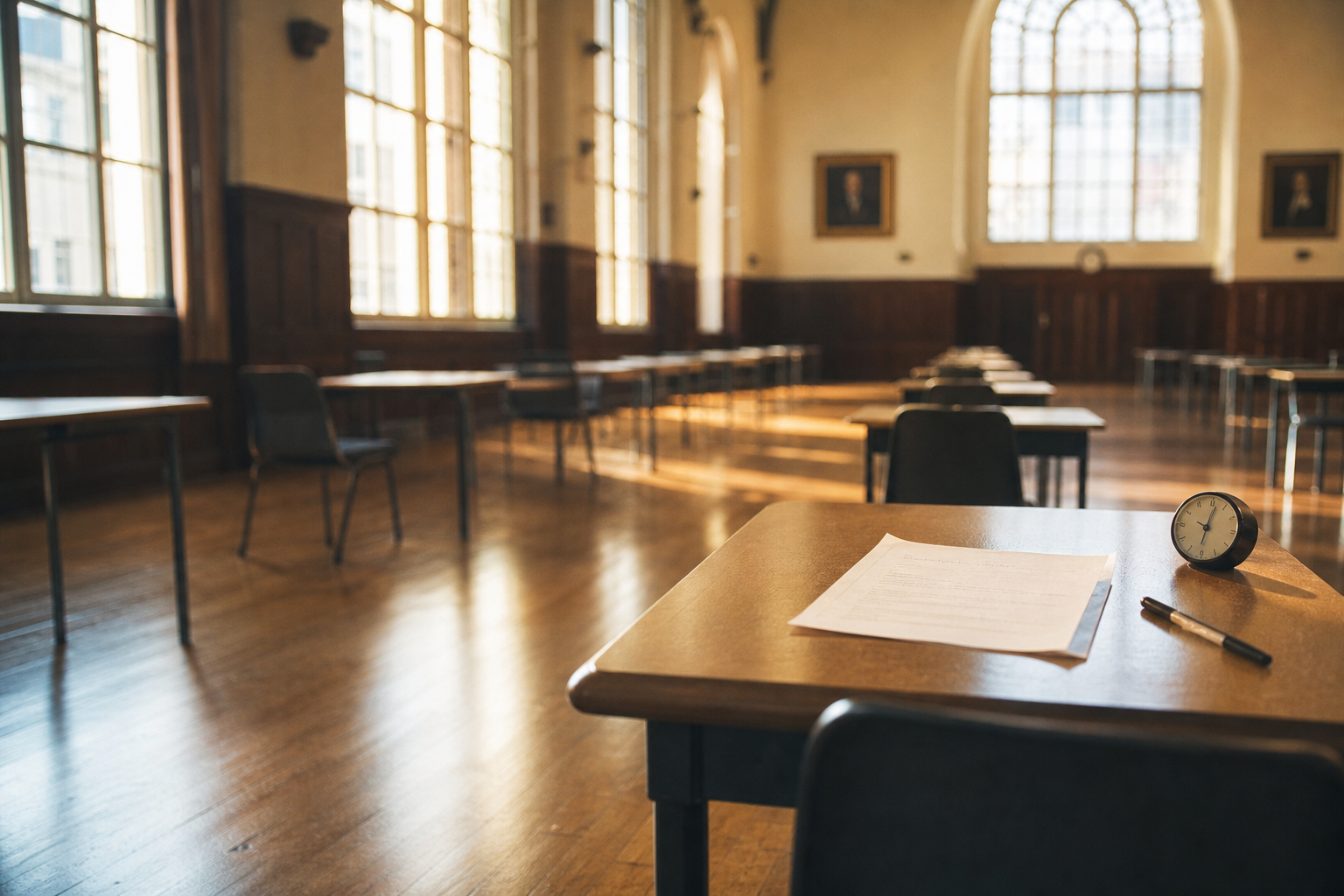
Mostly because practice feels smooth and the exam does not. A session that goes well tells you little about what you will still know in three weeks, or what you can produce under time pressure. The fix is not a more theatrical mock exam; it is changing how you practise.
Suppose it is Sunday night. You work a past paper at the kitchen table, check every answer, get most right, and sleep well. Thursday morning you read the third question, and a method you did cleanly four days ago will not come back.
Your Practice Felt Fine. That Is Exactly the Problem.
A review of decades of research, drawn from motor-skill and verbal-learning studies rather than from exam candidates, made the distinction that explains most of this. How well you perform during a study session is often an unreliable guide to whether anything lasting has been built, and people regularly read a smooth session as proof they have learned for good[1].
Your Sunday-night confidence was honestly held. You really did solve those questions — with the worked solution one page away, the topic named at the top of the sheet, and the method fresh from that afternoon. That is a different act from Thursday's. The fluency came from the conditions, not from the storage[1].
So the exam does not feel different mainly because the room is different. It feels different, on that account, because you spent the week measuring the wrong thing[1].
Stress Jams the Route Back to What You Know
A review of twenty years of work on stress and memory reached a narrow conclusion: stress mainly damages your ability to pull back out what you already know, and underperforming in exams is named as one of the risks[2]. That is a smaller claim than "pressure rewires your brain". The method has not left your head; the path to it is jammed.
One laboratory experiment suggests what makes a memory survive that. Participants who had learned material by testing themselves remembered it just as well when put under stress a day later; those who had learned the same material by rereading remembered less[3]. That was laboratory material and laboratory stress, not a real exam paper[3]. Rereading produces the smooth feeling; in that experiment, it was closing the notes and producing the answer from nothing that left the memory standing under stress[3].
Mix the Problem Types So You Have to Choose the Method
The strongest result here comes from ordinary math classrooms. Across 54 seventh-grade classes, sorted at random into two groups, students whose assignments mixed different kinds of problems together scored 61% on an unannounced test a month later; classmates who practiced one kind of problem at a time scored 38%[4].
Here is why the ordering matters, in mathematics rather than psychology. Consider
They differ only in the exponent on . The first yields to the substitution , because supplies the stray , giving . The second has no inner function to absorb that , so substitution goes nowhere and you need integration by parts, giving . Differentiate both to check: and .
Put both under a heading that says "Substitution" and you never take the hardest step, which is deciding. On the real paper, nothing is labeled. Arranging practice so no two problems in a row need the same method takes no special materials, and the teachers in that trial needed no training[4]. Take the odd-numbered questions from four sections and interleave them in rotation, one from each section and round again, so consecutive questions come from different sections. At Learn4Less, that disagreement between neighbouring questions is how we build review sheets.
Match the Questions, Not the Furniture
There is a real version of "make practice like the real thing", and it is narrower than what the idea usually becomes. A review pooling 222 classroom studies of more than 48,000 students in real classes found that quizzing raises their results, and that how much it helps depends partly on whether the practice questions match the real test's format and material[5]. Format and content. Not the chair.
The room is not nothing. People remembered less when tested in a different room from the one they had learned in, though that review does not say how large the drop is[6]. Two side findings matter more: the gap shrinks when people bring the old setting back to mind at test time, and when attention is on the material rather than the surroundings[6]. These were people remembering lists in a lab, not anyone sitting a math exam[6].
That buys you a free thirty seconds: before you read question one, picture the desk where you did the work. It also cancels the advice pointing the other way — studying somewhere unfamiliar to "break the association with comfort" is not supported here, and nothing speaks to chair height or room temperature[6].
One kind of matching costs nothing, and I will not pretend it is on the record: if the paper is at 8:30 in the morning, work one full set at 8:30. You are finding out what your handwriting and arithmetic do before you are properly awake.
A Few Minutes of Writing Before the Paper
Across four experiments, two of them run in real classrooms, students who spent a few minutes writing down their worries right before an important test scored better than students who did not, and those usually most anxious about tests were helped most[7].
Set beside the retrieval point, that reads as a mechanism rather than a ritual. If stress interferes with getting information back out[2], worry is occupying room you need for the mathematics, and moving it onto paper clears some of that room[7]. It costs a few minutes and needs no equipment.
What This Research Does Not Settle
None of these studies tested what this post's title describes. Nothing here says whether staging a practice exam more realistically changes what you score on the real one: not strict timing, not a family member proctoring, not writing in pen, not pacing, not switching between topics mid-paper. The one piece of "make it match" genuinely on the record concerns question format and subject matter[5].
The rest carries its own limits. The stress-proofing result is one experiment with laboratory material and laboratory stress[3]. The room effect comes from lab studies of people remembering lists[6]. The mixed-practice trial is the strongest item here, and it is still seventh-grade classes rather than first-year calculus students, and it tested homework arrangement rather than mock-exam staging[4]. The review that opens this post surveys many kinds of learning, not exam candidates[1].
So treat the ordering of your practice as well supported in seventh-grade classrooms[4], and retrieving rather than rereading as well supported across real classes[5], with its stress-proofing shown so far in one laboratory experiment[3]. Treat the staging as an untested guess, mine included.
One Change to Make This Weekend
Take the four topics you are weakest in and pull five questions from each. Deal them out in rotation rather than shuffling: one from the first topic, one from the second, and round again. Shuffling will not do this job. Twenty questions have nineteen places where one meets the next, and a random order leaves four of them, on average, holding two from the same topic; rotation leaves none. Then read the list once and swap any neighbours that still want the same method, since one topic can hold several. Close every solution and work the set without looking anything up.
Then mark it, and treat the number as the least of it. Sort the losses into three piles: ones you ran out of time for, ones you skipped and could have done, and ones you misread. Those need three different fixes, and the score alone hides which one you are looking at. The total will likely come out below your usual practice score, and that gap is what a smooth Sunday was hiding from you[1].
Summary
- Practice usually feels smooth. That feeling is not evidence the knowledge will hold.
- Stress hits retrieval hardest. The method is still there; the route is jammed.
- Mix the problem types. Seventh-grade classes doing that scored 61% versus 38% a month later.
- Match the questions, not the furniture. Format and content are what the classroom evidence backs.
References
- Soderstrom, N. C., & Bjork, R. A. (2015). Learning Versus Performance. Perspectives on Psychological Science, 10(2), 176–199. https://doi.org/10.1177/1745691615569000
- Vogel, S., & Schwabe, L. (2016). Learning and memory under stress: implications for the classroom. npj Science of Learning, 1(1), 16011. https://doi.org/10.1038/npjscilearn.2016.11 Free full text
- Smith, A. M., Floerke, V. A., & Thomas, A. K. (2016). Retrieval practice protects memory against acute stress. Science, 354(6315), 1046–1048. https://doi.org/10.1126/science.aah5067
- Rohrer, D., Dedrick, R. F., Hartwig, M. K., & Cheung, C. N. (2020). A randomized controlled trial of interleaved mathematics practice. Journal of Educational Psychology, 112(1), 40–52. https://doi.org/10.1037/edu0000367
- Yang, C., Luo, L., Vadillo, M. A., Yu, R., & Shanks, D. R. (2021). Testing (quizzing) boosts classroom learning: A systematic and meta-analytic review. Psychological Bulletin, 147(4), 399–435. https://doi.org/10.1037/bul0000309
- Smith, S. M., & Vela, E. (2001). Environmental context-dependent memory: A review and meta-analysis. Psychonomic Bulletin & Review, 8(2), 203–220. https://doi.org/10.3758/bf03196157 Free full text
- Ramirez, G., & Beilock, S. L. (2011). Writing About Testing Worries Boosts Exam Performance in the Classroom. Science, 331(6014), 211–213. https://doi.org/10.1126/science.1199427