
Chain Rule Errors Begin Before You Differentiate Anything

Most chain rule mistakes are not mistakes in the rule. The expression gets read as a familiar shape, the composition inside is never noticed, and the inner derivative never gets written. The repair is practice at deciding which rule a derivative needs, on problems whose type you do not know in advance.
Suppose twelve derivatives from the chain rule section are done on Sunday night, all correct. On Wednesday a quiz asks for the derivative of , with no heading above it, and out comes . Nothing was forgotten. The rule was never consulted.
The rule is two lines; noticing you need it is the job
If , with differentiable at and differentiable at , then
Two layers, two derivatives, one multiplication. For , the outer layer has derivative , and the inner layer has derivative . So
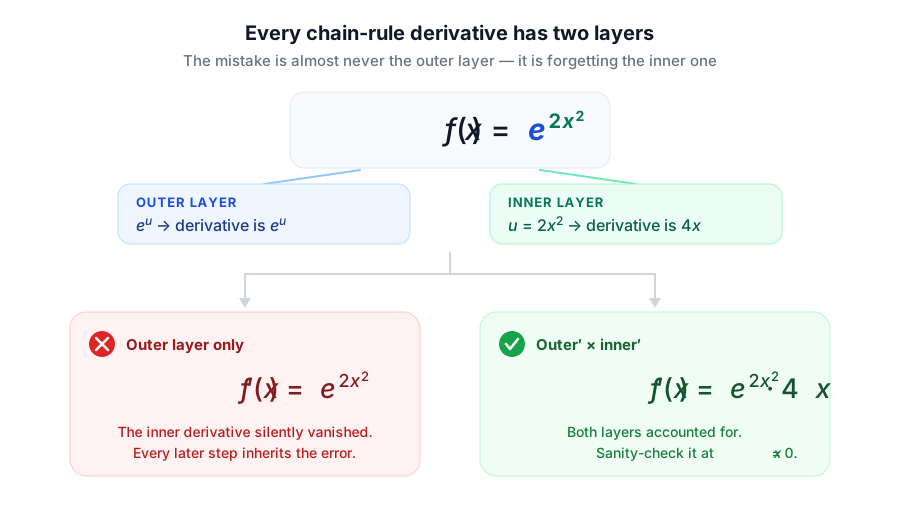
The hard part came first: seeing that is a composition, with a single object fed into the exponential. Holding a whole expression as one input is what a working idea of "function" buys you. A 1992 report asserted that college students often lack that understanding; a computer-based course built on it left many of them understanding functions better, though it was never compared against ordinary teaching[1].
The shape of the expression answers first
Put next to . They look almost the same, and the eye reaches for . But , and dropping the is wrong everywhere except where .
There is research on why the eye wins. In experiments with algebra students, those students responded to what an expression looked like rather than to what the rule said; the researchers suggest many stubborn algebra errors may come from the rule never being consulted, not from an inability to handle it. The experiments used algebra notation, not calculus, so treat it as a finding about reading notation in general[2].
So the missing piece is not more rule, but a step where the rule gets consulted[2].
Topic-sorted homework never asks the exam's real question
Open the chain rule exercises and every problem needs the chain rule. You are never in doubt, because the heading said so. The exam prints no heading.
Researchers counted 13,505 practice problems across six school mathematics textbooks. Only about one in ten sat mixed among different kinds; the rest came in blocks of a single skill. That count covered school texts, not first-year calculus books, though the layout will look familiar[3].
Mixing has been tested. In one experiment, 54 seventh-grade mathematics classes spent four months either mixing kinds of problems into their assignments or practicing one skill at a time. A month later, on an unannounced test, the mixed classes scored 61% and the one-skill classes 38%. Those were seventh-graders in school mathematics, and the researchers say caveats remain[4].
That is my reading applied to your situation, not something measured on it: choosing which rule a derivative needs is a separate skill from carrying it out[3][4]. A block of chain rule exercises never forces that choice, which is why mixed practice feels worse than it works.
Two checks that catch a missing inner derivative
Take the quiz problem. For , the product rule with , gives , and needs the chain rule: outer , inner , so . Therefore
Drop the inner derivative and the error does not stay put: a wrong feeds the critical points, the sign chart and the sketch, so one missing factor takes the rest of the question with it.
The first check is to substitute a number. At the correct expression gives , while the version missing the inner derivative gives . Now estimate the slope straight from the function:
The correct expression matches to four decimal places; the other is off by over half a unit, far beyond approximation error.
The second check is to expand, when the function allows it. The chain rule sends to . Expanding first gives , whose derivative is that same . That route has no inner derivative to forget, though most compositions cannot be expanded.
Neither check is a proof, and one test point can agree by accident: the wrong equals the correct at , where the missing factor is . Try a second value too.
Label the layers, then explain the wrong answer
Before differentiating anything, write the two layers of down: outer , inner . That sounds like a warm-up, not the work. But in one study with middle- and high-school students, computer practice asked them only to see how an equation keeps its structure as it is rearranged; they solved none, and afterwards solved equations much faster. That was school algebra by software, not calculus, but it suggests recognition is worth training alone[5].
So take twenty expressions and label outer and inner layer on each, differentiating none: , , , , , . Three have no inner layer, and "no composition here" is an answer you need to give.
Second habit: when you meet a wrong answer, say why it is wrong in your own words before reading the correction. A review pooling many studies of mathematics learning found that students prompted to explain steps in their own words did somewhat better on tests straight afterwards, with much less evidence that this survives a real classroom or a delay. Those authors also advise explaining why a common wrong method is wrong — advice, not a finding[6].
One framing to drop: memorize the rule versus understand it. A review of research on mathematics learning found the two support each other in both directions[7]. Drilling is not the opponent of understanding.
What this research does not settle
Nothing cited above studied calculus or the chain rule. The strongest experiment ran in seventh-grade classes, the textbook count covered school texts, the reading-the-page experiments used algebra students, and the structure-recognition training was middle- and high-school algebra by software[2][3][4][5]. Only one source looked at university students, and it is the weakest: a 1992 report with no comparison group and no numbers[1].
So everything above is an argument by analogy. Younger students, in algebra and school mathematics, did better when practice forced them to choose a method and notice a structure[4][5]. I think that carries over to a first-year derivative, because the failure has the same shape — but nobody has measured it there.
Two gaps sit inside the advice itself. The self-explanation gains were modest, and the evidence that they last or survive a classroom is thin[6]. Whether to teach the idea before the method is genuinely unsettled, the reviewers say[7].
Build the mixed set your textbook skipped
The exam will not label its questions, so strip the labels off yours. Take twenty derivatives from across the term, shuffle them, leave them a day, and name the rule before you write any derivative. If you work with someone, ask not for another chain rule explanation but for that list, answers held back — ten minutes for a classmate or a tutor at Learn4Less. The chain rule takes a minute to learn and a term to notice.
Summary
- The rule is not the problem. It may never get consulted, because the shape looks familiar.
- Topic-sorted homework hides the real question. Which rule does this one need?
- Label both layers first. Recognition, not the rule, may be what needs training.
- Nothing here was measured on calculus. Treat it as reasoning by analogy.
References
- Breidenbach, D., Dubinsky, E., Hawks, J., & Nichols, D. (1992). Development of the process conception of function. Educational Studies in Mathematics, 23(3), 247–285. https://doi.org/10.1007/bf02309532
- Kirshner, D., & Awtry, T. (2004). Visual Salience of Algebraic Transformations. Journal for Research in Mathematics Education, 35(4), 224. https://doi.org/10.2307/30034809
- Rohrer, D., Dedrick, R. F., & Hartwig, M. K. (2020). The Scarcity of Interleaved Practice in Mathematics Textbooks. Educational Psychology Review, 32(3), 873–883. https://doi.org/10.1007/s10648-020-09516-2
- Rohrer, D., Dedrick, R. F., Hartwig, M. K., & Cheung, C. N. (2020). A randomized controlled trial of interleaved mathematics practice. Journal of Educational Psychology, 112(1), 40–52. https://doi.org/10.1037/edu0000367
- Kellman, P. J., Massey, C. M., & Son, J. Y. (2010). Perceptual Learning Modules in Mathematics: Enhancing Students’ Pattern Recognition, Structure Extraction, and Fluency. Topics in Cognitive Science, 2(2), 285–305. https://doi.org/10.1111/j.1756-8765.2009.01053.x Free full text
- Rittle-Johnson, B., Loehr, A. M., & Durkin, K. (2017). Promoting self-explanation to improve mathematics learning: A meta-analysis and instructional design principles. ZDM, 49(4), 599–611. https://doi.org/10.1007/s11858-017-0834-z
- Rittle-Johnson, B., Schneider, M., & Star, J. R. (2015). Not a One-Way Street: Bidirectional Relations Between Procedural and Conceptual Knowledge of Mathematics. Educational Psychology Review, 27(4), 587–597. https://doi.org/10.1007/s10648-015-9302-x