Slow Breathing Before a University Exam: Does It Calm Anxiety?
Slow breathing may lower anxiety and physical arousal before an exam, although the exact ten-minute pre-exam situation has not been tested here. Treat it as a brief settling tool, not a guarantee that nervousness will disappear or performance will improve.
Suppose your final begins in ten minutes. Your heart is racing, and your breathing feels shallow. You wonder whether paced breathing will genuinely calm you or merely keep your mind busy.
Paced breathing means deliberately following a slow, steady breathing rhythm. You might use a timer, an animation, or a quiet count. The goal is not to take the deepest possible breaths. It is to breathe more slowly without straining.
Slow breathing can produce a real calming response
The broadest evidence comes from reviews that combine results across several experiments.
One review combined 12 trials involving 785 adults. People using breathwork reported less stress than people in the comparison groups, with a modest average benefit[1]. The same review combined 20 trials that measured anxiety and found a similar modest reduction[1].
These results make a calming effect believable. They do not guarantee that every student will feel calmer. They also cover several breathing methods and situations, not only slow breathing before exams.
Another review examined 15 studies of slow breathing in healthy people. It found changes in both reported feelings and the body’s control systems[2]. The breathing methods used fewer than 10 breaths per minute[2].
Several studies measured heart rate variability. This means the natural variation in time between one heartbeat and the next. Slow breathing increased this variation in the studies covered by that review[2]. A small experiment also found signs that deep abdominal breathing activated the body’s rest-and-recover system after a stressful task[3].
That matters for the distraction question. Breathing may occupy your attention, but researchers have also measured bodily changes during or after it[2][3]. The current studies cannot tell us how much relief comes from attention, body changes, expectations, or a mixture of all three.
Five minutes may be enough to feel more settled
One experiment studied 42 university students using three personalized slow-breathing rhythms. Each session lasted five minutes[4]. Slower rhythms increased reported relaxation and reduced signs of physical arousal during practice[4].
This study is especially relevant because the participants were university students. However, they were not waiting to enter an exam. The study measured relaxation during breathing rather than exam performance[4].
Another experiment tested slow breathing at six breaths per minute, both with and without a live display of heart activity. After breathing, 112 participants reported lower emotional arousal and greater emotional control[5]. The live display did not clearly improve most outcomes beyond slow breathing alone[5].
You therefore do not need special equipment to try the basic method. A simple timer or quiet count is enough as a practical choice. An app may help you keep a rhythm, but the available experiment did not establish that live body feedback was necessary[5].
A separate experiment with 60 healthy employees used one slow-breathing session after a stressful task. The version delivered through virtual reality helped participants feel less stressed during a later stressful task than the standard version[6]. It also reduced mind wandering and helped preserve attention[6]. This result supports the value of the setting, but it does not show that virtual reality is needed.
Do not make your first attempt outside the exam room
A calming skill is easier to use when the routine already feels familiar. This is a practical reason to test paced breathing before exam day.
There is also some direct support for practice. In the university student experiment, previous experience with relaxation methods went with stronger reported benefits from slow breathing[4]. However, that part of the finding does not prove that prior practice caused the stronger response.
A longer experiment assigned 40 adults by chance to breathing training or a comparison group. The breathing group completed 20 sessions over eight weeks[7]. After training, that group showed less negative emotion, better sustained attention, and changes in cortisol, a hormone involved in the stress response[7].
This does not mean you need eight weeks of training. It shows that repeated practice can produce benefits beyond one emergency attempt. A recent review of 25 controlled studies also found the clearest benefits when slow or paced breathing was used regularly, often within psychotherapy[8]. Because psychotherapy added other support, that review cannot tell us how much regular breathing alone contributed.
One workable plan is to practise for five minutes on several ordinary days. Sit somewhere quiet and let each inhale and exhale remain comfortable. Notice whether the pace feels calming, irritating, or forced. Adjust before you depend on it in a stressful setting.
A practical five-minute routine before the exam
Try this routine before a study session first. If it feels comfortable, use the same routine before the exam.
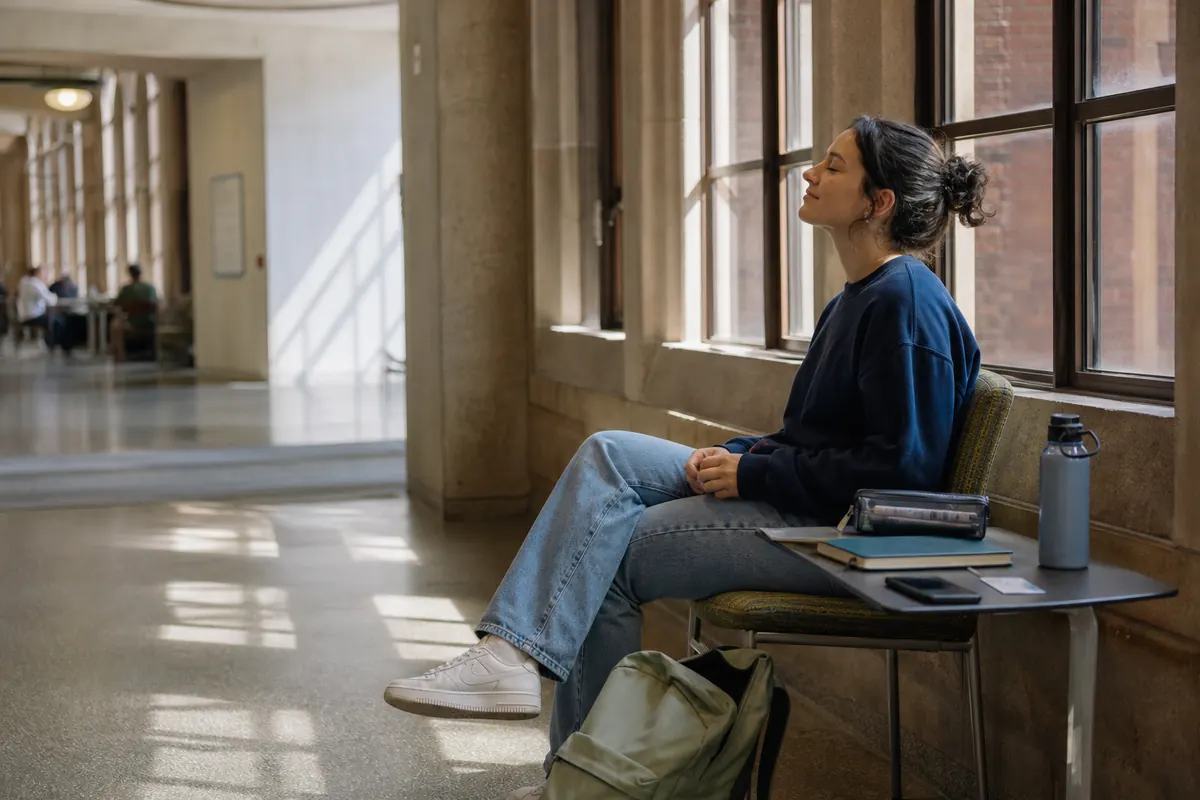
- Move away from the crowd. Find a chair or quiet section of the hallway. Put your phone on silent after setting a five-minute timer.
- Choose a slow, steady rhythm. Six breaths per minute has been tested without requiring live body feedback[5]. One breath includes both the inhale and the exhale.
- Keep the breaths comfortable. Do not compete with the timer or force unusually large breaths. A smooth rhythm is the practical goal.
- Let your attention return gently. When your thoughts jump to the exam, return to the next breath. You do not need to clear your mind completely.
- Stop when the timer ends. Notice whether your body feels more settled. Then gather your materials and enter the room.
Do not judge the routine by whether all anxiety disappears. A better immediate question is whether you feel settled enough to read instructions and begin deliberately. The studies here measured anxiety, stress, relaxation, attention, and bodily arousal. They did not establish that slow breathing improves university exam marks.
The studies do not recreate the final-exam moment
None of the studies here tested paced breathing during the ten minutes before a university final. One experiment included university students, but it measured relaxation during five-minute breathing sessions rather than exam results[4].
A review included 12 stress trials involving 785 adults[1]. Most of its 12 stress trials had some design weaknesses, so its modest benefit should not be treated as a precise promise[1].
The estimated size of the benefit also varies. One review found modest average reductions in stress and anxiety[1]. Another reported larger reductions, but it combined breathing alone with breathing used alongside psychotherapy[8]. Those settings are not equal.
The immediate studies mainly measured how people felt and how their bodies responded. They do not settle whether a calmer feeling leads to better recall, fewer mistakes, or higher exam marks[6][5][3][4].
Individual responses can differ as well. In one university student experiment, students with more anxious or depressive symptoms reported greater stress after slow breathing[4]. That single finding is not enough to predict your response. It is a good reason to test the routine on an ordinary day rather than relying on it for the first time before a final.
Make the routine familiar this week
Pick one five-minute period after studying today. Put your phone on silent, sit comfortably, and practise a slow rhythm. Repeat it before another study session later in the week.
On exam day, use the same place, timer, and rhythm if possible. Stop trying to eliminate every nervous feeling. Use the five minutes to lower the intensity enough to enter, listen, and begin with care.
Summary
- Use breathing as a settling tool. Do not expect every nervous feeling to disappear.
- Practise before exam day. Try five comfortable minutes after studying.
- Keep the rhythm simple. A timer or quiet count is enough.
- Judge readiness, not perfection. Aim to enter and begin with care.
References
- Fincham, G. W., Strauss, C., Montero-Marin, J., & Cavanagh, K. (2023). Effect of breathwork on stress and mental health: A meta-analysis of randomised-controlled trials. Scientific Reports, 13(1), 432. https://doi.org/10.1038/s41598-022-27247-y Free full text
- Zaccaro, A., Piarulli, A., Laurino, M., Garbella, E., Menicucci, D., Neri, B., et al. (2018). How Breath-Control Can Change Your Life: A Systematic Review on Psycho-Physiological Correlates of Slow Breathing. Frontiers in Human Neuroscience, 12, 353. https://doi.org/10.3389/fnhum.2018.00353 Free full text
- Maniaci, G., Daino, M., Iapichino, M., Giammanco, A., Taormina, C., Bonura, G., et al. (2024). Neurobiological and Anti‐Inflammatory Effects of a Deep Diaphragmatic Breathing Technique Based on Neofunctional Psychotherapy: A Pilot RCT. Stress and Health, 40(6), e3503. https://doi.org/10.1002/smi.3503 Free full text
- Moebus, L., Spitschan, M., & Ehrlenspiel, F. (2026). Lower breathing frequencies in personalized slow-paced breathing enhance relaxation and reduce arousal. iScience, 29(6), 115803. https://doi.org/10.1016/j.isci.2026.115803
- Laborde, S., Allen, M. S., Borges, U., Iskra, M., Zammit, N., You, M., et al. (2021). Psychophysiological effects of slow‐paced breathing at six cycles per minute with or without heart rate variability biofeedback. Psychophysiology, 59(1), e13952. https://doi.org/10.1111/psyp.13952 Free full text
- Blum, J., Rockstroh, C., & Göritz, A. S. (2019). Heart Rate Variability Biofeedback Based on Slow-Paced Breathing With Immersive Virtual Reality Nature Scenery. Frontiers in Psychology, 10, 2172. https://doi.org/10.3389/fpsyg.2019.02172 Free full text
- Ma, X., Yue, Z. Q., Gong, Z. Q., Zhang, H., Duan, N. Y., Shi, Y. T., et al. (2017). The Effect of Diaphragmatic Breathing on Attention, Negative Affect and Stress in Healthy Adults. Frontiers in Psychology, 8, 874. https://doi.org/10.3389/fpsyg.2017.00874 Free full text
- Lomas, C. (2026). Breathwork in embodied psychotherapies: a systematic review and meta-analysis. Body, Movement and Dance in Psychotherapy, 21(3), 330–351. https://doi.org/10.1080/17432979.2025.2609283