
Math Blocks Can Help Children Learn
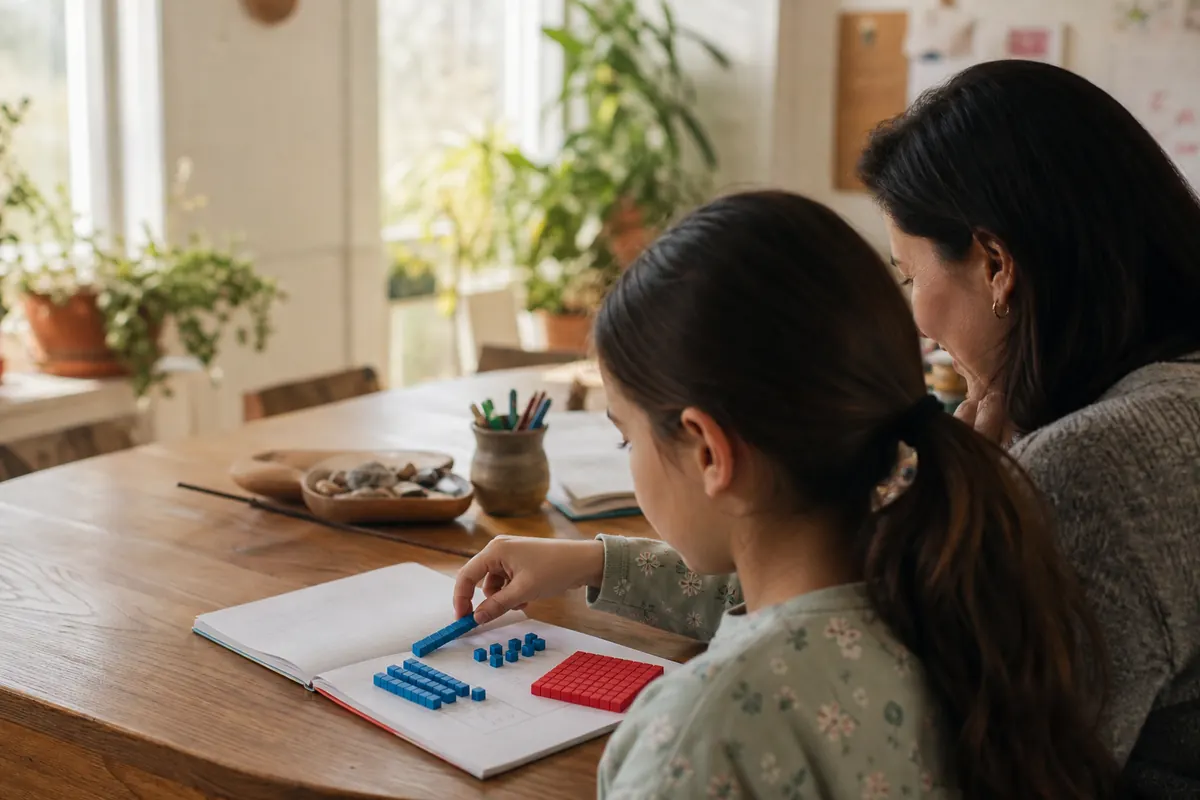
Math blocks can help children learn. They do not guarantee understanding.
Suppose a parent is helping a third-grader subtract 38 from 52. The child builds towers, knocks them down, and trades pieces when told. Yet the child cannot explain why the written 5 becomes 4 or why the 2 becomes 12.
The blocks are not necessarily the problem. The missing piece is the connection between the blocks and the written mathematics.
Blocks help more than symbols alone
A review that pooled 55 studies compared teaching with physical math objects against teaching with symbols alone. It included 7,237 learners from kindergarten through college. Overall, learners taught with objects did better[1].
The clearest advantage was remembering what they had learned. The advantages for solving problems, explaining reasoning, and using ideas on new problems were smaller[1].
That difference matters. Blocks can make a lesson easier to follow without guaranteeing deep understanding. A child still needs help seeing what each object represents.
One useful teaching pattern is called concrete–representational–abstract, or CRA. “Concrete” means handling objects. “Representational” means drawing those objects. “Abstract” means using numbers and symbols.
A review judged this approach helpful for students with learning disabilities who struggled with addition, subtraction, and multiplication. Much of that work involved regrouping[2]. One elementary study also linked this sequence with better subtraction performance among students at risk of mathematics failure[3].
The important word is sequence. The goal is not to keep children on blocks forever. It is to help them carry the same idea from objects to pictures and then symbols.
Every block move needs a matching written step
Consider 52 − 38.
Build 52 with five tens rods and two ones cubes. Ask the child to say what the pieces mean:
“Five tens are 50. Two ones are 2. Together they make 52.”
Now try to remove eight ones. There are only two ones, so one ten must be traded for ten ones. After the trade, there are four tens and twelve ones.
Write the matching idea:
52 = 40 + 12
This equation explains the trade. The amount has not changed. It has only been regrouped.
Now subtract the ones:
12 − 8 = 4
Then subtract the tens:
40 − 30 = 10
Put the remaining parts together:
10 + 4 = 14
Only after that should the child connect the actions to the usual written form. Cross out the 5 tens and write 4. Cross out the 2 ones and write 12.
Ask, “Why did the 5 become 4?” A useful answer is, “We traded one ten, so five tens became four tens.”
Then ask, “Why did the 2 become 12?” A useful answer is, “The two ones stayed, and the traded ten added ten more ones.”
If the child can only say, “Because you borrow,” return to 52 = 40 + 12. The equation names what happened more clearly than the word borrow.
Move from blocks to drawings before removing support
Taking the blocks away immediately can create a large jump. A quick drawing can serve as the middle step.
Try 63 − 27. Draw six long lines for tens and three dots for ones. Cross out one tens line and replace it with ten dots. The picture now shows five tens and thirteen ones.
Beside the drawing, write:
63 = 50 + 13
Then calculate:
13 − 7 = 6
50 − 20 = 30
30 + 6 = 36
Next, solve a similar problem using numbers only. Try 74 − 28. If the child gets stuck, ask for a small drawing rather than rebuilding the entire problem with blocks.
This gradual move matches the CRA approach used in the studies on regrouping[2][3]. It also gives you a simple test. If the child can draw and explain the trade without touching the blocks, the mathematical idea is beginning to stand on its own.
Fraction strips should lead to fraction relationships
The same routine works with fraction strips.
Place one 1/2 strip above two 1/4 strips. Line up their ends. The child can see that both rows cover the same length.
Now draw two equal bars. Shade half of the first bar. Divide the second into four equal parts and shade two.
Write:
1/2 = 2/4
Ask, “Why are these equal?” A strong answer is, “They cover the same amount of the whole. The pieces have different sizes, but the total length matches.”
Then remove the strips and ask about 3/6. The child can draw a bar with six equal parts and shade three. They should explain that three of six equal parts cover half the bar.
In one study of 31 fifth-graders receiving extra mathematics support, the group taught fraction ideas through objects, drawings, and symbols made more progress than the comparison group[4]. This was one small study, so it does not settle how every child should learn fractions.
The useful principle is still concrete: do not stop after matching strips. Ask the child to draw the relationship, write it, and explain what stayed equal.
Distraction is a signal to tighten the task
Some children will build houses, sort pieces by colour, or make patterns. That does not mean the materials must disappear.
One workable routine is to allow a short period for exploring new materials. Then give every piece a mathematical job. Put unused pieces back in the container. Keep only the blocks needed for the current question on the table.
Use this four-part routine:
- Build it. Make the number or relationship with the objects.
- Draw it. Sketch what the objects show.
- Write it. Add an equation for the same idea.
- Explain it. Say how the action and equation match.
If attention drifts, shorten the problem rather than adding more materials. For 52 − 38, begin with only the five tens and two ones needed. Ask one question at a time.
A classroom experiment randomly assigned 91 third-graders and 54 fourth-graders to lessons with physical or on-screen objects. Their learning after the lessons did not differ based on which type they used[5]. The form of the tool was not the deciding factor in that experiment.
Learn4Less sessions can use the build-draw-write-explain routine to connect a child’s block moves with written steps.
What these studies do not settle
The broad review combined learners from kindergarten through college. It also found that results changed with features of the teaching and the studies[1]. Its overall finding does not promise the same result for every elementary child or every kind of block.
A review of 38 uses of manipulatives with children who had mathematics learning disabilities reported benefits across several goals. However, the reviewers also found weaknesses and large differences in how the teaching was delivered[6]. That makes exact comparisons difficult.
The second-grade equivalence study combined fading objects with equal-sign lessons, comparison, and explanation. Its classrooms did better than classrooms receiving arithmetic practice alone, but the study cannot tell us which part of that package mattered most[7].
Physical materials are not always better than digital ones. The third- and fourth-grade classroom experiment found no learning difference between physical and on-screen materials[5].
These limits point to a careful conclusion. Blocks are tools, not automatic understanding.
Try one bridge on tonight’s homework
Choose one problem that usually causes trouble. Do not complete the whole page with blocks.
Build that one problem. Draw the same arrangement. Write an equation that names the change. Then ask the child to explain one matching pair, such as, “This traded tens rod is why 52 became 40 + 12.”
On the next problem, begin with the drawing. Keep the blocks nearby, but use them only if the drawing no longer makes sense.
That is the change to make first: never let a block move stand alone. Pair it with a picture, a written statement, and the child’s own explanation.
Summary
- Use blocks for one problem. Keep only the pieces needed on the table.
- Draw the same idea. Turn each block arrangement into a quick picture.
- Write the matching equation. For 52, show the regrouping as 40 + 12.
- Ask for an explanation. Have the child match one physical move to one written step.
References
- Carbonneau, K. J., Marley, S. C., & Selig, J. P. (2013). A meta-analysis of the efficacy of teaching mathematics with concrete manipulatives. Journal of Educational Psychology, 105(2), 380–400. https://doi.org/10.1037/a0031084
- Bouck, E. C., Satsangi, R., & Park, J. (2017). The Concrete–Representational–Abstract Approach for Students With Learning Disabilities: An Evidence-Based Practice Synthesis. Remedial and Special Education, 39(4), 211–228. https://doi.org/10.1177/0741932517721712
- Flores, M. M. (2009). Using the Concrete-Representational-Abstract Sequence to Teach Subtraction With Regrouping to Students at Risk for Failure. Remedial and Special Education, 31(3), 195–207. https://doi.org/10.1177/0741932508327467
- Flores, M. M., Hinton, V. M., & Meyer, J. M. (2018). Teaching Fraction Concepts Using the Concrete-Representational-Abstract Sequence. Remedial and Special Education, 41(3), 165–175. https://doi.org/10.1177/0741932518795477
- Burns, B. A., & Hamm, E. M. (2011). A Comparison of Concrete and Virtual Manipulative Use in Third‐ and Fourth‐Grade Mathematics. School Science and Mathematics, 111(6), 256–261. https://doi.org/10.1111/j.1949-8594.2011.00086.x
- Lafay, A., Osana, H. P., & Valat, M. (2019). Effects of Interventions with Manipulatives on Immediate Learning, Maintenance, and Transfer in Children with Mathematics Learning Disabilities: A Systematic Review. Education Research International, 2019, 1–21. https://doi.org/10.1155/2019/2142948 Free full text
- McNeil, N. M., Hornburg, C. B., Brletic-Shipley, H., & Matthews, J. M. (2019). Improving children’s understanding of mathematical equivalence via an intervention that goes beyond nontraditional arithmetic practice. Journal of Educational Psychology, 111(6), 1023–1044. https://doi.org/10.1037/edu0000337