
Does Having the TV On Make Homework Harder?
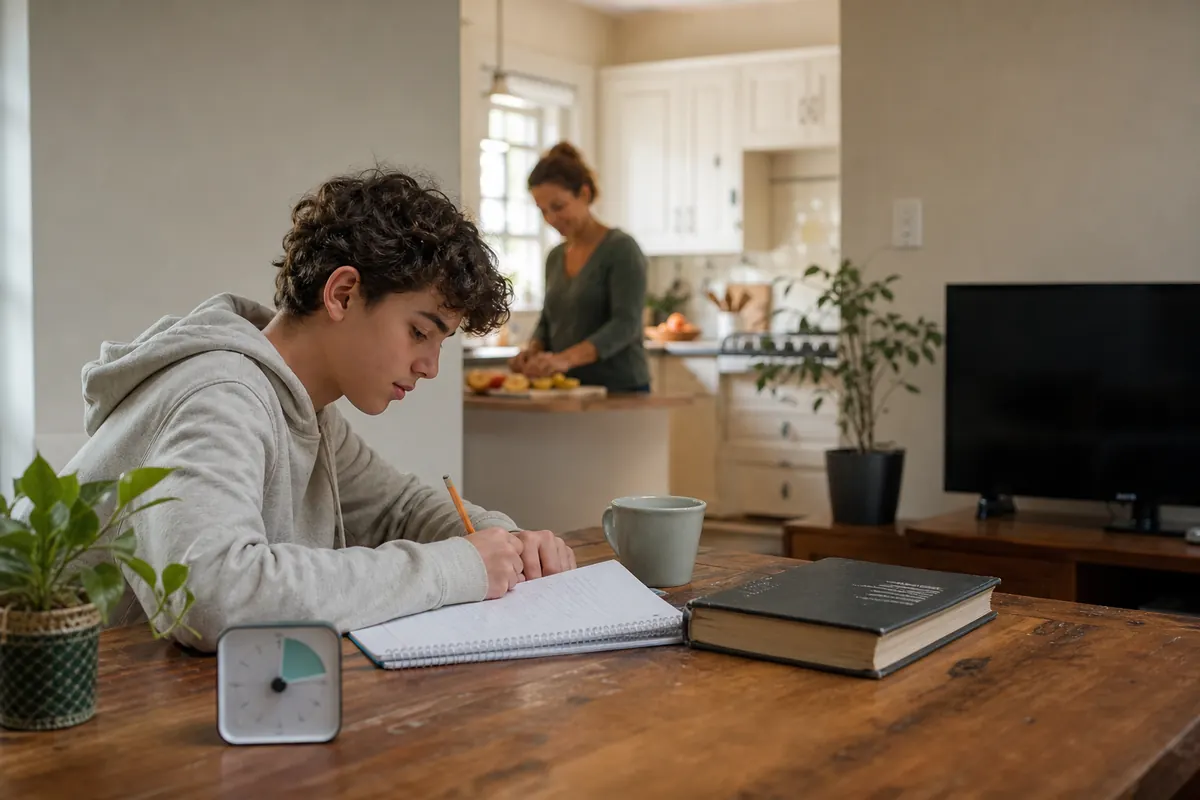
The safest choice is to turn the TV off during homework. Television can pull attention away, especially when it has a story.
Suppose a child is working at the kitchen table. Their sibling is watching television a few metres away. The child keeps writing, so the parent wonders whether the television is really causing trouble.
A television story can interfere with homework
The clearest homework experiments here involved eighth-graders, not elementary-school children. That age difference matters.
In one experiment, 160 eighth-graders completed two kinds of assignments with a soap opera, music videos, radio music, or no background media. The soap opera lowered the quality of their work on both kinds of assignments[1]. Music did not lower their work quality, and none of the background media clearly changed completion time[1].
Two other experiments involved 90 and 144 eighth-graders. The students were placed into television or quiet conditions by chance. Only the soap opera hindered their homework[2]. In one experiment, the students did worse work. In the other, they took longer[2].
A further experiment involved 192 eighth-graders who were age 14. Those working with a soap opera on television did worse and used more time than those working without background media[3]. The soap opera soundtrack alone did not cause the same problem[3].
These experiments point to an important distinction. A television programme with people, action, and a continuing story may be more distracting than sound alone[1][2][3]. This does not mean that every kind of sound is harmless for every child. It means the television screen and its story deserve special attention.
Looking up briefly can still break the flow
Part of the third experiment included direct observation. The extra time in the television conditions came from students looking at the screen[3]. They did not spend less total time looking at their assignment, yet their work was still worse[3].
The researchers proposed that moving attention between the assignment and television led to less careful thinking[3]. In everyday terms, the child may return to the page without fully recovering the thought they were following.
A child might say, “I was only looking for a second.” That may be true. The concern is not only the length of each look. It is the repeated shift away from the work.
One survey offers a useful warning about relying on feelings alone. Among 1,700 students in Grades 8 and 10, students generally felt background media hurt assignments based on learning or remembering[4]. However, they felt audio media and music television sometimes helped with paper-and-pencil work[4]. This survey recorded students’ opinions, not their results on a controlled homework task.
Children may honestly feel that television helps because the room seems less boring. That feeling does not prove that their work is better. A quiet comparison at home can provide more useful information.
The evidence for younger students is less clear
One pair of experiments did involve sixth-graders. Twelve children completed one kind of assignment, while nine completed another kind, under quiet, radio, and television conditions[5]. The experiments found no sizable differences in accuracy, understanding, reading speed, or study time[5].
That result does not match the clearer pattern in the eighth-grade soap opera experiments. The sixth-grade groups were very small, and the children selected and controlled their own television or radio[5]. That situation differs from having someone else’s programme playing nearby.
A separate experiment looked at much younger children during play, not homework. Fifty children aged one to three played while an adult game show was either on or off[6]. They looked at the television for only a few seconds at a time and less than once per minute[6]. Even so, their periods of focused play became shorter when the television was on[6].
That play experiment cannot tell us what happens during elementary-school homework. It does show that background television can interrupt attention even when a young child rarely watches it[6].
Try a screen-free homework block tonight
A workable family routine does not require perfect silence throughout the house. Start with one short period when the nearby television is off. Choose a clear stopping point before beginning.
Put the child’s materials on the table first. Move entertainment screens out of sight. Ask siblings to use headphones in another room if that is practical. When the work block ends, the television can return.
Try the same routine on several ordinary evenings. Notice whether the child looks away less often, needs fewer reminders, or finishes with less frustration. This is a family check, not a scientific test. Its purpose is to find a setting that makes work feel manageable.
Learn4Less sessions can model a short, screen-free work block with a clear stopping point.
Five steps for a calmer homework space
- Turn off nearby television first. Story-based television hindered homework in several eighth-grade experiments[1][2][3].
- Move the child away from the screen. In one experiment, extra working time came from looking at the television[3].
- Give siblings another viewing place. If the programme must stay on, increase the distance and remove the screen from view. This is a practical household choice.
- Use a clear work block. Tell the child when the quiet period begins and when it will end. A visible timer can make that boundary easier to accept.
- Judge the routine by the work. Do not rely only on whether the child says television helps. Older students’ opinions varied by assignment and medium[4].
Avoid turning this into a fight about willpower. The goal is to change the room, not blame the child. If the television is available to everyone nearby, looking up is an understandable response.
What these studies do not settle
Three direct homework studies here involved eighth-graders[1][2][3]. Only the third stated that its students were age 14[3]. Their results may not carry over fully to children aged 7 to 12.
The sixth-grade experiments found no sizable harm, but they involved only 12 children for one assignment type and nine for another[5]. The study of younger children measured toy play rather than schoolwork[6].
Another experiment found that 130 college students understood a reading passage equally well with a background video or in silence[7]. College students and timed reading are different from a child doing homework at the kitchen table.
The programmes also differed across these studies. Soap operas caused clearer problems than music videos, radio, or sound alone[1][2][3]. These studies do not tell us how every programme, volume level, room, or child will compare.
Make quiet the starting point this week
For the next school week, make the first homework block screen-free. Turn off the nearby television before the child begins. Keep the screen out of view until the agreed stopping point.
If the child works more steadily, keep that routine. If nothing changes, check other distractions and practical needs. The best-supported first change is still simple: remove the nearby television, especially when it carries a story.
Summary
- Turn off nearby TV. Start homework with the screen silent and out of view.
- Use a short block. Agree on a clear stopping point before work begins.
- Watch the work. Notice looking away, reminders, and frustration across several evenings.
- Change the room, not the child. Make focus easier instead of blaming willpower.
References
- Pool, M. M., Koolstra, C. M., & van der Voort, T. H. A. (2003). The Impact of Background Radio and Television on High School Students' Homework Performance. Journal of Communication, 53(1), 74–87. https://doi.org/10.1111/j.1460-2466.2003.tb03006.x Free full text
- POOL, M. M., VAN DER VOORT, T. H. A., BEENTJES, J. W. J., & KOOLSTRA, C. M. (2000). Background Television as an Inhibitor of Performance on Easy and Difficult Homework Assignments. Communication Research, 27(3), 293–326. https://doi.org/10.1177/009365000027003002
- POOL, M. M., KOOLSTRA, C. M., & VAN DER VOORT, T. H. A. (2003). Distraction Effects of Background Soap Operas on Homework Performance: An experimental study enriched with observational data. Educational Psychology, 23(4), 361–380. https://doi.org/10.1080/01443410303211
- Beentjes, J. W., Koolstra, C. M., & van der Voort, T. H. A. (1996). Combining background media with doing homework: Incidence of background media use and perceived effects. Communication Education, 45(1), 59–72. https://doi.org/10.1080/03634529609379032
- Cool, V. A., Yarbrough, D. B., Patton, J. E., Runde, R., & Keith, T. Z. (1994). Experimental Effects of Radio and Television Distractors on Children's Performance on Mathematics and Reading Assignments. The Journal of Experimental Education, 62(3), 181–194. https://doi.org/10.1080/00220973.1994.9943839
- Schmidt, M. E., Pempek, T. A., Kirkorian, H. L., Lund, A. F., & Anderson, D. R. (2008). The Effects of Background Television on the Toy Play Behavior of Very Young Children. Child Development, 79(4), 1137–1151. https://doi.org/10.1111/j.1467-8624.2008.01180.x
- Lee, J., Lin, L., & Robertson, T. (2011). The impact of media multitasking on learning. Learning, Media and Technology, 37(1), 94–104. https://doi.org/10.1080/17439884.2010.537664