
Bright Light Can Boost Alertness, but Timing Matters
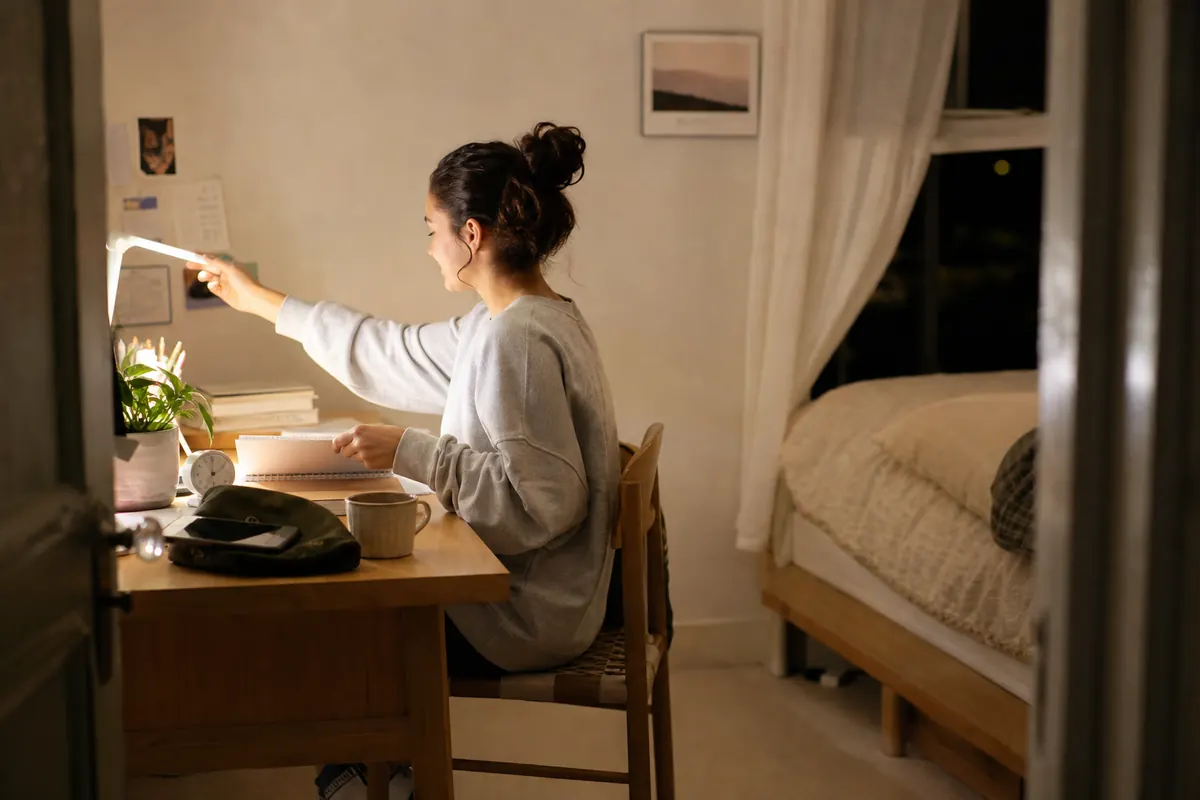
Bright light may make you more alert at 10 p.m., but a brighter desk lamp is not guaranteed to improve studying. Evening light, especially blue-rich light, may also delay sleep. The best choice depends on when you plan to stop.
Suppose it is 10 p.m. in the library. Your eyes feel heavy, but work remains. You wonder whether turning up the desk lamp will help or simply make sleep harder later.
That concern is reasonable. Light can increase alertness, particularly at night[1]. Yet feeling more awake does not always mean thinking or learning better[2]. You also need to consider what happens after you leave the library.
Bright light can help, but results depend on the setting
A review of 59 daytime articles found that brighter white light and light rich in shorter, bluer wavelengths often increased alertness. The results depended on the time of day and how sleepy people already were[2].
However, improvements in more demanding mental tasks were less predictable. The helpful light setting changed with the task and with the lighting used for comparison[2]. Alertness and productive studying are therefore not identical outcomes.
Another review reached a more cautious verdict about daytime white light. Results were unclear, especially on attention tests and body measures of alertness[1]. The studies also used very different lighting arrangements and usually compared only a few settings[1].
One experiment exposed 60 people to lighting ranging from dim to very bright during regular working hours. After one hour, brighter light did not reliably improve attention, mental control, or body measures of alertness[3].
Together, these findings do not support a simple rule that brighter is always better. Time of day, previous light exposure, sleepiness, light colour, and the task may all matter[1][2][3].
Light often has a clearer alerting effect at night
Nighttime experiments offer stronger reasons to expect a temporary alertness boost[1][4][5].
In one experiment, 16 healthy adults received either blue or green light during their biological night. Those receiving blue light reported less sleepiness, reacted faster, and had fewer lapses in attention[4]. The exposure lasted 6.5 hours in an intensive physiological monitoring unit, so it was not an ordinary library session[4].
Another experiment tested commercially available lamps during a two-hour evening session. Sixteen healthy young men felt more alert and reacted faster under the bluer light[5]. However, that light did not improve a task requiring more complex mental control[5].
A separate experiment involved 13 young men using two kinds of computer screen during the evening. The screen producing more blue light reduced sleepiness and improved performance on attention and memory tasks[6].
These experiments support a narrow conclusion. Blue-rich evening light can temporarily reduce sleepiness and improve certain attention tasks[6][4][5]. They do not prove that turning up any desk lamp will improve your coursework.
Light also affects brain systems that do more than create vision[7]. These systems are especially sensitive to bluer light and help regulate alertness and sleep timing[7]. This helps explain why light can make you feel awake even when you are not looking at anything interesting.
Evening alertness can come with a sleep cost
The same light that helps you feel awake may work against your plan to sleep[8][9].
One experiment compared reading from a light-emitting e-reader with reading a printed book before bed. With the e-reader, people took longer to fall asleep, felt less sleepy during the evening, and had a later body clock[9]. They also felt less alert the following morning[9].
A review of blue light and screens concluded that blue-rich artificial light at night can disturb the body clock and sleep[8]. Your body clock is the internal timing system that helps decide when you feel awake or sleepy.
This does not mean every desk lamp will ruin your night. The e-reader experiment tested a glowing screen used for hours before bed, not a library lamp[9]. Lamp colour, brightness at your eyes, exposure time, and your planned bedtime could change the result.
The practical trade-off is still clear. If you need to stay awake briefly, brighter light may help. If you plan to sleep soon, increasing evening light may push in the wrong direction.
Decide your stopping time before adjusting the lamp
A workable routine begins with your planned bedtime, not the lamp switch.
At 10 p.m., choose when the study session will end. If bedtime is soon, avoid turning the whole desk into the brightest spot in the library. Use enough light to work comfortably, then lower your light exposure while packing up. Put your phone away rather than adding another bright screen.
If you must continue, use a brighter setting for one defined final block. Begin with the work that needs the most attention. Leave simple planning and packing for the end. When the block finishes, lower the light and stop rather than repeatedly extending the session.
This routine is practical judgment, not a tested formula. Its purpose is to make the trade-off visible. You are choosing temporary alertness while limiting unnecessary light near bedtime.
Five ways to use light more carefully
-
Choose sleep time first. Evening light can reduce sleepiness while delaying sleep and lowering next-morning alertness[9].
-
Do not assume maximum brightness is best. A daytime experiment found no steady improvement as lighting became brighter[3].
-
Use bright daytime settings when possible. Bright light reduced afternoon sleepiness in two small experiments, including one after restricted sleep and another using natural window light[10][11].
-
Judge your work, not only your energy. Light can improve simple attention without consistently helping harder thinking tasks[2][5]. After a study block, check whether you can explain what you covered without looking.
-
Reduce bright screens near bedtime. A light-emitting e-reader delayed sleep and the body clock compared with a printed book[9]. If a screen is unnecessary, close it.
If you are repeatedly struggling to stay awake, moving the session earlier is a more dependable planning response than continually adding brighter light. A lamp can change how alert you feel under particular lighting conditions[2][5][10][11]. It cannot create extra time in tomorrow’s schedule.
What these studies do not settle
None of the studies here tested a student making a 10 p.m. desk-lamp decision in a library. The closest experiments used controlled lamps, screens, or single-colour light rather than a normal study space[6][4][5].
The evening screen experiment included only 13 young men[6]. One nighttime light experiment included 16 healthy adults[4]. The commercial-lamp experiment included 16 healthy young men[5]. Those groups are too narrow to tell us how every student will respond.
The findings also change with the outcome being measured. Some experiments found better reaction speed or sustained attention without better performance on more demanding tasks[2][5]. A morning experiment found that changing white light had little effect across most of its tasks[12].
Finally, the sleep evidence does not identify a safe universal lamp setting. These studies do not give one ideal brightness, colour, distance, or exposure time for late studying.
Make the stopping decision before the brightness decision
This week, try one change during your next late session. Write down when you will leave before touching the lamp controls. If you need a temporary alertness boost, increase the light only for the final planned block. Then lower the light, close unnecessary screens, and leave when planned.
That approach treats bright light as a short-term tool. It also prevents a useful alertness boost from quietly turning into a later bedtime.
Summary
- Choose bedtime first. Decide when you will leave before increasing the light.
- Brightness is not learning. Check your work rather than trusting how awake you feel.
- Use light briefly. Keep brighter evening light to one defined final study block.
- Dim before leaving. Lower the light and close unnecessary screens near bedtime.
References
- Lok, R., Smolders, K. C. H. J., Beersma, D. G. M., & de Kort, Y. A. W. (2018). Light, Alertness, and Alerting Effects of White Light: A Literature Overview. Journal of Biological Rhythms, 33(6), 589–601. https://doi.org/10.1177/0748730418796443 Free full text
- Siraji, M. A., Kalavally, V., Schaefer, A., & Haque, S. (2022). Effects of Daytime Electric Light Exposure on Human Alertness and Higher Cognitive Functions: A Systematic Review. Frontiers in Psychology, 12, 765750. https://doi.org/10.3389/fpsyg.2021.765750
- Smolders, K. C. H. J., Peeters, S. T., Vogels, I. M. L. C., & de Kort, Y. A. W. (2018). Investigation of Dose-Response Relationships for Effects of White Light Exposure on Correlates of Alertness and Executive Control during Regular Daytime Working Hours. Journal of Biological Rhythms, 33(6), 649–661. https://doi.org/10.1177/0748730418796438 Free full text
- Lockley, S. W., Evans, E. E., Scheer, F. A. J. L., Brainard, G. C., Czeisler, C. A., & Aeschbach, D. (2006). Short-Wavelength Sensitivity for the Direct Effects of Light on Alertness, Vigilance, and the Waking Electroencephalogram in Humans. Sleep, 29(2), 161–168. https://doi.org/10.1093/sleep/29.2.161
- Chellappa, S. L., Steiner, R., Blattner, P., Oelhafen, P., Götz, T., & Cajochen, C. (2011). Non-Visual Effects of Light on Melatonin, Alertness and Cognitive Performance: Can Blue-Enriched Light Keep Us Alert?. PLoS ONE, 6(1), e16429. https://doi.org/10.1371/journal.pone.0016429 Free full text
- Cajochen, C., Frey, S., Anders, D., Späti, J., Bues, M., Pross, A., et al. (2011). Evening exposure to a light-emitting diodes (LED)-backlit computer screen affects circadian physiology and cognitive performance. Journal of Applied Physiology, 110(5), 1432–1438. https://doi.org/10.1152/japplphysiol.00165.2011 Free full text
- Campbell, I., Sharifpour, R., & Vandewalle, G. (2023). Light as a Modulator of Non-Image-Forming Brain Functions—Positive and Negative Impacts of Increasing Light Availability. Clocks & Sleep, 5(1), 116–140. https://doi.org/10.3390/clockssleep5010012 Free full text
- Haghani, M., Abbasi, S., Abdoli, L., Shams, S. F., Zarandi, B. F. B. B., Shokrpour, N., et al. (2023). Blue Light and Digital Screens Revisited: A New Look at Blue Light from the Vision Quality, Circadian Rhythm and Cognitive Functions Perspective. Journal of Biomedical Physics and Engineering, online(3), 213–228. https://doi.org/10.31661/jbpe.v0i0.2106-1355 Free full text
- Chang, A. M., Aeschbach, D., Duffy, J. F., & Czeisler, C. A. (2014). Evening use of light-emitting eReaders negatively affects sleep, circadian timing, and next-morning alertness. Proceedings of the National Academy of Sciences, 112(4), 1232–1237. https://doi.org/10.1073/pnas.1418490112 Free full text
- Phipps-Nelson, J., Redman, J. R., Dijk, D. J., & Rajaratnam, S. M. W. (2003). Daytime Exposure to Bright Light, as Compared to Dim Light, Decreases Sleepiness and Improves Psychomotor Vigilance Performance. Sleep, 26(6), 695–700. https://doi.org/10.1093/sleep/26.6.695
- Kaida, K., Takahashi, M., Haratani, T., Otsuka, Y., Fukasawa, K., & Nakata, A. (2006). Indoor Exposure to Natural Bright Light Prevents Afternoon Sleepiness. Sleep, 29(4), 462–469. https://doi.org/10.1093/sleep/29.4.462
- Santhi, N., Groeger, J. A., Archer, S. N., Gimenez, M., Schlangen, L. J. M., & Dijk, D. J. (2013). Morning Sleep Inertia in Alertness and Performance: Effect of Cognitive Domain and White Light Conditions. PLoS ONE, 8(11), e79688. https://doi.org/10.1371/journal.pone.0079688 Free full text