
Brief Afternoon Naps Can Sharpen Focus While Studying
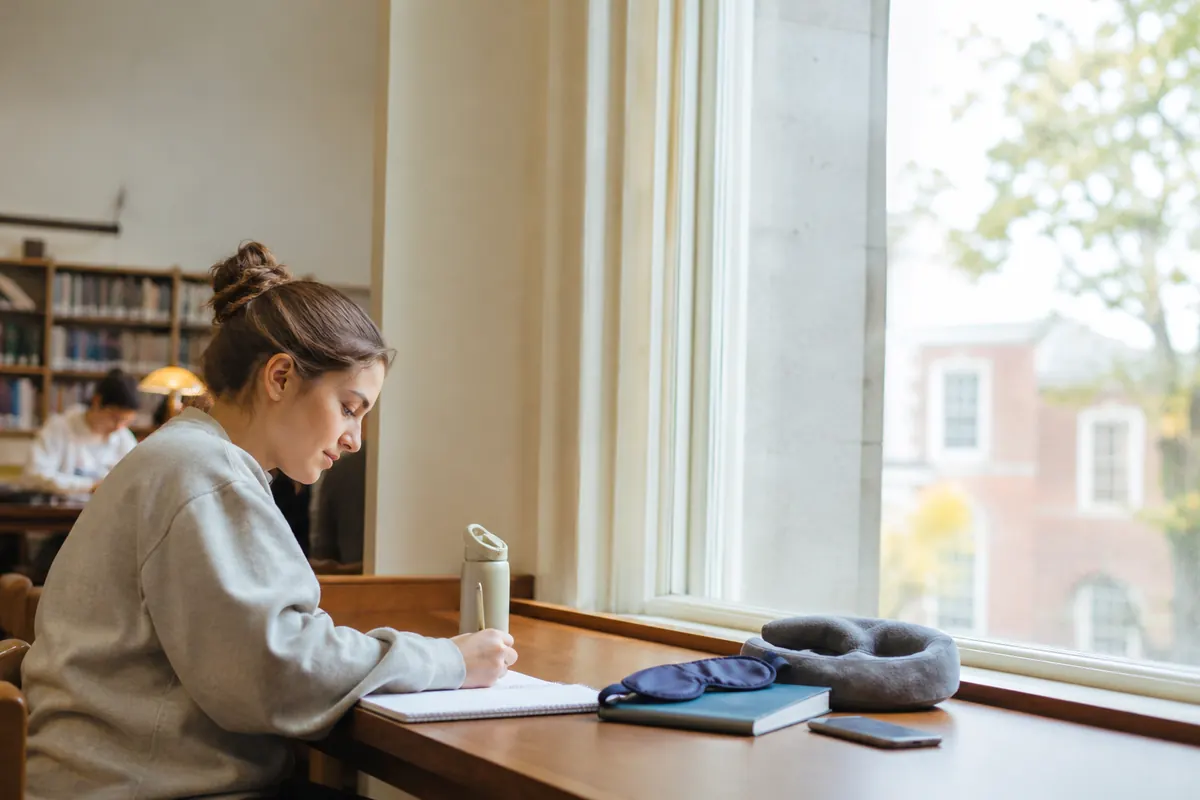
Yes. A brief afternoon nap can improve alertness and attention. Keep it short and leave a little time after waking, because a longer nap can briefly make you feel worse before you feel better.
Suppose you slept for only six hours last night. By mid-afternoon, you are rereading the same paragraph in the library. Your eyes keep closing, and another coffee feels unappealing. You could keep pushing through. You could also close your laptop, set an alarm, and try to sleep briefly. The second option has useful evidence behind it[1].
Afternoon naps can improve alertness and attention
A review combining 54 studies found that afternoon naps gave people a modest overall advantage on thinking tasks. The clearest benefits included staying watchful, remembering information, and processing it quickly[1]. These are relevant when a long study session starts feeling foggy.
Another review combined 11 studies involving 381 working-age adults. People generally performed better after a daytime nap, especially on alertness tasks[2]. Benefits mainly appeared during the first two hours after the nap. Results immediately after waking were less consistent[2].
That last detail matters. A nap can help even when results immediately after waking are less consistent[2]. Temporary post-nap grogginess is often called sleep inertia. After a 30-minute nap, alertness and performance can briefly become worse before benefits appear[3].
One experiment directly tested college students[4]. In one experiment, 80 college students were split at random between a daytime sleep opportunity and staying awake. The students offered sleep had better working-memory accuracy, fewer attention lapses, and less sleepiness afterward[4]. Their nighttime sleep did not differ from that of the students who stayed awake[4].
A nap is therefore a reasonable response to genuine afternoon drowsiness. It is not simply lost study time. The useful question is how long you can sleep without making the groggy period too disruptive.
About ten minutes may give the cleanest recovery
One experiment compared no nap with exactly 5, 10, 20, or 30 minutes of sleep. It involved 24 healthy young adults after their nighttime sleep was limited to about five hours[3].
Five minutes of sleep offered few benefits. Ten minutes produced immediate improvements in sleepiness, fatigue, energy, thinking performance, and other measures[3]. Some benefits remained for more than two hours[3].
The 20-minute nap also helped, but its benefits appeared later. The 30-minute nap caused worse alertness and performance immediately after waking. Improvements came after that groggy period[3].
A second experiment found a similar contrast after young adults slept for less than five hours. A 10-minute nap produced immediate gains in reported alertness and thinking performance[5]. After a 30-minute nap, most measures initially became worse and then partly recovered[5].
This does not make 10 minutes a universal rule. It does make that length a sensible starting point when you need to resume studying soon.
Remember that 10 minutes asleep is not always the same as setting a 10-minute alarm. You may need several minutes to settle. A nap opportunity means the full period you set aside, whether you sleep for all of it or not.
In one experiment, 12 students received a 15-minute nap opportunity after sleeping for only four hours. They slept for about 10 minutes on average[6]. Soon afterward, they felt less sleepy and answered one reasoning task more accurately. Several other performance measures did not improve[6].
For a library afternoon, a 15-minute nap opportunity is a practical place to begin. It is short enough to fit between study blocks and may provide around 10 minutes of actual sleep[6].
Build the nap into your afternoon instead of collapsing
Imagine that you notice heavy eyelids at 2:30 p.m. Do not spend another hour negotiating with yourself while scrolling on your phone. Decide whether you have enough time for a short nap and a calm return.
Find a safe, permitted place where you can relax. Put your phone on silent, set one alarm, and place it where you must move to stop it. Give yourself about 15 minutes for the nap opportunity. Then allow a short buffer before returning to demanding work.
Use that buffer to sit up, gather your materials, and decide what you will do next. This is practical planning, not a special recovery technique. The purpose is to avoid expecting perfect concentration the instant the alarm rings.
If you know that you often sleep through alarms, do not experiment before a fixed appointment or test. Try the routine on an ordinary study day first.
A same-day nap plan
- Check whether you are truly drowsy. Repeated yawning, closing eyes, and rereading without taking anything in are good reasons to pause.
- Choose a short nap opportunity. Start with about 15 minutes. Brief naps produced faster benefits than 30-minute naps in two small experiments after restricted sleep[3][5].
- Remove the usual interruptions. Silence notifications and put away the material you were studying. This is a practical way to protect the short rest period.
- Leave room after waking. Do not schedule the alarm for the exact minute you must perform. Immediate results after naps were inconsistent across 11 studies[2].
- Return with one defined task. Before lying down, write down the first thing you will do afterward. That prevents your break from turning into an unplanned end to the day.
- Protect tonight's sleep. Treat the nap as short-term support, not repayment for repeatedly shortened nights. In adolescents facing several nights of restricted sleep, longer afternoon naps reduced performance decline but did not remove it[7].
What these studies do not settle
These studies do not identify one perfect nap length for every student. The broad review of 54 studies found benefits across different nap lengths[1]. The clearest case for 10 minutes comes from a single experiment with 24 healthy young adults who were not regular nappers[3].
The experiments that directly tested brief naps after restricted sleep used nights of about five hours or less, not exactly six hours[3][5][6]. A broader review found no clear difference based on prior sleep restriction, but described that conclusion as tentative[1].
Many findings also came from controlled settings. All 11 studies in one review used laboratory conditions, although one included a smaller group in a working environment[2]. A real library has noise, alarms, awkward chairs, and the risk that you will not fall asleep.
These sources mainly concern healthy people. One review specifically focused on healthy adults with regular sleep schedules rather than people with sleep or medical disorders[8]. They cannot explain frequent or severe daytime sleepiness.
Repeated sleep loss is a separate concern. In 57 adolescents aged 15 to 19, one-hour naps reduced the decline caused by several restricted nights but did not eliminate it[7]. That finding involved younger students and longer naps, so it does not give an exact rule for a university afternoon.
Try one controlled nap this week
Choose one ordinary afternoon when your schedule has room. If genuine drowsiness arrives, set aside 15 minutes in a safe place. Leave a short return period, then begin the task you wrote down beforehand.
Notice only three things: whether you fell asleep, whether you felt groggy on waking, and whether you could focus afterward. If the nap leaves you slow, shorten the next attempt or allow more recovery time. If it helps, keep it as an occasional tool for long study days—not as a plan for losing sleep every night.
Summary
- Try a brief nap. Set aside about 15 minutes when afternoon drowsiness interrupts studying.
- Allow a waking buffer. Do not plan demanding work for the instant your alarm rings.
- Test it safely. Try the routine on an ordinary day without a fixed appointment.
- Protect nighttime sleep. Use naps as occasional support, not repayment for repeated short nights.
References
- Leong, R. L., Lo, J. C., & Chee, M. W. (2022). Systematic review and meta-analyses on the effects of afternoon napping on cognition. Sleep Medicine Reviews, 65, 101666. https://doi.org/10.1016/j.smrv.2022.101666 Free full text
- Dutheil, F., Danini, B., Bagheri, R., Fantini, M. L., Pereira, B., Moustafa, F., et al. (2021). Effects of a Short Daytime Nap on the Cognitive Performance: A Systematic Review and Meta-Analysis. International Journal of Environmental Research and Public Health, 18(19), 10212. https://doi.org/10.3390/ijerph181910212 Free full text
- Brooks, A., & Lack, L. (2006). A Brief Afternoon Nap Following Nocturnal Sleep Restriction: Which Nap Duration is Most Recuperative?. Sleep, 29(6), 831–840. https://doi.org/10.1093/sleep/29.6.831
- Lau, E. Y. Y., Wong, M. L., Lau, K. N. T., Hui, F. W. Y., & Tseng, C. H. (2015). Rapid-Eye-Movement-Sleep (REM) Associated Enhancement of Working Memory Performance after a Daytime Nap. PLOS ONE, 10(5), e0125752. https://doi.org/10.1371/journal.pone.0125752 Free full text
- Tietzel, A. J., & Lack, L. C. (2001). The Short-Term Benefits of Brief and Long Naps Following Nocturnal Sleep Restriction. Sleep, 24(3), 293–300. https://doi.org/10.1093/sleep/24.3.293
- Takahashi, M., & Arito, H. (2000). Maintenance of Alertness and Performance by a Brief Nap After Lunch Under Prior Sleep Deficit. Sleep, 23(6), 1–7. https://doi.org/10.1093/sleep/23.6.1h
- Lo, J. C., Lee, S. M., Teo, L. M., Lim, J., Gooley, J. J., & Chee, M. W. L. (2016). Neurobehavioral Impact of Successive Cycles of Sleep Restriction With and Without Naps in Adolescents. Sleep, 40(2). https://doi.org/10.1093/sleep/zsw042
- MILNER, C. E., & COTE, K. A. (2009). Benefits of napping in healthy adults: impact of nap length, time of day, age, and experience with napping. Journal of Sleep Research, 18(2), 272–281. https://doi.org/10.1111/j.1365-2869.2008.00718.x